
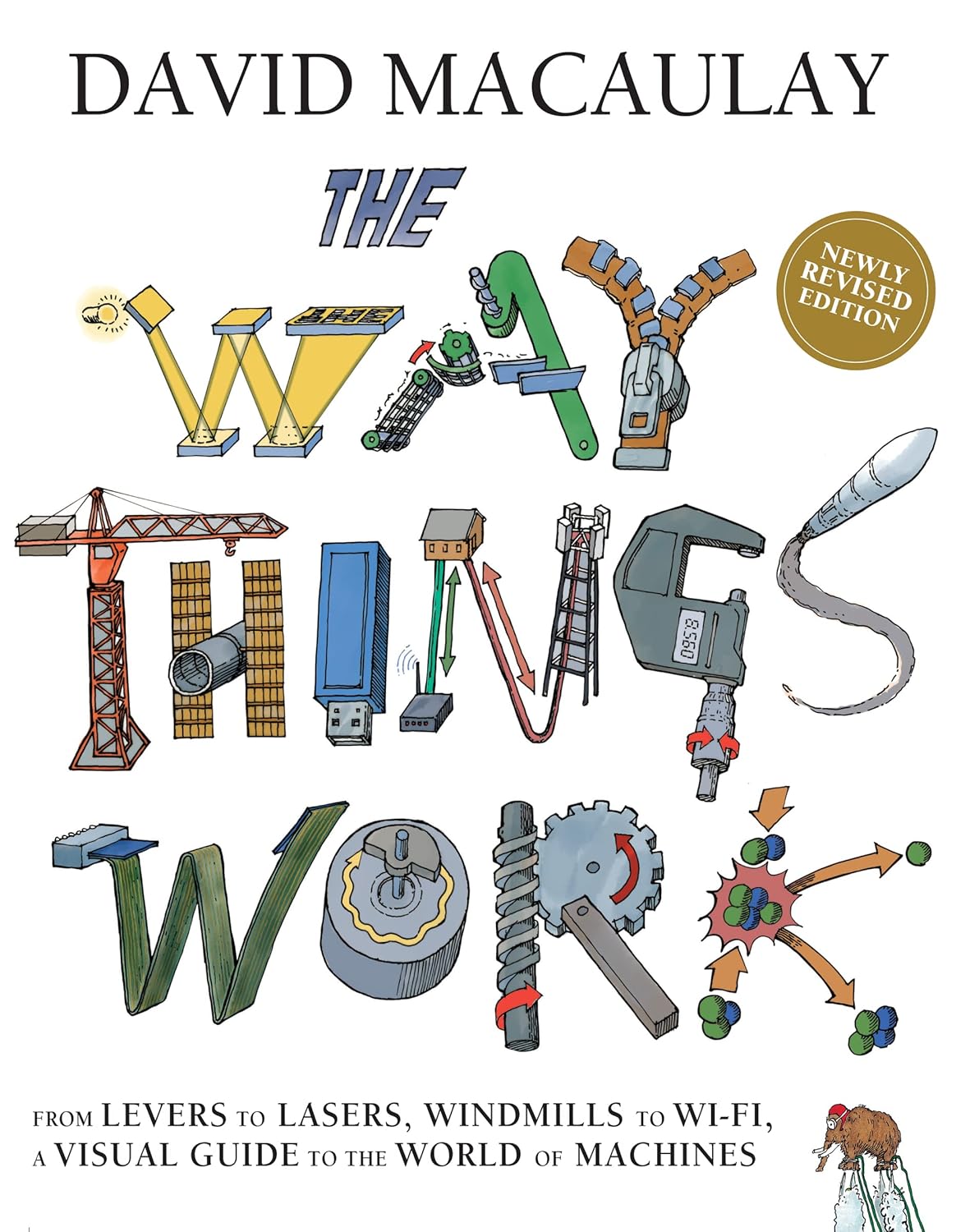
The Way Things Work: Newly Revised Edition: The Ultimate Guide to How Things Work
Original price was: $35.00.$16.76Current price is: $16.76.
Related Products




[ad_1]
As seen on CBS News Sunday Morning.
Explainer-in-Chief David Macaulay updates his worldwide bestseller to capture the latest developments in the technology that most impacts our lives. What possible link could there be between parking meters and meat grinders, jumbo jets and jackhammers, remote control and rockets, electric guitars and egg beaters? Macaulay explains them all!
Famously packed with information on the inner workings of everything from windmills to Wi-Fi, this extraordinary and humorous book both guides readers through the fundamental principles of machines and shows how the developments of the past are building blocks of the world of tomorrow. This sweepingly revised edition embraces recent technological developments, from touchscreens to 3D printers. Each scientific principle is brilliantly explained, with the help of a charming, if rather slow-witted, woolly mammoth.
An illustrated survey of significant inventions closes the book, along with a glossary of technical terms and an index.
A New York Times Bestseller
From the Publisher
A Conversation with David Macaulay
Explainer-in-Chief David Macaulay talks about the ins and outs of updating his essential guide to the world of machines – The Way Things Work Now.
What was the most rewarding thing about doing this updated version of your now-classic book?
The opportunity not only to stay current, but to make improvements to the object itself. The first is a no-brainer, but the second is personal. Staying up-to-date meant adding devices that are now so familiar we take them for granted and in fact have become completely dependent on them. It’s actually fun to have at least a basic sense of how a touchscreen works, not to mention e-paper. One clue—it’s not paper.
The more personal reward came with the opportunity to create what I hope is a more visually attractive book. Replacing the two color images (required of the first edition to keep costs down) with full-color art meant that not only is the book brighter and I think more inviting but also it offers greater clarity. In many of the earlier spreads, pieces of text floated in a sea of white space, often seeming disconnected from the related art. It doesn’t help a reader trying to absorb new information if they aren’t quite sure about the order or combination in which it should be viewed.
It takes a team to create a work like this! Can you briefly describe how you all worked together?
This book was a group effort from the beginning. As with the original editions, the new one was produced simultaneously on both sides of the Atlantic. Research, writing, editing, and overall design happened in London. The pictures were developed and finally produced in my Vermont studio. I’m not a big fan of the distance, since it makes quick and more casual conversation possible between team members, even with Skype and FaceTime, etc., impossible. But since we weren’t developing a whole new project, these communication shortcuts probably made sense. It’s just not as much fun to work in isolation.
How has your process evolved over the years?
I think the answer is ‘Backwards’. Each big book takes me longer than the one before, although the process hasn’t really changed much. Once I have my subject, I begin the research and stay with it until I run out of time. The original The Way Things Work was scheduled to be published in 1988. I joined the team in 1984 as the illustrator and spent the first two years trying to figure out how to avoid just making pictures of machines. It was during that time that I came up with the idea of an inventor’s notebook and the mammoth—an innocent victim of technology. Not only was I trying to put off the ‘hard work’ for as long as possible; I was hoping to find a way of introducing people to technology that was a little bit different and as unintimidating as possible. Because of the schedule, procrastination was severely limited. Now I can spend four years or more searching for just the right way of doing something before I finally have to do it. I ask more questions than I ever did and seem to have less confidence in my answers, so I ask them again. It’s a painful and pathetic process, and in the end, I can’t say that it actually produces a better book. So my process is perhaps devolving.
Why do we need this book if we can find pretty much all this information online?
If all you’re looking for is information, the Internet with all its content, hyperlinks, diverse media, and incredible speed is hard to beat. But The Way Things Work Now was created to be much more than just a catalog of information. It was intended as a friendly and reassuring introduction to the often complicated world of machines—a catalyst for curiosity with a reward on every page or two. The book had to be illuminating, engaging, and entertaining—these are not necessarily characteristics so highly valued online. It had to be straightforward but never simplistic. One of the great things about a book is that the limits are built in. It can only be so long, and then you run out of pages. This is a plus. For younger readers, it seems to contain everything they might ever need to know. For older readers who know there is so much more out there, it offers a sizable introduction and perhaps some direction.
What do you enjoy most about reading nonfiction?
Learning and being entertained at the same time. I love being introduced to new ideas and gaining new insights from knowledgeable writers who also know how to tell a story. I can find the facts online, but it’s the story that makes them stick.
You’ve created quite a number of books. Do you have a favorite?
I have several favorites. Angelo is my favorite ‘picture book’ because I finally created a couple of characters I really cared about. Cathedral is my favorite architecture book because I had no preconceived idea of what I was trying to do until I actually did it. Underground is my favorite ‘subterranean’ book because I couldn’t just go to the library and find other subterranean books that weren’t engineering texts. I had an opportunity to create a book that could show regular people, like me, what actually goes on down there. And Baaa is my favorite depressing book, mostly because I thought I was creating a work of fiction based on my own twisted view of life. Turns out it’s a work of nonfiction, and life actually is pretty twisted—once you get past the sheep.
What are you working on now?
I’m working on a book about crossing the Atlantic, something my family and I did sixty years ago on a ship called the SS United States. It combines history and technology with biography and autobiography, all of which are described primarily through illustration—as usual.
Publisher : Clarion Books
Publication date : October 4, 2016
Edition : Updated
Language : English
Print length : 408 pages
ISBN-10 : 0544824385
ISBN-13 : 978-0544824386
Item Weight : 3.5 pounds
Reading age : 10 years and up
Dimensions : 8.44 x 1.25 x 10.88 inches
Best Sellers Rank: #170 in Books (See Top 100 in Books) #1 in Teen & Young Adult Machinery & Tools #1 in Teen & Young Adult Physics #1 in Teen & Young Adult History of Science
Customer Reviews: 4.8 4.8 out of 5 stars (2,613) var dpAcrHasRegisteredArcLinkClickAction; P.when(‘A’, ‘ready’).execute(function(A) { if (dpAcrHasRegisteredArcLinkClickAction !== true) { dpAcrHasRegisteredArcLinkClickAction = true; A.declarative( ‘acrLink-click-metrics’, ‘click’, { “allowLinkDefault”: true }, function (event) { if (window.ue) { ue.count(“acrLinkClickCount”, (ue.count(“acrLinkClickCount”) || 0) + 1); } } ); } }); P.when(‘A’, ‘cf’).execute(function(A) { A.declarative(‘acrStarsLink-click-metrics’, ‘click’, { “allowLinkDefault” : true }, function(event){ if(window.ue) { ue.count(“acrStarsLinkWithPopoverClickCount”, (ue.count(“acrStarsLinkWithPopoverClickCount”) || 0) + 1); } }); });
[ad_2]
13 reviews for The Way Things Work: Newly Revised Edition: The Ultimate Guide to How Things Work
Be the first to review “The Way Things Work: Newly Revised Edition: The Ultimate Guide to How Things Work”

Original price was: $35.00.$16.76Current price is: $16.76.
There are no reviews yet.