

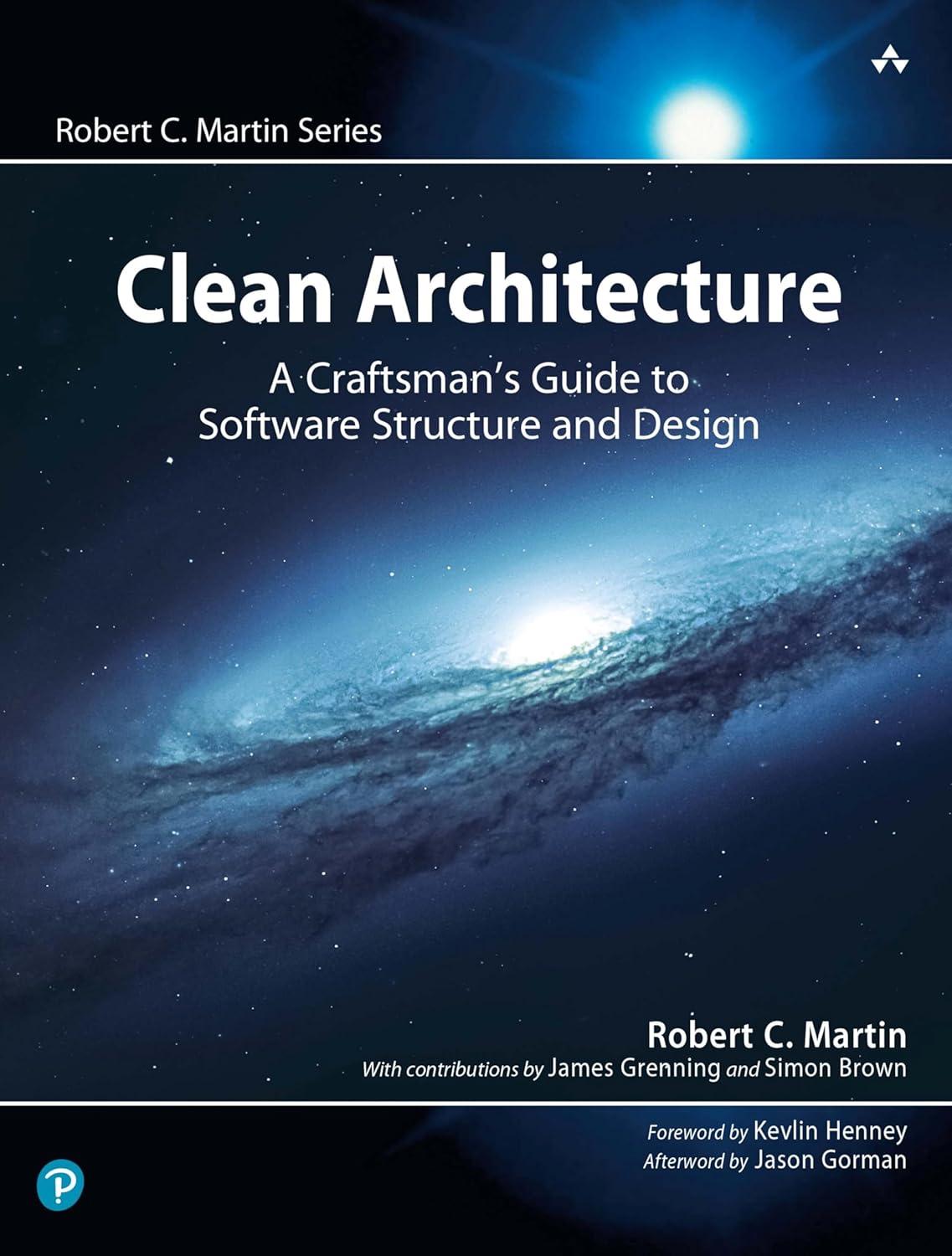
Clean Architecture: A Craftsman’s Guide to Software Structure and Design (Robert C. Martin Series)
Original price was: $49.99.$24.42Current price is: $24.42.
Related Products






Practical Software Architecture Solutions from the Legendary Robert C. Martin (“Uncle Bob”)
By applying universal rules of software architecture, you can dramatically improve developer productivity throughout the life of any software system. Now, building upon the success of his best-selling books Clean Code and The Clean Coder, legendary software craftsman Robert C. Martin (“Uncle Bob”) reveals those rules and helps you apply them.
Martin’s Clean Architecture doesn’t merely present options. Drawing on over a half-century of experience in software environments of every imaginable type, Martin tells you what choices to make and why they are critical to your success. As you’ve come to expect from Uncle Bob, this book is packed with direct, no-nonsense solutions for the real challenges you’ll face–the ones that will make or break your projects.
Learn what software architects need to achieve–and core disciplines and practices for achieving itMaster essential software design principles for addressing function, component separation, and data managementSee how programming paradigms impose discipline by restricting what developers can doUnderstand what’s critically important and what’s merely a “detail”Implement optimal, high-level structures for web, database, thick-client, console, and embedded applicationsDefine appropriate boundaries and layers, and organize components and servicesSee why designs and architectures go wrong, and how to prevent (or fix) these failures
Clean Architecture is essential reading for every current or aspiring software architect, systems analyst, system designer, and software manager–and for every programmer who must execute someone else’s designs.
Register your book for convenient access to downloads, updates, and/or corrections as they become available. See inside book for details.
From the brand


For those who want to increase their skills and proficiency to the level of a Master Craftsman.
Explore more of the series


Publisher : Pearson
Publication date : September 10, 2017
Edition : 1st
Language : English
Print length : 432 pages
ISBN-10 : 0134494164
ISBN-13 : 978-0134494166
Item Weight : 3.99 ounces
Dimensions : 0.8 x 6.9 x 9 inches
Part of series : Robert C. Martin Series
Best Sellers Rank: #30,627 in Books (See Top 100 in Books) #4 in Software Design & Engineering #17 in Software Development (Books) #51 in Business Technology
Customer Reviews: 4.6 4.6 out of 5 stars (3,926) var dpAcrHasRegisteredArcLinkClickAction; P.when(‘A’, ‘ready’).execute(function(A) { if (dpAcrHasRegisteredArcLinkClickAction !== true) { dpAcrHasRegisteredArcLinkClickAction = true; A.declarative( ‘acrLink-click-metrics’, ‘click’, { “allowLinkDefault”: true }, function (event) { if (window.ue) { ue.count(“acrLinkClickCount”, (ue.count(“acrLinkClickCount”) || 0) + 1); } } ); } }); P.when(‘A’, ‘cf’).execute(function(A) { A.declarative(‘acrStarsLink-click-metrics’, ‘click’, { “allowLinkDefault” : true }, function(event){ if(window.ue) { ue.count(“acrStarsLinkWithPopoverClickCount”, (ue.count(“acrStarsLinkWithPopoverClickCount”) || 0) + 1); } }); });
11 reviews for Clean Architecture: A Craftsman’s Guide to Software Structure and Design (Robert C. Martin Series)
Add a review

Original price was: $49.99.$24.42Current price is: $24.42.
Luis Pineda –
Excellent book
This book is pure history, really enjoyable reading, the autor experience is priceless and the examples in every chapter gives you how the engineers work back in the day !!!!
John S. –
Outstanding Book!!
This book provides outstanding insight into good, clean software architecture. It should be mandatory reading for software engineering students!!
K. Lewis –
Some good thinking on a limited subset of application architecture
I found a lot of the explanations to be very clear and thought provoking.However, there is little practical advice on making trade-offs, supporting operational requirements, etc. This is a book about structuring software components. The subtitle says as much, so you shouldn’t expect a complete guide on application, system or enterprise architecture. In fact the author seems to misunderstand the meaning of “service architecture”.I think, overall, this is a very limited, if important, perspective on software architecture.Still, it’s a relatively light read with interesting insights.
Jonathan Beyrak Lev –
Excellent, clear, incisive – but I wanted more
I have read four books, dozens of articles, and have watched scores of videos by Uncle Bob. As always I found this one fascinating and well written. Bob has a flare for synthesizing very complex technical material from many sources, then boiling it down to easily and enjoyably absorbable explanations. He manages the magic of combining theoretically deep discussion with a very practical, even advice-like perspective. I’m so happy he’s made himself the uncle of young programmers like me and invited us to squat on his lawn.My caveat is that, having gone through so much of Bob’s previous material, there was unfortunately much here that was already familiar to me, including some sections that are taken almost verbatim from his previous writings. In itself this is no problem – had it been the first I ever read of the man I would be totally ecstatic about it, and it’s reasonable of him to assume that most readers would not have followed him around the internets as assiduously as I have. But I was hoping to hear more about topics he only hinted at in his blog posts, e.g. the different kinds of architecture implied by different desired user experiences. I read him mention event-driven, request-based, and batch processing, and I was assuming he would elaborate on these ideas in this book, which he does not. There are many other details I wish he’d gone into or at least offered good follow-up reading on, such as presenters and the creation of use cases.Finally, he does not appear to provide the name of the stellar body on the cover, which is an unfortunate break with custom.
Maros Vranec –
Another solid book by Robert Martin
I liked this book less than the Clean Code, but it was a better read for me than the Clean Coder. I’ve found a distillation of this book in article from Robert Martin, which he wrote in 2012 while working at 8th Light (I cannot paste a link in here). The book is partially a very detailed description of the ideas from the article and what is behind them.The book starts with 3 myths we developers live in:1. Myth: We just need to get to market first and we clean it up later.2. Myth: Messy code makes us faster today and slows us later. Myth: We can switch mode from making messes to cleaning messes. (making messes is always slower, even in very short term as shown in example of a simple kata in the book)3. Myth: Starting from scratch is a solution.There is a well written history lesson in the next part. Uncle Bob presents Structured Programming, OOP and Functional Programming and says there is nothing else (programming paradigm-wise) to be invented. Part 3 is about SOLID principles from architecture point of view and part 4 are his Component Principles about component cohesion and coupling from his Agile Software Development book.Part 5 is about Architecture and was the most interesting to read. Most memorable chapters for me were the Screaming Architecture and the Clean Architecture. Both of them are not new, you could have seen them in his videos or the article from 8thlight. The point of Screaming Architecture is that when a new developer joins a health-care project, he should be able to immediately tell “this is a health-care project” just from the project structure. Another topic which was part of multiple chapters, are micro-services. I felt that Robert Martin is not very fond of starting with them. He says services are little more than expensive function calls and as a communication mechanism between the project boundaries (i.e. a detail), they are a decision which should be deffered as far as possible.Part 6, the Details, are a detailed explanations of his article Clean Architecture from 2012. There is a little gem in there, the Missing Chapter 34 written by Simon Brown. I liked his explanation of 4 different kinds of packaging classes together to form components.
Lasha –
material, quality , packaging
Everything is good, packaging , quality, and material. Thank you <3
John –
The book itself, a must have.I was disappointed to receive a used copy.I requested to replace it considering the price, but nothing happened.
Amazon Customer –
Dobra zawartość, dobrze się czyta. Nic tylko polecać chcącym poszerzać swoją wiedzę.
Bence Demeter –
This book is a real gem in the software architecture field. It discusses the basics and programming paradigms, then goes up a level and speaks about component cohesion, then component coupling, sketches up a general architecture model that relies on these principles, and then explains many different cases and patterns. Arguably one of the most valuable books I’ve ever read.
shahid k. –
I have other books on coding and it’s standard This art covers everything from ethics to estimation this a good asset for anybody who want to make quality software i there was more on tdd I would have delighted but this book is super
Kellerman Rivero Suarez –
Martin follows a clean and practical approach in this book. He explains with great pedagogy key concept of the architecture. As any other book of practices, this is a merely guide or tool, so you should be careful and diligent evaluating your requirements to see if the advice given in the book applies to you.