
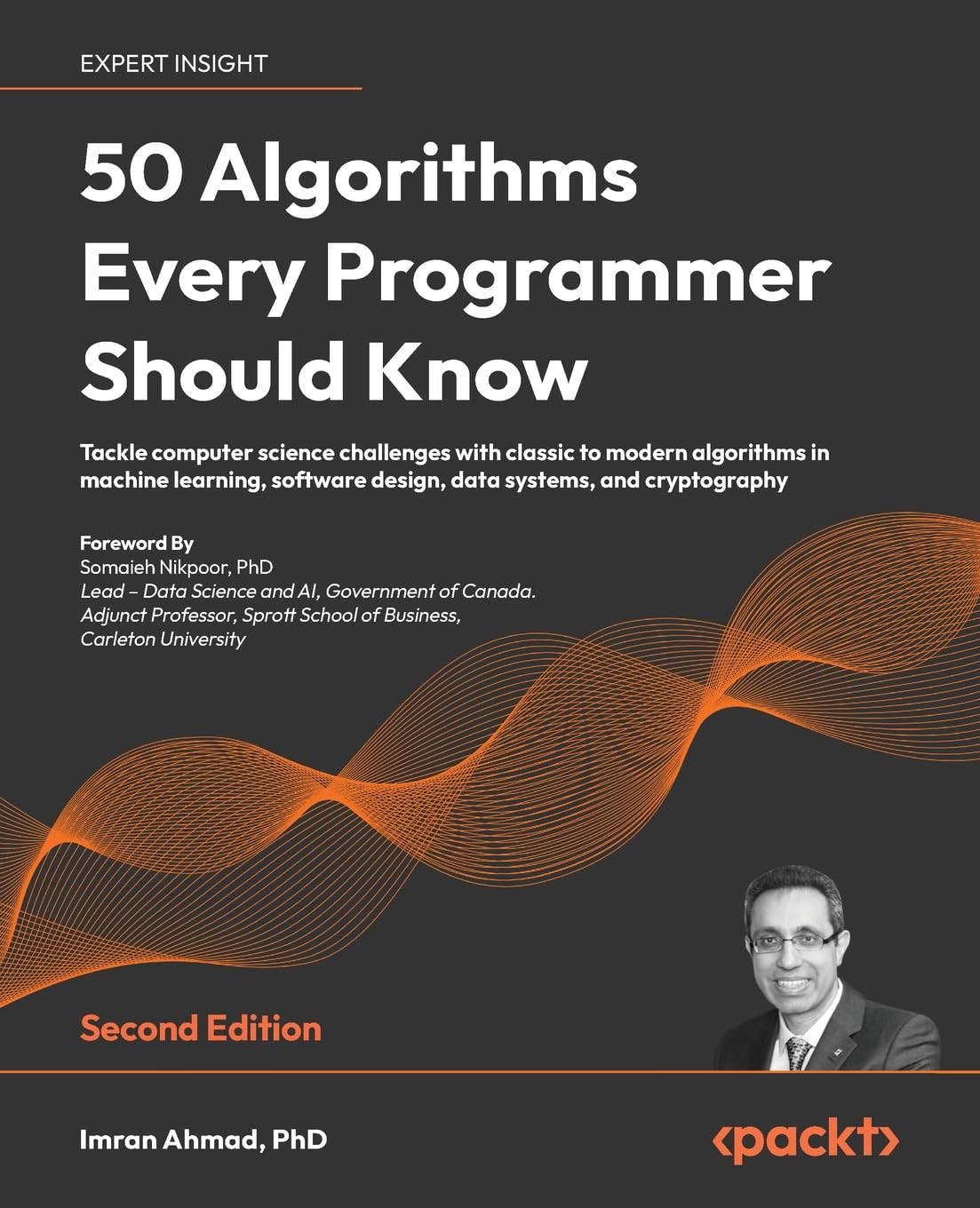
50 Algorithms Every Programmer Should Know: Tackle computer science challenges with classic to modern algorithms in machine learning, software design, data systems, and cryptography
Original price was: $49.99.$35.55Current price is: $35.55.
Related Products




Delve into the realm of generative AI and large language models (LLMs) while exploring modern deep learning techniques, including LSTMs, GRUs, RNNs with new chapters included in this 50% new edition overhaul
Purchase of the print or Kindle book includes a free eBook in PDF format.
Key FeaturesFamiliarize yourself with advanced deep learning architecturesExplore newer topics, such as handling hidden bias in data and algorithm explainabilityGet to grips with different programming algorithms and choose the right data structures for their optimal implementationBook Description
The ability to use algorithms to solve real-world problems is a must-have skill for any developer or programmer. This book will help you not only to develop the skills to select and use an algorithm to tackle problems in the real world but also to understand how it works.
You’ll start with an introduction to algorithms and discover various algorithm design techniques, before exploring how to implement different types of algorithms, with the help of practical examples. As you advance, you’ll learn about linear programming, page ranking, and graphs, and will then work with machine learning algorithms to understand the math and logic behind them.
Case studies will show you how to apply these algorithms optimally before you focus on deep learning algorithms and learn about different types of deep learning models along with their practical use.
You will also learn about modern sequential models and their variants, algorithms, methodologies, and architectures that are used to implement Large Language Models (LLMs) such as ChatGPT.
Finally, you’ll become well versed in techniques that enable parallel processing, giving you the ability to use these algorithms for compute-intensive tasks.
By the end of this programming book, you’ll have become adept at solving real-world computational problems by using a wide range of algorithms.
What you will learnDesign algorithms for solving complex problemsBecome familiar with neural networks and deep learning techniquesExplore existing data structures and algorithms found in Python librariesImplement graph algorithms for fraud detection using network analysisDelve into state-of-the-art algorithms for proficient Natural Language Processing illustrated with real-world examplesCreate a recommendation engine that suggests relevant movies to subscribersGrasp the concepts of sequential machine learning models and their foundational role in the development of cutting-edge LLMsWho this book is for
This computer science book is for programmers or developers who want to understand the use of algorithms for problem-solving and writing efficient code.
Whether you are a beginner looking to learn the most used algorithms concisely or an experienced programmer looking to explore cutting-edge algorithms in data science, machine learning, and cryptography, you’ll find this book useful.
Python programming experience is a must, knowledge of data science will be helpful but not necessary.
Table of ContentsOverview of AlgorithmsData Structures Used in AlgorithmsSorting and Searching AlgorithmsDesigning AlgorithmsGraph AlgorithmsUnsupervised Machine Learning AlgorithmsTraditional Supervised Learning AlgorithmsNeural Network AlgorithmsAlgorithms for Natural Language ProcessingUnderstanding Sequential ModelsAdvanced Sequential Modeling AlgorithmsRecommendation EnginesAlgorithmic Strategies for Data HandlingCryptographyLarge-Scale AlgorithmsPractical Considerations
From the brand

See Our Full Range

Packt is a leading publisher of technical learning content with the ability to publish books on emerging tech faster than any other.
Our mission is to increase the shared value of deep tech knowledge by helping tech pros put software to work.
We help the most interesting minds and ground-breaking creators on the planet distill and share the working knowledge of their peers.
Publisher : Packt Publishing
Publication date : September 29, 2023
Edition : 2nd ed.
Language : English
Print length : 538 pages
ISBN-10 : 1803247762
ISBN-13 : 978-1803247762
Item Weight : 2.01 pounds
Dimensions : 7.5 x 1.22 x 9.25 inches
Best Sellers Rank: #44,650 in Books (See Top 100 in Books) #11 in Computer Programming Languages #19 in Natural Language Processing (Books) #25 in Python Programming
Customer Reviews: 4.6 4.6 out of 5 stars (111) var dpAcrHasRegisteredArcLinkClickAction; P.when(‘A’, ‘ready’).execute(function(A) { if (dpAcrHasRegisteredArcLinkClickAction !== true) { dpAcrHasRegisteredArcLinkClickAction = true; A.declarative( ‘acrLink-click-metrics’, ‘click’, { “allowLinkDefault”: true }, function (event) { if (window.ue) { ue.count(“acrLinkClickCount”, (ue.count(“acrLinkClickCount”) || 0) + 1); } } ); } }); P.when(‘A’, ‘cf’).execute(function(A) { A.declarative(‘acrStarsLink-click-metrics’, ‘click’, { “allowLinkDefault” : true }, function(event){ if(window.ue) { ue.count(“acrStarsLinkWithPopoverClickCount”, (ue.count(“acrStarsLinkWithPopoverClickCount”) || 0) + 1); } }); });
13 reviews for 50 Algorithms Every Programmer Should Know: Tackle computer science challenges with classic to modern algorithms in machine learning, software design, data systems, and cryptography
Add a review

Original price was: $49.99.$35.55Current price is: $35.55.
chandler –
Beginner to Upper Intermediate in a well done way
Amazingly written and detailed book. It takes you from the very beginning of what makes up algorithms, simple python, and launches you into the most interesting and complex algorithms i have notices. For DSA this book is really great and helped to understand some problems at work on a deeper level…. Even AI let’s this stuff wrong sometimes, so atleast my job is safe for a little longer!
Amazon Customer –
Neat and helpful
Helpful and easy to follow. I don’t know if I’ll use all these, but as an aspiring coder this helped me a lot.
Customer –
Programming holy Grail
I am a practising programmer for last 10 years, I have been studying a lot of programming questions and varieties for my personal and professional growth, I stumbled upon this book which has changed the narrative and outlook of my learning, This is the most concise book anyone can buy to start coding it has all the necessary steps to break the ice and get into hands on development, it has live written examples which you can code it would display necessary result and also the book progresses from easy to hard coding problems. This book also helps in developing intuitiveness, the book also have max coverage in Python which helps young programmers to work and learn
Jose Alexander Cadiz –
Well structured, informative, with room to improve
Well structured, very informative and it is easy to follow. I bought the book to learn and incorporate algorithms, the author starts with ordering and searching, then dive into ML. While that is my ultimate objective, I wanted to get a little bit more familiar with “lesser” algorithms first, to better understand the ML’s, but it’s ok, ML is very exciting, and the author does a good job introducing it the sooner he can.There room for improvement for future editions though, as there are several errors in the books, especially in the chapter 6 and 7, where the author (or the corrector) either invert terms or acronyms (like in the explanation of TPR, which goes to TRP back a forth confusion the explanation (page 208)), or the notation, like when defining the dimension of a matrix (b files and n features, then you have a matrix n x b, it is actually b x n (page 191). in linear algebra, order matters), or figures without caption (Figure 7.2 Add a caption here…). The code is clear, also with several mistakes in some cases, but these can be corrected as you get the code in GitHUb. Some others are more due to Python versions (like deprecated words i.e. affinity vs metric) or old .csv paths, no longer valid. Some conclusions get also mismatched, like “we increase the decision boundary to get better precision and can expect more recall, and we lower the decision boundary to get better recall and can expect less precision”.I haven’t finished the book yet, and for sure will find more omissions, but don’t get the wrong conclusion, the book is quite good, and you can learn a lot from the way the author structures the flow from how an algorithm works, how to implement it and what application it is useful for.
Aethelhawk –
Helpful framework for understanding coding.
Daughter loved the book for graduate school in bio analysis.
Allen Wyma –
Great Book for Beginners into Algorthms
I’ve gone through the big and found it is great for those who are beginners in algorithms. It will explain in detail about the o(n) complexity and the difference of the implementation in different algorithms. I’ve always had problems understanding the o(n) complexity, but this has helped my mind to better understand the meaning and start to figure out which algorithms make sense in which situations.The best part of the book is that it uses python to teach the algorithms which is a very familiar language to most programmers, even those working with NLP.
Roboticist –
Truly essential knowledge
This is the second book describing algorithms every programmer should know. I use this book to teach new programmers new languages: They must implement the algorithms in each new language they want to learn.
lucia –
The perfect data science book
This book is perfect for anyone wanting to learn about algorithms and machine learning without the math stress. Complex math is made easy to understand, thanks to the author’s clear explanations. Even if you’re not great at math, you’ll get it! Helpful Python examples are spread throughout the book to help make tricky ideas clear for both beginners and experienced readers. The book’s friendly style makes learning fun and takes away the math worry. It’s definitely one of my top picks of data science or AI books.
Marzio –
Il libro è buono, copre molti concetti abbastanza bene e lo consiglio. Tuttavia ci sono vari errori nella formule presentate e alcuni temi sono trattati in maniera approssimativa e confusa. La parte su Deep learning, RNN e Transformers potrebbe essere spiegata in maniera più fluida, creando maggiore legame tra i concetti.
Ali Hamza –
Having journeyed through numerous programming and algorithm books, including the previous edition “40 Algorithms Every Programmer Should Know”, I am thrilled with the advancements and in-depth additions in Imran Ahmad’s new edition, “50 Algorithms Every Programmer Should Know”. This version not only expands the arsenal of algorithms but also refines and deepens our understanding of each topic.From the onset, Ahmad provides a robust introduction, seamlessly merging foundational knowledge from the previous edition while introducing fresh and advanced content. The progression is smooth and intuitive, ensuring both newcomers and returning readers are catered to effectively.A highlight of this new edition is its enriched discussion on Advanced Deep Learning Architectures. While the entire book is a testament to Ahmad’s meticulous approach, Chapters 10 and 11 stand out. They introduce Sequential Networks in such an articulate manner, paving the way for readers to grasp the nuances of Generative AI beautifully. These chapters are a testament to the evolution of deep learning and are a must-read for anyone keen on the future of AI.The real-world case studies, the insights into neural networks, and the deep dive into recommendation engines remain as enlightening as ever. But what elevates this edition is its focus on modern challenges like hidden bias in data and the pressing need for algorithm explainability.While the previous edition was a gem in its own right, this major new version broadens the horizon, making it an essential read for Python programmers and algorithm enthusiasts alike. Even if you’ve devoured the previous edition, this one promises new insights, deeper understanding, and a refreshed perspective on the world of algorithms.In sum, if the previous edition was a foundational pillar, “50 Algorithms Every Programmer Should Know” is a towering edifice of knowledge. It’s not just an upgrade; it’s a transformative experience in understanding algorithms. A hearty applause to Imran Ahmad for this monumental work!
Stephan Hütter –
I was quite disappointed. It seems like it was written in a rush. Some trivial concepts are explained in some detail and some vital concepts are left out completely. More than once there are explanations of the form: “This is important because it is widely used.” with no further explanation whatsoever. Some sections are simple wrong and others feel like they were copied (sometimes wrongly)
Andreas –
Often unnecessarily convoluted and repetitive language while the content so far (after 7 chapters) feels like a series of entry level articles lacking depth or proper explanations.Multiple minor inconsistencies between code and text, typos and bad formatting and seemingly missing the section “Performance analysis of merge sort”.
Amazon Customer –
Admittedly I have only looked into 1 chapter, chapter 9: natural language processing but I’m not impressed. First 3 pages talk about what NLP is at the depth that could be summarised in 5 sentences. Next 2 pages are dedicated to tokenisation which has the complexity of splitting text by white space. For this we use a python library. Next 3 pages are in similar vein I kid you not spending 1/3rd of a page on white space removal. After burning 2 pages on tokenisation. The only actual explanation on how things will work will rely on using a python library and how to pass arguments to the library functions in about 4 lines of python.There is some useful information in the chapter as a whole, but it isn’t a description of any algorithm. It a vague description of a topic, I probably can get more info about on wikipedia.