
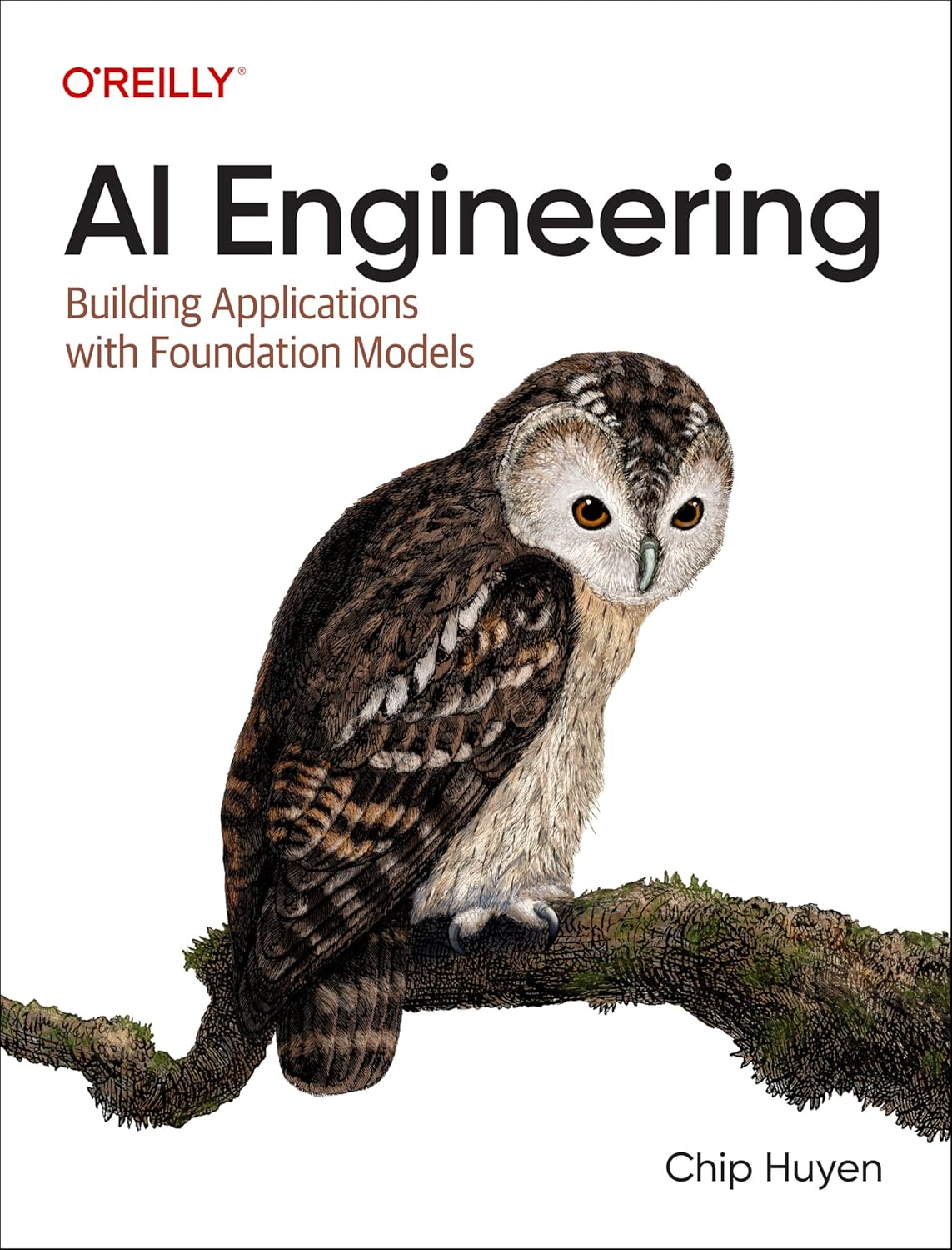
AI Engineering: Building Applications with Foundation Models
Original price was: $79.99.$57.74Current price is: $57.74.
Related Products





Recent breakthroughs in AI have not only increased demand for AI products, they’ve also lowered the barriers to entry for those who want to build AI products. The model-as-a-service approach has transformed AI from an esoteric discipline into a powerful development tool that anyone can use. Everyone, including those with minimal or no prior AI experience, can now leverage AI models to build applications. In this book, author Chip Huyen discusses AI engineering: the process of building applications with readily available foundation models.
The book starts with an overview of AI engineering, explaining how it differs from traditional ML engineering and discussing the new AI stack. The more AI is used, the more opportunities there are for catastrophic failures, and therefore, the more important evaluation becomes. This book discusses different approaches to evaluating open-ended models, including the rapidly growing AI-as-a-judge approach.
AI application developers will discover how to navigate the AI landscape, including models, datasets, evaluation benchmarks, and the seemingly infinite number of use cases and application patterns. You’ll learn a framework for developing an AI application, starting with simple techniques and progressing toward more sophisticated methods, and discover how to efficiently deploy these applications.
Understand what AI engineering is and how it differs from traditional machine learning engineering Learn the process for developing an AI application, the challenges at each step, and approaches to address them Explore various model adaptation techniques, including prompt engineering, RAG, fine-tuning, agents, and dataset engineering, and understand how and why they work Examine the bottlenecks for latency and cost when serving foundation models and learn how to overcome them Choose the right model, dataset, evaluation benchmarks, and metrics for your needs
Chip Huyen works to accelerate data analytics on GPUs at Voltron Data. Previously, she was with Snorkel AI and NVIDIA, founded an AI infrastructure startup, and taught Machine Learning Systems Design at Stanford. She’s the author of the book Designing Machine Learning Systems, an Amazon bestseller in AI.
AI Engineering builds upon and is complementary to Designing Machine Learning Systems (O’Reilly).
From the brand

Machine Learning, AI & more
Machine Learning
Artificial Intelligence
Deep Learning
Language Processing (NLP, LLM)

Sharing the knowledge of experts
O’Reilly’s mission is to change the world by sharing the knowledge of innovators. For over 40 years, we’ve inspired companies and individuals to do new things (and do them better) by providing the skills and understanding that are necessary for success.
Our customers are hungry to build the innovations that propel the world forward. And we help them do just that.
Publisher : O’Reilly Media
Publication date : January 7, 2025
Edition : 1st
Language : English
Print length : 532 pages
ISBN-10 : 1098166302
ISBN-13 : 978-1098166304
Item Weight : 2.05 pounds
Dimensions : 6.9 x 1.1 x 9 inches
Best Sellers Rank: #2,151 in Books (See Top 100 in Books) #1 in Machine Theory (Books) #1 in Enterprise Applications #1 in Natural Language Processing (Books)
Customer Reviews: 4.6 4.6 out of 5 stars (686) var dpAcrHasRegisteredArcLinkClickAction; P.when(‘A’, ‘ready’).execute(function(A) { if (dpAcrHasRegisteredArcLinkClickAction !== true) { dpAcrHasRegisteredArcLinkClickAction = true; A.declarative( ‘acrLink-click-metrics’, ‘click’, { “allowLinkDefault”: true }, function (event) { if (window.ue) { ue.count(“acrLinkClickCount”, (ue.count(“acrLinkClickCount”) || 0) + 1); } } ); } }); P.when(‘A’, ‘cf’).execute(function(A) { A.declarative(‘acrStarsLink-click-metrics’, ‘click’, { “allowLinkDefault” : true }, function(event){ if(window.ue) { ue.count(“acrStarsLinkWithPopoverClickCount”, (ue.count(“acrStarsLinkWithPopoverClickCount”) || 0) + 1); } }); });
13 reviews for AI Engineering: Building Applications with Foundation Models
Add a review

Original price was: $79.99.$57.74Current price is: $57.74.
David E. Hallman –
Excellent Book.
I don’t normally have the time for reviews anymore but I had to do one for this book. This book is excellent. The level of detail and range of topics was just right. With some books I’ve had to force myself to finish. This one kept me interested throughout the entire book and provided everything clearly. I’m more interested in usage of foundation models (LLM’s, RAG, etc.) but the chapters on model pre-training/training/evaluation provided great detail. I’m looking forward to more works from Chip.
Scott J. Pearson –
The best intro to AI engineering I’ve encountered
It’s always daunting to pick up a technical book that’s over 500 pages long or 21 hours long. However, this book did not disappoint. Not every section, of course, addressed my particular needs. However, the entire treatise was clearly communicated with a broader technical audience in mind. That should be no surprise because Chip Huyen, besides being an AI expert, taught graduate school classes in AI at Stanford and writes science fiction as a side hobby. This book is simply the best technical introduction I’ve encountered to date.The book starts with high-level concepts about AI, which would be accessible to all sorts of scientific folks. Then it focuses on technical topics that are of most interest to engineers. It does an excellent job of centering around concepts first and not being wedded to particular technologies which will soon change. I valued the insights so much that, after listening to the audiobook, I even bought a paper copy to have for a reference.I plan to continue to read about AI engineering, but given that I haven’t taken formal coursework in the topic, this book served as an equivalent to a graduate school class to give me confidence to dive deeper. Although some math were presented, the audiobook was incredibly accessible, unlike with some technical books. For those who spend time commuting in cars, I recommend listening to the text if you don’t have time to flip through a paper book.Overall, this book raised my game significantly about AI. Where other books obscure with technical jargon, this book enlightens with clear concepts. I still need to brush up on a few focused topics to ready myself for a project, but I’m much more fluent about the ideas than before. I highly recommend this in-depth introduction, at least for the next few years until the field outpaces our knowledge once again.
John Lockney –
A superb technical guide.
This book is so incredibly well-organized and well-edited that it’s hard to believe it’s a first edition rather than a third or fourth. I love when authors invite readers to jump around and read chapters out of order; in this case, every section proved helpful. This book offers a clear and valuable overview of AI, I plan to keep it close at hand as a reference.
Amazon Customer –
Must read for aspiring AI engineers
A great resource for anyone looking to enter the field of AI engineering. The book assumes some prior experience with basic ML and AI concepts, which allows it to dive deeper into practical and relevant topics without spending too much time on fundamentals. Highly recommended if you have that foundation and want to take the next step.
Matthias Busch –
Good foundation
Very informative. The audio version could use a little polishing like reading a table is not very conducive to the understanding and should be skipped
Mahmoud Youssef –
The best book on AI Engineering
The best book on AI Engineering. I enjoyed reading every page of this book. The book cover the whole breadth of the AI engineering field from the platform to the application itself covering very important topics including evaluation and security among others. The book covers all the different approaches for addressing each issues in the application design including the approaches from research and academia. The author has an amazing writing style that is fun to read and learn from.
Peter Fen –
Great book , lot of knowledge and insights.
A great book that gives you a comprehensive overview of the GenAI tech in an easy to digest format. A great starting point for all seriously involved in AI tech.
Hillary D. –
AI and machine learning.
Enjoying it so far. I’m on chapter 3 as of right now and I can confidently say it’s very eye opening.I’d recommend it to anyone looking into machine learning or AI engineering.
Julien Zaegel –
The central idea of the book is that foundation models have become so powerful and expensive to build that, instead of training models, many organizations might be better off creating applications on top of them. The book covers evaluation, guardrails, security, finetuning, context construction, inference optimization, user feedback and architecture.The level of detail is excellent: we’re looking under the hood just enough to understand what’s going on, but keep that high level perspective that allows the book to give a overview of a broad topic in just 500 pages.I highly recommended this book to engineers looking for an overview of AI engineering — as opposed to ML engineering, which might be too low-level for them and be more relevant for data scientists.
Kindle Customer –
The book had exactly the level of depth I needed. I’m coming from the data engineering side and needed some complete overview of AI Engineering. The book gave a complete coverage of the key topics while still going with some details (but avoiding the non-necessary technicalities). The reference are really valuable and worth the de-tour while reading.
john ireland –
All words and no substance – not even a single diagram or flowchart to illustrate a process – to call it ‘engineering’ completely misses the point.
Ivan Diaz –
Best book on AI engineering. It is not based on technologies, but on principles and patterns. It is a MUST if you start with agents development or if you just want to know about AI topics.
Anderson Mendes de Almeida –
Conteúdo incrível!