
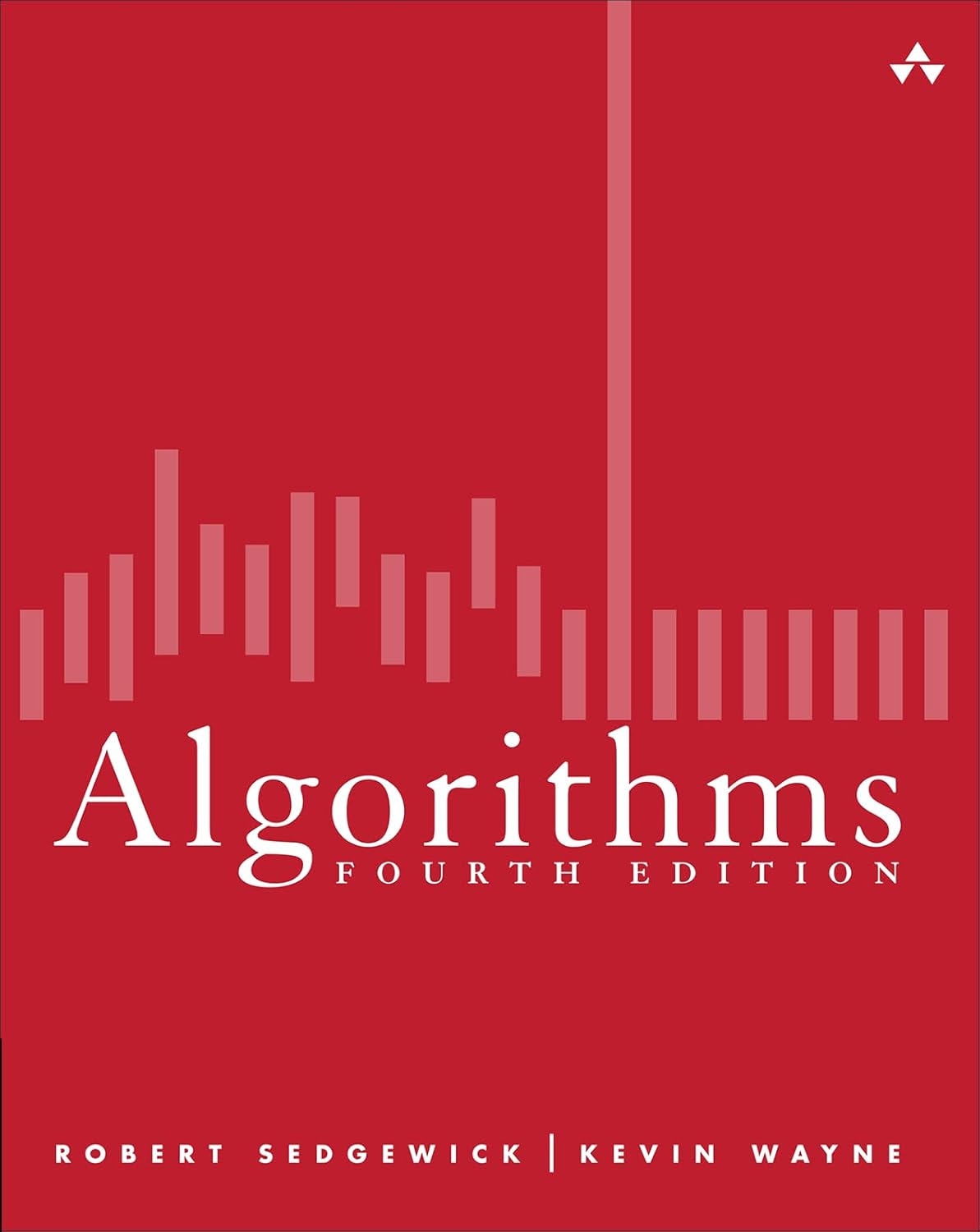
Algorithms (4th Edition)
$89.99
Related Products


This fourth edition of Robert Sedgewick and Kevin Wayne’s Algorithms is the leading textbook on algorithms today and is widely used in colleges and universities worldwide. This book surveys the most important computer algorithms currently in use and provides a full treatment of data structures and algorithms for sorting, searching, graph processing, and string processing–including fifty algorithms every programmer should know. In this edition, new Java implementations are written in an accessible modular programming style, where all of the code is exposed to the reader and ready to use.
The algorithms in this book represent a body of knowledge developed over the last 50 years that has become indispensable, not just for professional programmers and computer science students but for any student with interests in science, mathematics, and engineering, not to mention students who use computation in the liberal arts.
The companion web site, algs4.cs.princeton.edu, contains
An online synopsis Full Java implementations Test data Exercises and answers Dynamic visualizations Lecture slides Programming assignments with checklists Links to related material
The MOOC related to this book is accessible via the “Online Course” link at algs4.cs.princeton.edu. The course offers more than 100 video lecture segments that are integrated with the text, extensive online assessments, and the large-scale discussion forums that have proven so valuable. Offered each fall and spring, this course regularly attracts tens of thousands of registrants.
Robert Sedgewick and Kevin Wayne are developing a modern approach to disseminating knowledge that fully embraces technology, enabling people all around the world to discover new ways of learning and teaching. By integrating their textbook, online content, and MOOC, all at the state of the art, they have built a unique resource that greatly expands the breadth and depth of the educational experience.
From the Publisher
Distinctive Features

Algorithms
Descriptions of algorithms are based on complete implementations and on a discussion of the operations of these programs on a consistent set of examples. Instead of presenting pseudo-code, Sedgewick and Wayne work with real code, so that the programs can quickly be put to practical use. Programs are written in Java, but in a style such that most of the code can be reused to develop implementations in other modern programming languages.

Data types
Sedgewick and Wayne use a modern programming style based on data abstraction, so that algorithms and their data structures are encapsulated together.

Applications
Each chapter has a detailed description of applications where the algorithms described play a critical role. These range from applications in physics and molecular biology, to engineering computers and systems, to familiar tasks such as data compression and searching on the web.

A scientific approach
The emphasizes developing mathematical models for describing the performance of algorithms, using the models to develop hypotheses about performance, and then testing the hypotheses by running the algorithms in realistic contexts.

Breadth of coverage
Segewick and Wayne’s primary goal is to introduce the most important algorithms in use today to as wide an audience as possible. These algorithms are generally ingenious creations that, remarkably, can each be expressed in just a dozen or two lines of code. As a group, they represent problem-solving power of amazing scope. They have enabled the construction of computational artifacts, the solution of scientific problems, and the development of commercial applications that would not have been feasible without them.
They cover basic abstract data types, sorting algorithms, searching algorithms, graph processing, and string processing. They keep the material in algorithmic context, describing data structures, algorithm design paradigms, reduction, and problem-solving models. They cover classic methods that have been taught since the 1960s and new methods that have been invented in recent years.
Publisher : Addison-Wesley Professional
Publication date : March 24, 2011
Edition : 4th
Language : English
Print length : 976 pages
ISBN-10 : 032157351X
ISBN-13 : 978-0321573513
Item Weight : 3.16 pounds
Dimensions : 7.7 x 1.4 x 9.3 inches
Best Sellers Rank: #102,784 in Books (See Top 100 in Books) #4 in Computer Programming Structured Design #15 in Programming Algorithms #20 in Computer Systems Analysis & Design (Books)
Customer Reviews: 4.6 4.6 out of 5 stars (865) var dpAcrHasRegisteredArcLinkClickAction; P.when(‘A’, ‘ready’).execute(function(A) { if (dpAcrHasRegisteredArcLinkClickAction !== true) { dpAcrHasRegisteredArcLinkClickAction = true; A.declarative( ‘acrLink-click-metrics’, ‘click’, { “allowLinkDefault”: true }, function (event) { if (window.ue) { ue.count(“acrLinkClickCount”, (ue.count(“acrLinkClickCount”) || 0) + 1); } } ); } }); P.when(‘A’, ‘cf’).execute(function(A) { A.declarative(‘acrStarsLink-click-metrics’, ‘click’, { “allowLinkDefault” : true }, function(event){ if(window.ue) { ue.count(“acrStarsLinkWithPopoverClickCount”, (ue.count(“acrStarsLinkWithPopoverClickCount”) || 0) + 1); } }); });

Mitch Oldroyd –
A good buy for ANYONE
The authors provide an clear and concise set of criterion for the use of algorithms in general, and then go about developing the basic set to use in daily development of your own. I got this book as a reference to assist newcomers and interns in their progress, but find myself referring to its contents frequently to remind myself of some foundational elements that have floated merrily away over the years.I would heartily recommend this book to everyone. For the student to learn the basic set of algorithms, for the entry and mid level software engineers (or programmers) to inspire new ideas from a solid foundation, and for us veterans as a reminder to a solid way for development of our own algorithms.It is well written, and easy to understand (even for the interns I’ve had read through it). The examples are developed around Java, and so the book starts with a section on Java and basic programming techniques. It contains a large set of the basic algorithms that are frequently necessary on a day to day basis, but also shows HOW and WHY they were developed. It also provides a section on several advanced topics, again with an eye to the HOWs and WHYs. All along the way, there are references to “Good” development foundations, and reminders the development philosophies.
Aldric Borders –
Great Book. Must-read for anyone learning data structures and algorithms
Short and simple this book WALKS you through what data structures are, their purpose and use. It teaches you not only the concepts but provides complete code examples. What I particularly liked is how the book teaches you to systematically test and measure the performance of the data structures and points out why it performs as measured using both mathematical theory as well as data driven analysis. The content of the book is presented in an order which allows you to learn gradually and use what was learned in earlier chapters to develop more complex ideas in later chapters. This book can be read by absolute beginners, meaning you don’t need a prior exposure to data structures to grasp the content as it progresses from simple to advanced. Another great point is this book goes out of its way to give real world applications and uses of the data structures and their associated algorithms; giving the reader a real grasp on the usefulness of the content, making it real, not just an academic pursuit. There is no shortage of material, a very good balance of breath and depth.
greg martinson –
Excellent book on algorithms
For the experienced programmer or novice this a book you will appreciate and be glad you purchased.If genius is like it is said, the ability to make a complex subject simple to understand then Robert Sedgewick is truly a genius.Sedgewick explores some of the top algorithms in use today and focuses on their application, and implementation. Each algorithim, it’s application, and performance is also summarized for quick reference.Sedgewick steps through the algorithm with dynamic visual depictions of the data structures involved.I can’t say enough good things this book. This book assists the developer or programmer to effectively learn and use algorithms, and get on with life. It’s rare to see a book this well written for the purpose of learning as well as reference. Especially on a subject as involved as algorithms.In conjunction with the book, I would recommend using the online MOOC courses, Algorithms Part I, and Algorithms Part II, available at Princeton University. Here, Sedgewick, has developed some enjoyable and instructional video lectures and presentations of the book.I would also like to thank Robert Sedgewick for this brilliant piece of work, and Princeton University for bringing it online.
internet pseudonym –
Wish I’d bought the Print Version
3.5 is the average of 5 and 1: 5 for the book, 2 for the Kindelization of the book (yes I made up a word.) This is a wonderful book about algorithms, and fairly accessible. (I am teaching myself via online classes, not using this as part of real class, so I mean that the book works well without anyone around to ask questions about it.) I like understanding why certain code runs faster, and this book has been a very helpful introduction.HOWEVER, the Kindle edition is less good for one reason: The code examples are almost unreadable. This is a book about computer programming; the example code is one of the most important parts of the book. There are two problems with the example code in this book: typos and layout. Linebreaks are added in random places, which makes code really hard to read, and there are common OCR typos, like “t” for “+”. Worse, sometimes “=” and “-” look the same, or are OMITTED ENTIRELY. This is largely fixed in the PC Reading App (But NOT the Cloud Reader) by being able to click “View Code Image,” but the view code image button does not behave correctly in the Android app or the Cloud Reader.If I had it to do over, I would have ordered the print version, though it’s quite a bit more expensive.(Note: I’m reading this on a PC and on an Android phone. I don’t know what it would look like on an actual Kindle, but I’d be willing to be it would look pretty similar.)
Shyam Baitmangalkar –
If you want to digest different algorithms used in practice, then Sir Robert Sedgewick will help you out through this book. This book is a “must” if you are willing to learn and master over algorithms (focuses on Java implementations). I had referred this book when I was in college and was very much impressed by the way in which Sir Sedgewick explains. Paperback copy of this book is slightly expensive and moreover if you own a kindle, why go for a paperback edition?? Hence went ahead and purchased this kindle edition.
Fabio Massimo Ercoli –
Spiega in modo unico davvero, ne ho letti diversi di testi di algoritmi, penso che questo sia il migliore in assoluto!
iliass –
The book teaches algorithms with a scientific approach and there is no magic everything is proved. The code is simple and elegant. The author has also online course explaining the book content.There is also community driven GitHub repo containing answers to all book’s exercises.The only thing that I didn’t like is the absence of unit tests.
Noharicot –
Le livre est excellent ! Une bonne ressource
A.G.M. –
Es un libro muy cuidado con un gran cantidad de ejercicios y sus soluciones. Todo informático debería conocer. La web es extraordinaria. Lo recomiendo encarecidamente, vale la pena.