

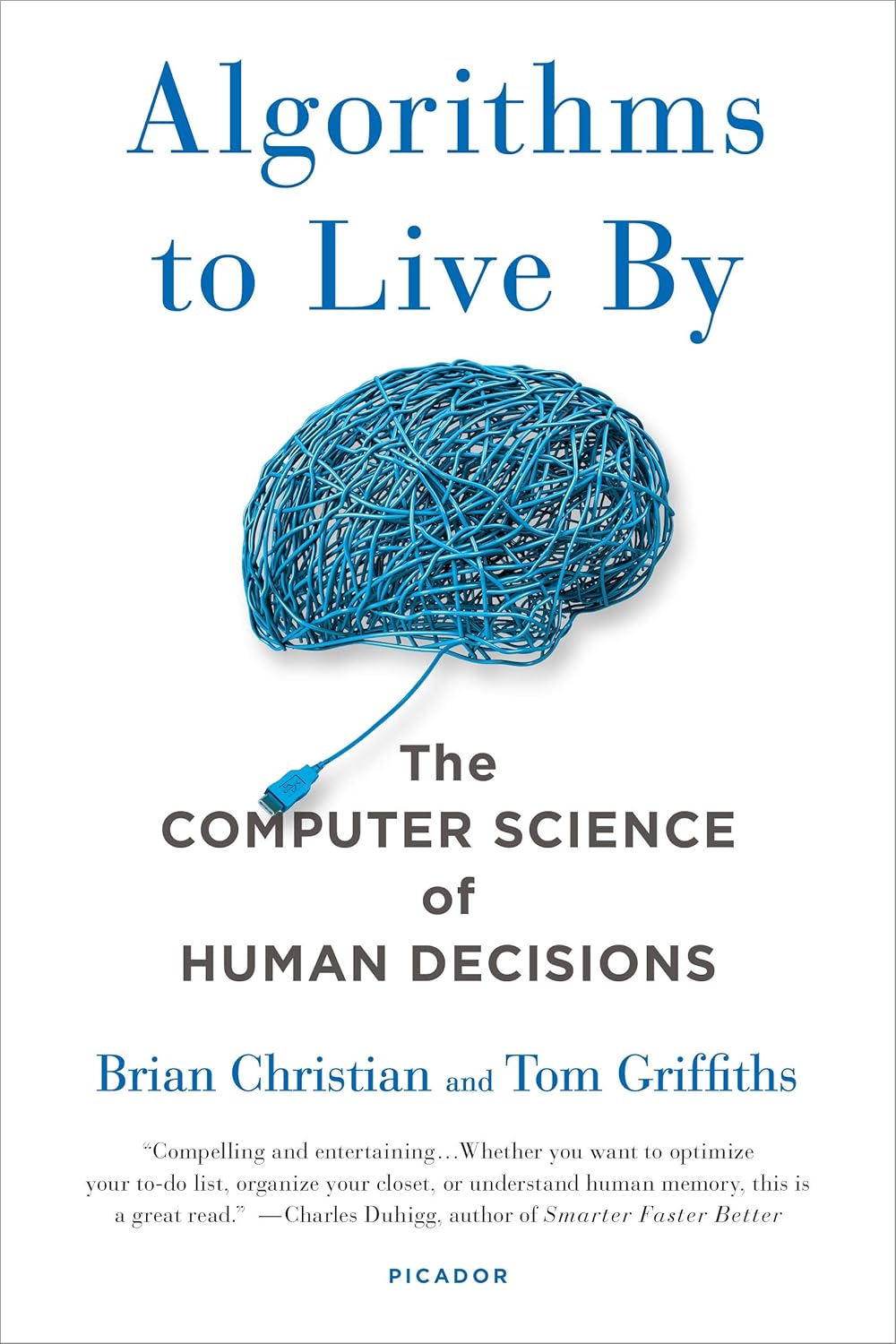
Algorithms to Live By: The Computer Science of Human Decisions
Original price was: $22.99.$8.70Current price is: $8.70.
Related Products



An exploration of how computer algorithms can be applied to our everyday lives to solve common decision-making problems and illuminate the workings of the human mind.
What should we do, or leave undone, in a day or a lifetime? How much messiness should we accept? What balance of the new and familiar is the most fulfilling? These may seem like uniquely human quandaries, but they are not. Computers, like us, confront limited space and time, so computer scientists have been grappling with similar problems for decades. And the solutions they’ve found have much to teach us.
In a dazzlingly interdisciplinary work, Brian Christian and Tom Griffiths show how algorithms developed for computers also untangle very human questions. They explain how to have better hunches and when to leave things to chance, how to deal with overwhelming choices and how best to connect with others. From finding a spouse to finding a parking spot, from organizing one’s inbox to peering into the future, Algorithms to Live By transforms the wisdom of computer science into strategies for human living.
From the Publisher


Publisher : Holt Paperbacks
Publication date : April 4, 2017
Edition : Reprint
Language : English
Print length : 368 pages
ISBN-10 : 1250118360
ISBN-13 : 978-1250118363
Item Weight : 2.31 pounds
Dimensions : 6.1 x 0.9 x 9.15 inches
Best Sellers Rank: #15,645 in Books (See Top 100 in Books) #10 in Cognitive Psychology (Books) #15 in Medical Cognitive Psychology #29 in Decision-Making & Problem Solving
Customer Reviews: 4.5 4.5 out of 5 stars (6,473) var dpAcrHasRegisteredArcLinkClickAction; P.when(‘A’, ‘ready’).execute(function(A) { if (dpAcrHasRegisteredArcLinkClickAction !== true) { dpAcrHasRegisteredArcLinkClickAction = true; A.declarative( ‘acrLink-click-metrics’, ‘click’, { “allowLinkDefault”: true }, function (event) { if (window.ue) { ue.count(“acrLinkClickCount”, (ue.count(“acrLinkClickCount”) || 0) + 1); } } ); } }); P.when(‘A’, ‘cf’).execute(function(A) { A.declarative(‘acrStarsLink-click-metrics’, ‘click’, { “allowLinkDefault” : true }, function(event){ if(window.ue) { ue.count(“acrStarsLinkWithPopoverClickCount”, (ue.count(“acrStarsLinkWithPopoverClickCount”) || 0) + 1); } }); });
7 reviews for Algorithms to Live By: The Computer Science of Human Decisions
Add a review

Original price was: $22.99.$8.70Current price is: $8.70.
Michael S. –
Great book on real world problems solved by computer science
Despite being an East-coaster, I’m a member of the Long Now Foundation, which–when I’m asked to describe it–I usually say is like TED, but with a long term view and way better substance. The Long Now gives regular talks, and then puts those talks up in video and audio form for others, who couldn’t be in attendance. I subscribe to the podcast in iTunes, and listen to it–along with other podcasts–on my way to and from work.A few months ago, Brian Christian was the guest speaker, and gave a talk centered around the subject matter of his latest book: Algorithms to Live By. The talk was fascinating, and contained a nice mixture of computer science, statistics, and humor to win the crowd over, and Christian managed to do so without coming across as too “pop science.”I purchased the book that same week, and between juggling work responsibilities and twins, managed to carve out about an hour each night to read through it. There were chapters that held my interest, and chapters that didn’t, but overall the book was a fantastic mix of how various computer science problems are also real work problems, and algorithms that solve one can be applied to the other as well.The first thing that catches you in the book is the discussion of optimal stopping, and how given a decision that needs to be made, you should begin making your choice after 37% of the options have been mulled over, assuming any of the next decisions/options are better than the ones that came before. This is illustrated with the secretary problem, and you can see why the authors led with this example not just in the book, but also in the Long Now talk. It seems both crazy and fascinating to have a difficult decision boiled down to such a hard percentage. The authors then go over different variations of the problem, and show how slight alteration can bring the best outcome.The authors (Christian and Tom Griffiths) then follow this up with a rapid succession of entertaining problems such as exploit/explore to determine whether you should go with something that you know, or try something new, as well as chapters on sorting, caching, and scheduling, giving messy desk people hope by showing that a stack of files on a desk where something searched for is retrieved and then placed on top of the pile will eventually result in the most optimized sorting methodology for the job, and reminding older, forgetful people that accumulation of knowledge can result in greater time to sift and retrieve that information, renaming so-called brain farts to caching misses.The chapter on Bayes’ rule is where things start to get a little bogged down, but only in the beginning. Eventually, the chapter turns into an explanation on forecasting, showing which various predictive methodologies should be used for which various distributions–even equating the Erlang distribution to politics.The back half of the book isn’t as tight or as entertaining as the parts that came before it, but overfitting was a great read to be perusing while Nate Silver was being hammered for his polling methodology in the most recent election, and the chapter on networking gave a great, easy-to-read introduction to how information networks differ from telephony. The authors then conclude the book with game theory, discussing the tragedy of the commons, and how, as a society, we could pursue better options in order to ensure mass participation in important initiatives.As somebody who studies and works in computer science and mathematics, I can say that casual readers will likely get lost in some sections, but powering through or re-reading will get you on to the more entertaining sections. This is a great book that works as a science popularizer without injecting fluffy prose/concepts or dumbing the material down.
Justinian Vonkost –
A brief intro into what algorithms are and are not
When one thinks of algorithms, it is often in association with computers or machines. Not humans. It is also common to think algorithms are there to provide a simple, neat solution to complex problems only a machine could solve. Or that algorithms can, once fed enough information, predict one’s every action and solve every problem. The main premise of Algorithms to Live By is to disabuse one of such notions. Algorithms to Live By explores how regular people use algorithms without even realizing it in their day-to-day lives. By doing so, the authors hope to destigmatize the word and get people to see the concept differently. Though the book can be dry at times, the authors manage to write a book that is accessible to most people. And there are moments of insight that do make the book a fascinating read.As aforementioned, the book explores how people use algorithms in their day-to-day to accomplish tasks. They focus on several elements: explore/exploit, or when it is best to continue to look for something better or make a choice from what one already knows; sorting and tradeoffs; and scheduling being among the subjects of focus. What makes these sections interesting is that they often talk about tradeoffs that one would seem counterintuitive. An example of this is in the scheduling section. The authors mention how the placement of a task on a schedule may be influenced by how much one knows about the task: by its duration or difficulty. This may increase the difficulty of scheduling if one were to know every detail of every task that must be done for the day. They also mention that while some may be tempted to schedule tasks based on how easy they are, this may also come with downsides. Especially if one decides to prioritize harder tasks before easier ones, only to realize that its completion requires completing an easier task. They give an example of a NASA Mars rover being frozen due to this fact. The rover was programmed to prioritize high priority tasks first in its queue over low priority tasks. However, one of the low-priority tasks kept being pulled from the bottom of the queue to the top. This caused the rover to freeze. Thus, even well-thought-out systems can lead to problems.The above example with NASA shows another aspect of the book I like; the use of real world examples. The authors tell stories involving real world mathematicians and scientists struggling with these issues in their personal lives. This helps make the subjects feel personal and applicable to one’s own life. In fact, I would argue that the only issue with the book is that these anecdotes seem to be an afterthought. This is due to the fact that the anecdotes become more prominent as the book progresses towards the end. Thus, the first few chapters can be somewhat dry in its presentation which may turn off a lay reader. Furthermore, the use of hypothetical scenarios in the earlier chapters feel like a pale imitation of the personal anecdotes of later chapters.All in all, this book was fairly enjoyable. While having some rough patches, the authors did try and succeed in making an accessible book.
N. Walton –
I’ve read quite a lot of pop-sci books. One of my favourites: “Godel-Escher-Bach” really made me think hard about life and how things are interconnected. “Zen and the art of motorcycle maintenance” did the same. I think that a science book, written for the general populate which makes you genuinely stop and think is one that has fulfilled its purpose.When it comes to “pop-sci” computer science books, I think a lot of them are just banal listings of cool things people did: Turing, Babbage, IBM, etc etc. Yeah, computers are awesome, and a lot of very clever people did very clever things with them. Some AI or game theory books (like Rock Paper Scissors) are able to focus in on a few small areas and unravel them a little.However this book has absolutely opened my eyes. Like G,E,B’s “eternal golden braid”, the cover of the book says it all: Everything’s interconnected. There are some problems which humans have been grappling with for millennia, along with some new ones which have only arisen since the advent of the motorcar, or the washing machine. Many of these problems have good, bad, ugly and downright crazy solutions. Once you mix in “love”, “anger”, “personal gain”, “altruism” and all the other factors, you’re led into a world of fuzzy logic, bizarre solutions, and some very very interesting stories.All of these stories, along with their underlying problems and paradoxes are brilliantly explained, wrapped together in a very logical, clear order. There’s nothing suffixed with “discussed later in this book”, everything is explained in the right order to lead from the simplest problems (those on a microscopic scale), to the hardest macroscopic ones (global economies and political policy). Amongst all these stories and problem domains, the author boils the problem down into a particular game theoretic procedure, or simply explains how it’s a twist on a simpler problem. As the book progresses, the braids get more and more tightly bound, showing how people use mutli-level decision trees. The discussion of how poker players “psych” each other out, and can trick each other into a variety of “level games” is truly inspiring. It solves the problem I always had with poker: “it’s just a game of chance, right?”. This explains that, no, actually, there’s a huge amount of psychology going on. It rounds it out by giving the one single most stark example of how simple psychology won a poker champion almost half a million dollars, leaving you agape at the simplicity and complexity all rolled into one.I have to say, I was engrossed in this book. I think everyone should read it, because it gives practical, simple advice on how to break out of “symmetrical” problems, and shows how you can get one-up on the other people by employing some simple strategies.Absolutely fantastic book.
Vasco Pereira –
Opened my mind up to solve issues from my life with an analytical approach
明日は億万長者 –
If you are interested in something about algorithms, you should read this book. I read it both in English and in Japanese. My impression from the book is different in original and translation. Japanese translation is excellent, but if you want to have some insight from this book, English version is better for the Japanese. But you can check your English understanding, Japanese version is very helpful. I bought this book to increase my understanding how to program python. Because I want to brash up my knowledge of computer and algorithms. However, this book is very useful for brash up my life itself.
Mina F. Beshay –
The book is awesome and a must read.The packaging is not that great, but it’s acceptable.
Nic –
“Algorithms to live by” è un libro davvero illuminante che ci mostra come la scienza informatica può aiutarci a prendere decisioni migliori nella vita quotidiana. Gli autori, Brian Christian e Tom Griffiths, applicano i principi dell’informatica e dell’ottimizzazione al mondo reale, aiutandoci a risolvere problemi come la gestione del tempo, la scelta della casa ideale, la decisione di lasciare o meno un lavoro e molto altro ancora. La scrittura è chiara e accessibile, e gli esempi sono divertenti ed istruttivi. Se sei interessato ad applicare la logica delle scienze informatiche alla vita quotidiana, questo libro è una lettura obbligatoria. Lo consiglio vivamente a chiunque abbia una mente curiosa e aperta.