
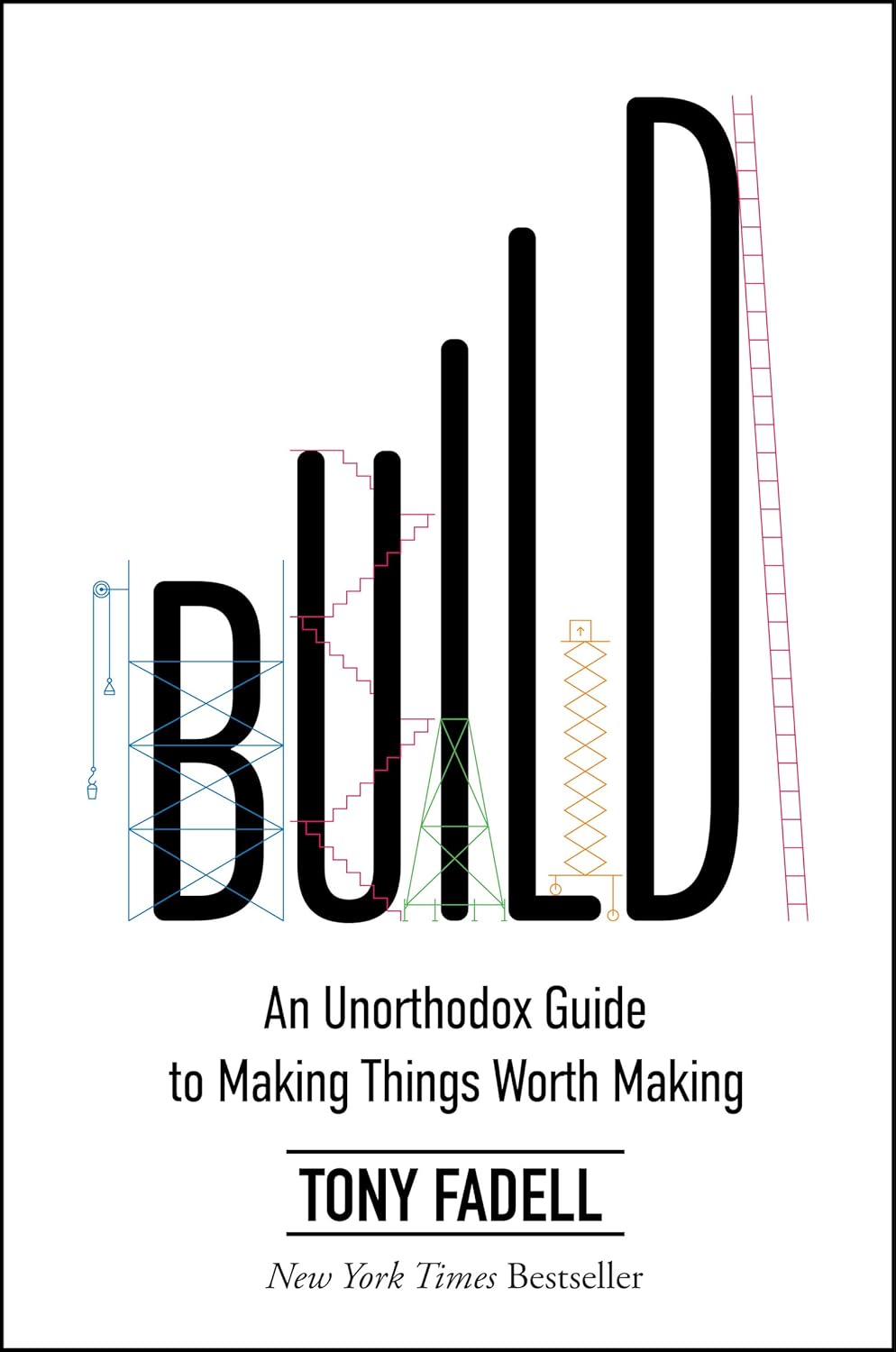
Build: An Unorthodox Guide to Making Things Worth Making
Original price was: $35.00.$15.71Current price is: $15.71.
Related Products



**New York Times, Wall Street Journal, and USAToday Bestseller for May 2022**
Tony Fadell led the teams that created the iPod, iPhone and Nest Learning Thermostat and learned enough in 30+ years in Silicon Valley about leadership, design, startups, Apple, Google, decision-making, mentorship, devastating failure and unbelievable success to fill an encyclopedia.
So that’s what this book is. An advice encyclopedia. A mentor in a box.
Written for anyone who wants to grow at work―from young grads navigating their first jobs to CEOs deciding whether to sell their company―Build is full of personal stories, practical career advice and fascinating insights into some of the most impactful products and people of the 20th century.
Each quick 5-20 page entry builds on the previous one, charting Tony’s personal journey in product development from a product designer to a leader, from a startup founder to an executive to a mentor. Tony uses examples that are instantly captivating, like the process of building the very first iPod and iPhone. Every chapter is designed to help readers with a problem they’re facing right now―how to get funding for their startup, whether to quit their job or not, or just how to deal with the jerk in the next cubicle.
Tony forged his path to success alongside mentors like Steve Jobs and Bill Campbell, icons of Silicon Valley who succeeded time and time again. But Tony doesn’t follow the Silicon Valley credo that you have to reinvent everything from scratch to make something great. His advice is unorthodox because it’s old school. Because Tony’s learned that human nature doesn’t change. You don’t have to reinvent how you lead and manage―just what you make.
And Tony’s ready to help everyone make things worth making.
Get unorthodox, old-school advice on the tough stuff:
Building Your Career: When is the right time to quit your job, how do you find a mentor, and how do you deal with the jerk in the next cubicle?Product Storytelling: Learn how to craft a compelling narrative for your product, a lesson Tony learned directly from watching Steve Jobs build the story for the iPhone.From Idea to Exit: Go inside the moments of devastating failure and unbelievable success, from getting funding for your startup to deciding when to sell your company.Disruptive Innovation: Understand why you don’t have to reinvent everything from scratch and how Tony’s old-school advice helped create some of the most impactful products of our time, including the iPod and iPhone.
From the Publisher


Publisher : Harper Business
Publication date : May 3, 2022
Language : English
Print length : 416 pages
ISBN-10 : 0063046067
ISBN-13 : 978-0063046061
Item Weight : 1.55 pounds
Dimensions : 6.12 x 1.17 x 9.25 inches
Best Sellers Rank: #16,969 in Books (See Top 100 in Books) #18 in Computers & Technology Industry #37 in Decision-Making & Problem Solving #54 in Entrepreneurship (Books)
Customer Reviews: 4.7 4.7 out of 5 stars (2,759) var dpAcrHasRegisteredArcLinkClickAction; P.when(‘A’, ‘ready’).execute(function(A) { if (dpAcrHasRegisteredArcLinkClickAction !== true) { dpAcrHasRegisteredArcLinkClickAction = true; A.declarative( ‘acrLink-click-metrics’, ‘click’, { “allowLinkDefault”: true }, function (event) { if (window.ue) { ue.count(“acrLinkClickCount”, (ue.count(“acrLinkClickCount”) || 0) + 1); } } ); } }); P.when(‘A’, ‘cf’).execute(function(A) { A.declarative(‘acrStarsLink-click-metrics’, ‘click’, { “allowLinkDefault” : true }, function(event){ if(window.ue) { ue.count(“acrStarsLinkWithPopoverClickCount”, (ue.count(“acrStarsLinkWithPopoverClickCount”) || 0) + 1); } }); });
9 reviews for Build: An Unorthodox Guide to Making Things Worth Making
Add a review

Original price was: $35.00.$15.71Current price is: $15.71.
Dr Ali Victor Binazir –
The Podfather speaks: hard-won wisdom on risk, invention, leading humans & rising after falling
Let’s say I told you that you could sit down to chat with the inventor and designer of some of the most successful products in history — things so crazy innovative, useful, and cool that they generated *hundreds of billions* of bucks. Heck, one of those products may even be in your pocket right now. And let’s say the guy has a lot of great stories to tell — working with the geniuses of his age, taking mad risks, making huge mistakes, scoring epic wins. And he’s a pretty good storyteller to boot.Interested? Well, Tony Fadell is that guy — the man behind the iPod, iPhone, Nest Thermostat and and much more you may not have heard of. If you didn’t know his name or story till now, here’s your chance to learn from one of the greatest inventor-entrepreneurs of all time, and drink in his hard-earned, often counterintuitive wisdom.Fadell divides his book into six parts: Build Yourself; Build Your Career; Build Your Product; Build Your Business; Build Your Team; Be CEO. Each part comprises a few chapters telling stories from his career along with the lessons learned. Each chapter begins with a nugget of concentrated Tony wisdom which is basically incompressible. Heck, the entire *book* is pretty incompressible — I highlighted almost a third of it. Here’s one about mentorship:”A good mentor won’t hand you the answers, but they will try to help you see your problem from a new perspective. They’ll loan you some of their hard-fought advice so you can discover your own solution.”This is straight-up Buddha talk, the ‘ehi-passiko’ of “Yeah, I’ve got some ideas to share but I want you to go figure it out on your own” — if the Buddha were a world-class coder, designer, manager, fundraiser, and CEO. Here’s another one on what kind of company to join:”If you’re going to throw your time, energy, and youth at a company, try to join one that’s not just making a better mousetrap. Find a business that’s starting a revolution. A company that’s likely to make a substantial change in the status quo has the following characteristics:1) It’s creating a product or service that’s wholly new or combines existing technology in a novel way that the competition can’t make or even understand…2) This product solves a problem—a real pain point—that a lot of customers experience daily…3) The novel technology can deliver on the company vision—not just within the product but also the infrastructure, platforms, and systems that support it.4) Leadership is not dogmatic about what the solution looks like and is willing to adapt to their customers’ needs.5) It’s thinking about a problem or a customer need in a way you’ve never heard before, but which makes perfect sense once you hear it.”What would I have given to have known that as a kid! There’s a lifetime of wisdom scrunched down into those five bullet points there — and several more in the rest of the book. Really you’ll want to read it for the stories of both epic triumph and epic failure, sometimes happening at the same time. Fadell tells the tales of brilliance and fallibility, the geniuses you may have never heard of, and how the success of no venture, no matter how innovative and well-planned, is ever foreordained.I won’t give away too much so you can fully experience the joy of discovering this book on your own. This is obviously required reading if you’re a budding entrepreneur. But if you’re at all interested in leadership, innovation, management, resilience, or just the origins of miraculous gizmos, you need to read this book. It’s about as close as you’re going to get to living inside the head of one of our modern-day entrepreneurial legends.– Ali Binazir, M.D., M.Phil., Happiness Engineer, startup coach and author of The Tao of Dating: The Smart Woman’s Guide to Being Absolutely Irresistible, the highest-rated dating book on Amazon, and Should I Go to Medical School?: An Irreverent Guide to the Pros and Cons of a Career in Medicine
Timothy Prickett Morgan –
This is a view, not sure why it’s a review. . . .
Outstanding – and well built, of course. It says thirteen more words required for review, which I think is silly. Hrmph.
A M –
Charming style and some thought-provoking ideas
The book lists many suggestions regarding the “recipes” of successful startups. Most of the tips are commonsense, and the non-commonsense ones are based just on the author’s intuition and personal experience. I know several counter-examples to these ideas, but since the recommendations are supposed to be probabilistic statements, my counter-examples are not refutations. The proper method to research this field is by constructing a table of a large representative sample of companies, where (1) the columns are whether the company succeeded or failed (the dependent variable) and many other features that might be relevant to the success or failure (the independent variables), and (2) each row refers to another company; and then (3) running some machine learning algorithm that finds the patterns of the successful companies. Intuitions and personal experience are not enough. Never.I enjoyed reading this book mainly because of the style: many short sentences (I tried to imitate this style in the last two sentences of the previous paragraph), and down-to-earth recommendations. There are also some thought-provoking ideas and lovely gossip about Apple, Google and some other companies in which the author was involved.
Greger Teigre –
The book I wished I read when I was 25
“Many times you just need someone to confirm your gut feeling and give you the confidence to follow it.” – this quote from Tony’s Acknowledgements chapter summarises my feeling throughout the entire book. When you are starting out your career, there is so much “wisdom/crap” that you need to parse through and figure out whether you believe in or not. It is so refreshing to read such a no-nonsense, detailed description of what matters and what doesn’t from someone who has real battle scars and victories.Starting out my career in Silicon Valley in the late 90s, I was never fortunate enough to meet Tony, and when moving back to Norway I met a start-up world that was 20 years behind Silicon Valley. This was right around the time Tony got the call from Apple to work on the iPod. I would have loved coming along for that ride!For every single decision you need to make to build a great product, a great company, a great team, you have to also decide who am I? what do I believe in? what kind of values are important to me? what kind of culture is a great product culture that I will thrive in and want to work in? And many, many more hard questions. Tony takes you through his career and points out the learnings that he believes were important, not only to his successes, but also to his failures. Brutally honest and with a personal, and down-to-earth language.There have been so many points throughout my life where I have felt something should be the right thing to do or believe in, but where I haven’t really dared. And where I haven’t had enough conviction to push through, ignore nay-sayers, and just do what I believe in. Tony goes through most of these and more, one by one and also explains why it is the right thing to do. And then there are the hard to come by experiences, like how is an effective board supposed to work for a VC-funded, highly innovative product company. Or how important it is to have a mentor who has been there before and what you need a mentor for.The title says this is an “unorthodox” guide. To me this sounds like title was determined by the publisher’s desire to make it a bestseller. Tony is seeing beyond the fuzz and the pretenders and focuses on the deeper fundamentals of human behaviour and the fundamental dynamics between technology, market, individual drive and motivation, and the sometimes harsh realities of starting a new company (or startup within a company). It’s nothing unorthodox about what he is writing about. It cuts through the crap and gets you to focus on what is important.Also, in many of Tony’s advice, it is evident that he is spoiled by living in the Bay Area. Examples are: always have a “seed crystal” on your board or you absolutely need to have a great mentor before considering starting a company or you should be relentless in pushing your employees to perfect the experience. The Bay Area has huge competition for talent, but the wider Bay Area also has the population of the entire country of Norway. That means that if you have a name in the Valley, know the other big names, and have built up a network over years, you can tap into a talent pool and a culture that is just there. You mostly need to carefully build this yourself outside the valley. Don’t let that discourage you though, what Tony points out is fundamentally human and fundamental to building great product anywhere in the world. Just think carefully about what you might need to build yourself before directly following Tony’s advice.
oneofnozamas –
スタートアップ経営者の生の声です。自営も企業勤めもある者ですが、目次の項目1つ1つでうなずくことが多いです。未経験のことでも、おそらくそうなのだろうなと参考になります。少し内容に冗長なところもありますが、経営、事業、プロジェクトなど、誰にでも参考にする状況、任務、役職があるのではないかと思います。理論やノウハウという形ではなく、”生の声”であるところが特徴だと思います。それが共感と現場を思い起こさせます。語りも正直で、事業に真正面から取り組む一所懸命な著者の人柄を表しているのだろうと思います。
Burak –
Çok güzel bir rehber kitap. Dönüp sürekli başvuru yapabilirsiniz.
Pankaj mishra –
Great for building team , management.best for CEOs, product manager.tony fedell talks about most of his challenges at MNCs like Google ,nest,apple.perspective of small companies remain untouched.
Dario B. –
I bought the book thinking of finding passions and advice in the process of building a product, but I found much more. The book very well organized tells you, perhaps in an unorthodox way, the experience and key elements of manufacturing companies that make money because they think before making great products and not because they make products to make money.
Herman S –
Boken är inte en step-by-step guide till skapande, utan ger insikt kring de aspekter som rör skapandet av något som är värt att skapa. Allt mellan marketing och krångliga jurister till arbetsroller och arbetsdynamik diskuteras. Du blir alltså ingen snickare av att läsa denna bok.