
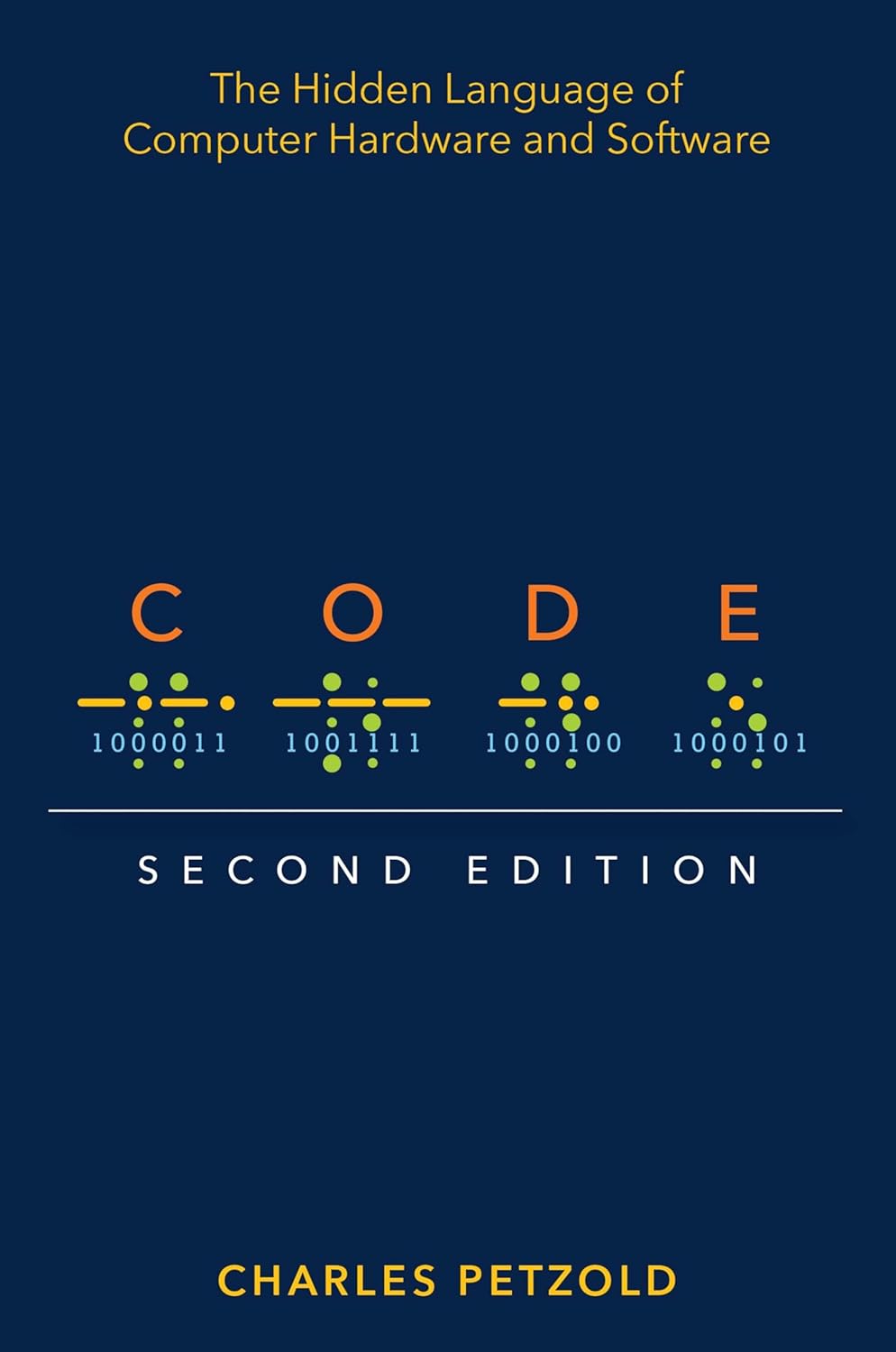
Code: The Hidden Language of Computer Hardware and Software
Original price was: $39.99.$32.05Current price is: $32.05.
Related Products



The classic guide to how computers work, updated with new chapters and interactive graphics
“For me, Code was a revelation. It was the first book about programming that spoke to me. It started with a story, and it built up, layer by layer, analogy by analogy, until I understood not just the Code, but the System. Code is a book that is as much about Systems Thinking and abstractions as it is about code and programming. Code teaches us how many unseen layers there are between the computer systems that we as users look at every day and the magical silicon rocks that we infused with lightning and taught to think.”
– Scott Hanselman, Partner Program Director, Microsoft, and host of Hanselminutes
Computers are everywhere, most obviously in our laptops and smartphones, but also our cars, televisions, microwave ovens, alarm clocks, robot vacuum cleaners, and other smart appliances. Have you ever wondered what goes on inside these devices to make our lives easier but occasionally more infuriating?
For more than 20 years, readers have delighted in Charles Petzold’s illuminating story of the secret inner life of computers, and now he has revised it for this new age of computing. Cleverly illustrated and easy to understand, this is the book that cracks the mystery. You’ll discover what flashlights, black cats, seesaws, and the ride of Paul Revere can teach you about computing, and how human ingenuity and our compulsion to communicate have shaped every electronic device we use.
This new expanded edition explores more deeply the bit-by-bit and gate-by-gate construction of the heart of every smart device, the central processing unit that combines the simplest of basic operations to perform the most complex of feats. Petzold’s companion website, CodeHiddenLanguage.com, uses animated graphics of key circuits in the book to make computers even easier to comprehend.
In addition to substantially revised and updated content, new chapters include:
Chapter 18: Let’s Build a Clock!Chapter 21: The Arithmetic Logic UnitChapter 22: Registers and BussesChapter 23: CPU Control SignalsChapter 24: Jumps, Loops, and CallsChapter 28: The World Brain
From the simple ticking of clocks to the worldwide hum of the internet, Code reveals the essence of the digital revolution.
From the Publisher

The classic guide to how computers work
This new expanded edition explores more deeply the bit-by-bit, gate-by-gate construction of the heart of every smart device—the central processing unit that combines the simplest of basic operations to perform the most complex of feats. Petzold’s companion website uses animated graphics of key circuits in the book to make computers even easier to comprehend.
In addition to substantially revised and updated content, new chapters include:
Chapter 18: Let’s Build a Clock!Chapter 21: The Arithmetic Logic UnitChapter 22: Registers and BussesChapter 23: CPU Control SignalsChapter 24: Jumps, Loops, and CallsChapter 28: The World Brain

“…the first book about programming that spoke to me.”
For me, Code was a revelation. It was the first book about programming that spoke to me. It started with a story, and it built up, layer by layer, analogy by analogy, until I understood not just the Code, but the System. Code is a book that is as much about Systems Thinking and abstractions as it is about code and programming.
Code teaches us how many unseen layers there are between the computer systems that we as users look at every day and the magical silicon rocks that we infused with lightning and taught to think.
Scott Hanselman, Partner Program Director, Microsoft, and host of Hanselminutes
Preface to the Second Edition
The first edition of this book was published in September 1999. With much delight I realized that I had finally written a book that would never need revising! This was in stark contrast to my first book, which was about programming applications for Microsoft Windows. That one had already gone through five editions in just ten years. My second book on the OS/2 Presentation Manager (the what?) became obsolete much more quickly. But Code, I was certain, would last forever.
My original idea with Code was to start with very simple concepts but slowly build to a very deep understanding of the workings of digital computers. Through this steady progression up the hill of knowledge, I would employ a minimum of metaphors, analogies, and silly illustrations, and instead use the language and symbols of the actual engineers who design and build computers. I also had a very clever trick up my sleeve: I would use ancient technologies to demonstrate universal principles under the assumption that these ancient technologies were already quite old and would never get older. It was as if I were writing a book about the internal combustion engine but based on the Ford Model T.
I still think that my approach was sound, but I was wrong in some of the details. As the years went by, the book started to show its age. Some of the cultural references became stale. Phones and fingers supplemented keyboards and mice. The internet certainly existed in 1999, but it was nothing like what it eventually became. Unicode—the text encoding that allows a uniform representation of all the world’s languages as well as emojis—got less than a page in the first edition. And JavaScript, the programming language that has become pervasive on the web, wasn’t mentioned at all.
Those problems would probably have been easy to fix, but there existed another aspect of the first edition that continued to bother me. I wanted to show the workings of an actual CPU—the central processing unit that forms the brain, heart, and soul of a computer—but the first edition didn’t quite make it. I felt that I had gotten close to this crucial breakthrough but then I had given up. Readers didn’t seem to complain, but to me it was a glaring flaw.
That deficiency has been corrected in this second edition. That’s why it’s some 70 pages longer. Yes, it’s a longer journey, but if you come along with me through the pages of this second edition, we shall dive much deeper into the internals of the CPU. Whether this will be a more pleasurable experience for you or not, I do not know. If you feel like you’re going to drown, please come up for air. But if you make it through Chapter 24, you should feel quite proud, and you’ll be pleased to know that the remainder of the book is a breeze.
Charles Petzold
Publisher : Microsoft Press
Publication date : August 7, 2022
Edition : 2nd
Language : English
Print length : 480 pages
ISBN-10 : 0137909101
ISBN-13 : 978-0137909100
Item Weight : 1.45 pounds
Dimensions : 6 x 0.98 x 8.9 inches
Best Sellers Rank: #15,244 in Books (See Top 100 in Books) #1 in Unicode Encoding Standard #4 in Data Processing #7 in Software Development (Books)
Customer Reviews: 4.8 4.8 out of 5 stars (886) var dpAcrHasRegisteredArcLinkClickAction; P.when(‘A’, ‘ready’).execute(function(A) { if (dpAcrHasRegisteredArcLinkClickAction !== true) { dpAcrHasRegisteredArcLinkClickAction = true; A.declarative( ‘acrLink-click-metrics’, ‘click’, { “allowLinkDefault”: true }, function (event) { if (window.ue) { ue.count(“acrLinkClickCount”, (ue.count(“acrLinkClickCount”) || 0) + 1); } } ); } }); P.when(‘A’, ‘cf’).execute(function(A) { A.declarative(‘acrStarsLink-click-metrics’, ‘click’, { “allowLinkDefault” : true }, function(event){ if(window.ue) { ue.count(“acrStarsLinkWithPopoverClickCount”, (ue.count(“acrStarsLinkWithPopoverClickCount”) || 0) + 1); } }); });
13 reviews for Code: The Hidden Language of Computer Hardware and Software
Add a review

Original price was: $39.99.$32.05Current price is: $32.05.
Austin –
Engaging Read for Beginners and Techies Alike
An engaging and accessible exploration of how computers really work. The author breaks down complex concepts into simple, relatable explanations, making topics like binary, logic gates, and basic circuits far less intimidating. For newcomers, it’s a great way to build a foundational understanding of computer theory with just a touch of electrical engineering.As someone with a technical background, I still found it entertaining; the examples and analogies added fresh ways to frame ideas I already knew. It’s the kind of book that can bridge the gap between “I use computers” and “I understand what’s happening under the hood.”Highly recommended for anyone curious about what makes hardware and software tick, whether you’re starting from scratch or just want a new perspective.
Skyler Scott –
Great book for anyone interested in computing
Fantastic book. It goes through the invention of hardware that use code. It shows how most are a binary system from braille to the telegraph. It introduces electricity concepts like current, resistance, conductiveness. It gives you the concepts of logic with logical gates and Boolean Algebra.
Michael Donoghue –
If you only buy one technical computer book, this is it
Disclaimer: I owned the first edition for years and read it a dozen times, mainly for pleasure since it’s not only informative but also just enjoyable to read. I’m a professional software architect and have dozens of textbooks on computer science and engineering so I’ve been around the block.This is the kind of book I would buy all for all my friends (if I had more than a couple) and family members (if they were even slightly into computers, which they aren’t sadly). Petzold does an exceptional job at describing digital logic and guides you through building a conceptual CPU from very first principles.I think his bottom up approach is the way to go and has helped me understand complex topics in an extremely simple way. When I’m not reading fiction, this is my go to bedtime reading.The second edition has about 100 more pages than the first and some content has been completely reworked and it’s great.If you ever had even a passing interest in knowing how computers work at a very fundamental level, get this book!
just some guy –
The holy bible
The second edition is well written. Charles P. is known for his excellent books on programming and architecture. If you want to know how computers work, this book is for you. Be aware there are some errors (see errata on the internet). I corrected everything in 10 mins, no big deal.
LCoop –
This is the book to get if you want to learn about AI
I wanted to know more about all the fuzz is about with AI and Language Learning Models, a friend recommended this book, and wow, it is the authoritative compendium on the subject matter. Great read, very thorough introduction to AI pragmatics and evolutionary Quantum processing.
Yura –
First programmer?
As an ardent reader of the past 1st edition, I was fairly excited to get the latest version. That is, until I encountered the history chapter of the new edition.For one thing, what I do NOT understand in this second edition is the newly added description of August Ada Byron (countless of Lovelace). The author claims it was Babbage who was the first programmer to design the engines, not Ada. I am not trying to start a futile argument here about who has more or fewer contributions, etc.What I am trying to assert here is that it is undisputed that Ada (unless the new evidence arises) left *the very first demonstration* of what this seemingly imaginary machine, which didn’t even physically exist, was capable of through her program. Because Babbage designed the engine itself, that doesn’t automatically put him in the position of a programmer (despite Babbage being a brilliant engineer/scientist and may have had a simple or detailed program in his mind). However, it was Ada who gave a definite touch to programming concepts that ultimately led to modern-day programming. Ada deserves more recognition than a mere “tutorial writer,” and she is certainly entitled to the title she deserves.Other than that, like the previous edition, this book is a must-read for people who are from related/unrelated fields. I always loved the 1st edition, and I would do too with the 2nd. Still, I think history should always be approached with more care, particularly if matters have potential controversies.
Abigail Spencer –
Easy, fun read
A very basic book that should be mandatory for anyone working with computers, from basic coding to electrical engineers. It’s easy to read, goes over the whole process from early communication with flash lights to switches and routers, to how code works with the computers hardware. As a data scientist without much of a computer science background, this was a delight.
Joey D –
Most Influential Book
I read the first edition of this book circa 2006. As a high school kid, I was already well versed in software but hardware and the way a CPU works felt like magic. I then read CODE and it forever changed my understanding of computers and how they worked at the lowest level. I consider it one of the most influential books I have ever read given at the time CS/EE wasn’t what it is today. Resources to learn this kind of stuff as an adolescent were scarce and or non-existent. I bought the second edition just to have it on my shelf.
Markus Dold –
Interessting, great book
Delphin –
One of the best, if not the best, books on computing… nice touch with the colored diagrams
David –
Good concise write up on how hardware and software interact inside an Intel 8080 cpu.
Cliente Amazon –
Loved it. Easy, funny way to learn more about these topics. An excellent read for younger people too.
Felipe D. F. –
Excelente livro. Descreve de maneira muito fundamentada a estrutura de como um computador funciona e os diferentes “códigos” que são utilizados. Durante o livro ele vai estruturando o conhecimento para ir ao longo dos capítulos construíndo a estrutura de um computador simples. Muito bom para iniciantes, se forem ler de maneira sequencial, ou para consulta caso de usuários com alguma base de conhecimento.