

Deep Learning: A Visual Approach
Original price was: $99.99.$67.31Current price is: $67.31.
Related Products






A richly-illustrated, full-color introduction to deep learning that offers visual and conceptual explanations instead of equations. You’ll learn how to use key deep learning algorithms without the need for complex math.
Ever since computers began beating us at chess, they’ve been getting better at a wide range of human activities, from writing songs and generating news articles to helping doctors provide healthcare.
Deep learning is the source of many of these breakthroughs, and its remarkable ability to find patterns hiding in data has made it the fastest growing field in artificial intelligence (AI). Digital assistants on our phones use deep learning to understand and respond intelligently to voice commands; automotive systems use it to safely navigate road hazards; online platforms use it to deliver personalized suggestions for movies and books – the possibilities are endless.
Deep Learning: A Visual Approach is for anyone who wants to understand this fascinating field in depth, but without any of the advanced math and programming usually required to grasp its internals. If you want to know how these tools work, and use them yourself, the answers are all within these pages. And, if you’re ready to write your own programs, there are also plenty of supplemental Python notebooks in the accompanying Github repository to get you going.
The book’s conversational style, extensive color illustrations, illuminating analogies, and real-world examples expertly explain the key concepts in deep learning, including:
• How text generators create novel stories and articles
• How deep learning systems learn to play and win at human games
• How image classification systems identify objects or people in a photo
• How to think about probabilities in a way that’s useful to everyday life
• How to use the machine learning techniques that form the core of modern AI
Intellectual adventurers of all kinds can use the powerful ideas covered in Deep Learning: A Visual Approach to build intelligent systems that help us better understand the world and everyone who lives in it. It’s the future of AI, and this book allows you to fully envision it.
Full Color Illustrations
From the Publisher


‘Best Yet’
“Andrew is famous for his ability to teach complex topics that blend mathematics and algorithms, and this work I think is his best yet.”
—Peter Shirley, Distinguished Research Engineer, Nvidia

‘Read It Cover-to-Cover’
“I would recommend that anyone entering this area, or even already familiar with the subject, read it cover-to-cover to firmly ground their understanding.“
—Richard Szeliski, author of Computer Vision: Algorithms and Applications

‘Great Introduction to Deep Learning’
“This book is a great introduction to machine learning, in general, and more specifically to deep learning (neural networks). The author thoroughly explains each concept using pictures instead of math.”
—Mike, Amazon reviewer

About The Author
Dr. Andrew Glassner is a Senior Research Scientist at Weta Digital, where he uses deep learning to help artists produce visual effects for film and television. He was Technical Papers Chair for SIGGRAPH ’94, Founding Editor of the Journal of Computer Graphics Tools, and Editor-in-Chief of ACM Transactions on Graphics. His prior books include the Graphics Gems series and the textbook Principles of Digital Image Synthesis. Glassner holds a PhD from UNC-Chapel Hill. He paints, plays jazz piano, and writes novels. He can be followed on Twitter as @AndrewGlassner.
Who Should Read This Book
You don’t need math or programming experience. You don’t need to be a computer whiz. You don’t have to be a technologist at all!
This book is for anyone with curiosity and a desire to look behind the headlines. You may be surprised that most of the algorithms of deep learning aren’t very complicated or hard to understand. They’re usually simple and elegant and gain their power by being repeated millions of times over huge databases.
In addition to satisfying pure intellectual curiosity, Glassner wrote this book for people who come face to face with deep learning, either in their own work or when interacting with others who use it. After all, one of the best reasons to understand AI is so we can use it ourselves! We can build AI systems now that help us do our work better, enjoy our hobbies more deeply, and understand the world around us more fully.
If you want to know how this stuff works, you’re going to feel right at home.

About the Publisher
No Starch Press has published the finest in geek entertainment since 1994, creating both timely and timeless titles like Python Crash Course, Python for Kids, How Linux Works, and Hacking: The Art of Exploitation. An independent, San Francisco-based publishing company, No Starch Press focuses on a curated list of well-crafted books that make a difference. They publish on many topics, including computer programming, cybersecurity, operating systems, and LEGO. The titles have personality, the authors are passionate experts, and all the content goes through extensive editorial and technical reviews. Long known for its fun, fearless approach to technology, No Starch Press has earned wide support from STEM enthusiasts worldwide.
Publisher : No Starch Press
Publication date : June 29, 2021
Edition : Illustrated
Language : English
Print length : 768 pages
ISBN-10 : 1718500726
ISBN-13 : 978-1718500723
Item Weight : 3.85 pounds
Dimensions : 7 x 1.56 x 9.25 inches
Best Sellers Rank: #184,396 in Books (See Top 100 in Books) #51 in Computer Neural Networks #58 in Natural Language Processing (Books) #634 in Computer Programming (Books)
Customer Reviews: 4.7 4.7 out of 5 stars (171) var dpAcrHasRegisteredArcLinkClickAction; P.when(‘A’, ‘ready’).execute(function(A) { if (dpAcrHasRegisteredArcLinkClickAction !== true) { dpAcrHasRegisteredArcLinkClickAction = true; A.declarative( ‘acrLink-click-metrics’, ‘click’, { “allowLinkDefault”: true }, function (event) { if (window.ue) { ue.count(“acrLinkClickCount”, (ue.count(“acrLinkClickCount”) || 0) + 1); } } ); } }); P.when(‘A’, ‘cf’).execute(function(A) { A.declarative(‘acrStarsLink-click-metrics’, ‘click’, { “allowLinkDefault” : true }, function(event){ if(window.ue) { ue.count(“acrStarsLinkWithPopoverClickCount”, (ue.count(“acrStarsLinkWithPopoverClickCount”) || 0) + 1); } }); });
13 reviews for Deep Learning: A Visual Approach
Add a review

Original price was: $99.99.$67.31Current price is: $67.31.
CL –
Loved it
I’ve easily read dozens of tech books. I liked this one a lot. Sure, there were boring parts, but most of it was engaging, especially on dry subjects. I previously read “How AI Works” and found this more informative and way more enjoyable. I got through the 700 pages in about 5 weeks while also learning about probability and linear algebra from other books and online sources. I’d love to read something more advanced by the author, maybe getting into more modern applications. I feel more comfortable with the subject and feel I am now ready to conquer more advanced texts. I initially picked this up to give me some background before reading “How to Build a LLM (from scratch)”. I’ve ordered an intermediary Deep Learning with Python book as well, but wouldn’t mind a more advanced theory book to accompany these books. I’ll definitely be rereading sections of this book to further familiarize myself with topics like backpropagation. Highly recommend if you’re looking for a gentle, but broad introduction to the topic.
Amazon Customer –
A Good Place to Start Learning AI
Diving into the world of artificial intelligence can feel like stepping into a vast, uncharted ocean, and if you’re looking for a reliable vessel to navigate these waters, this book is an excellent choice. However, I must be candid—this journey is not for the faint-hearted or those hoping to breeze through. The subject of AI, with its complex algorithms and intricate theories, is notoriously challenging. You won’t find yourself flipping pages at a rapid pace, as this is not a title designed for speed-reading. Instead, it demands your full attention and a willingness to engage deeply with the material.At the heart of AI lies mathematics—a fundamental pillar that underpins the entire discipline. This book, while comprehensive, offers only a glimpse into the mathematical framework that drives artificial intelligence. But don’t be disheartened by this. Think of it as a solid foundation, a primer that will arm you with the essential concepts needed before you delve deeper into the more advanced mathematical intricacies elsewhere. When you do eventually tackle those more complex equations, you’ll find yourself better equipped, with a clearer understanding of the principles at play.I should also mention that I’m no stranger to Andrew’s work. Having explored some of his other writings, I can confidently say that he possesses a unique flair for communication. His ability to distill complex ideas into accessible language, without losing the essence of the subject, is truly commendable. Andrew writes with a certain finesse and sophistication that makes even the most daunting topics seem approachable. His style is not just informative, but also engaging, with a touch of elegance that sets his work apart from others in the field.In summary, while the path to mastering AI is undeniably steep, this book serves as an invaluable guide. It’s not just a starting point; it’s a beacon for those who are serious about understanding the intricacies of artificial intelligence. Be prepared to invest time and effort, and in return, you’ll gain a solid foothold in a subject that is as fascinating as it is complex.
MrGee –
An enjoyable, and seriously excellent, path to understanding Deep Learning…
Deep Learning is changing our world. If you want to understand more, this is a great place to start. Andrew Glassner is a talented explainer – I took his short course on Deep Learning and learned so much, but also came away impressed at how well he can make complex material so clear and engaging. And this book is jammed packed with insights, visuals, and clear explanations. The author has a playful, sometimes quirky style that shines through, which gives this tour a lot of personality as well as information. Very enjoyable reading – I felt like he captured all that was good about his course (and then some) and bottled it up in this book. There is a lot more material here than in that course, and it is well laid-out and organized so that it is easy to roam around and come back to review the pieces that matter to you.Even if you plan to go to on to be a world-class Deep Learning engineer or mathematician, you have to start by understanding the concepts. And this book does a great job of presenting all the core ideas in a way that makes them clear and memorable.
R. Cote –
Before GPT can chat, it has to learn.
One of the most comprehensive guides to AI and deep learning available. All concepts covered clearly and concisely with illustrations. Complex concepts are broken down into understandable terms. Even though ML and AI require some complex math, you won’t need it to get idea of what’s going on inside the computer’s “brain”.I use this as a reference when teaching AI concepts and preparing presentations.I highly recommend it
Rafael Azevedo Souza Costa –
Great examples and practical explanations
Excellent book. Highly recommend
La Monte HP Yarroll –
Taught me backpropagation
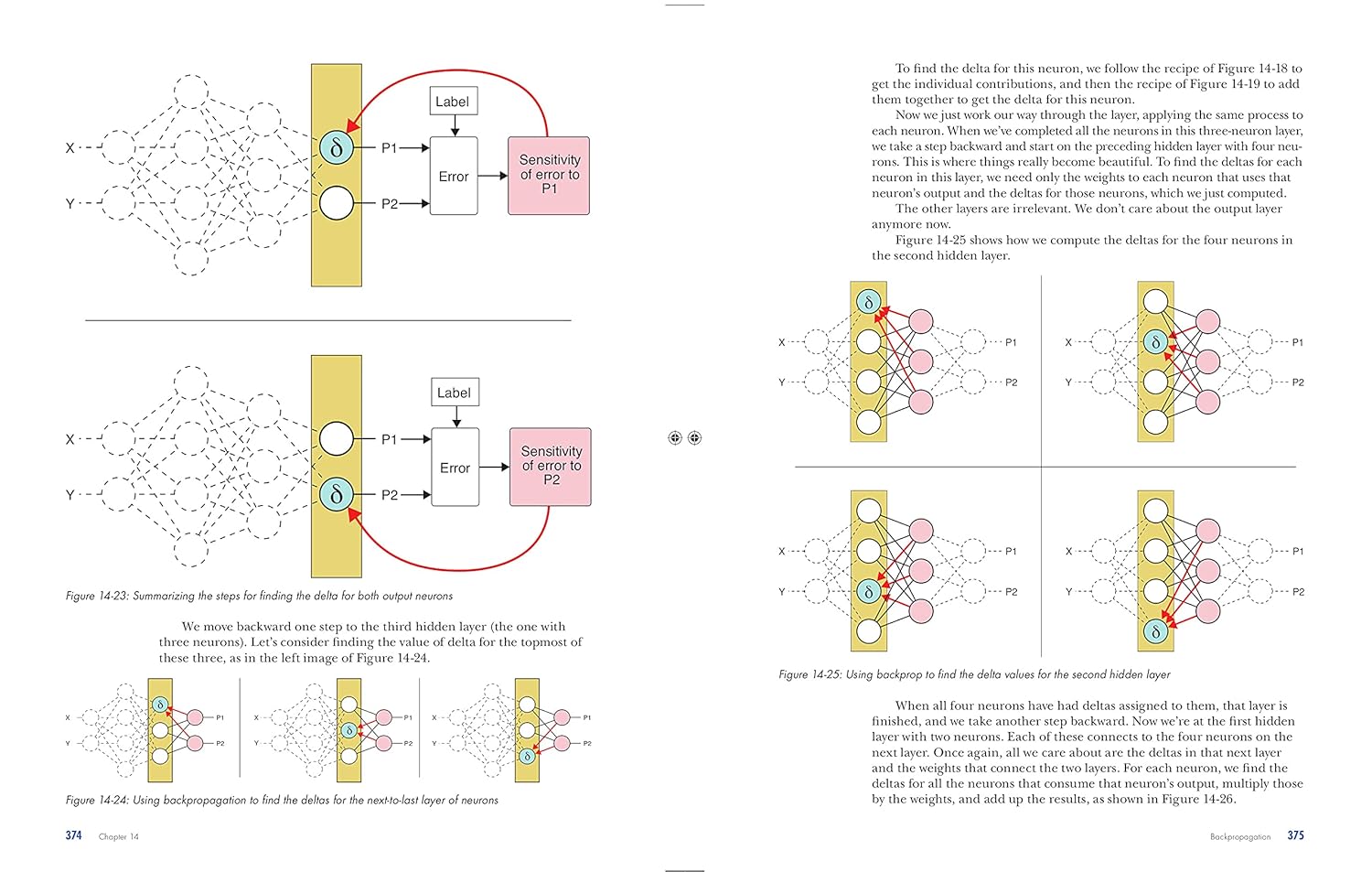
I’m finding this book a great reference to supplement Syracuse IST 691 Deep Learning in Practice. In particular, its explanation of backpropagation is the clearest I have found yet, and that even includes 3 Blue 1 Brown, which always does excellent explanations.
Thomas –
Great for intuitive understanding
Amazing book. Great examples and diagrams. If you’re looking to get an intuitive grasp of deep learning, look no further. If you’re an engineer looking to apply it, I would recommend pairing this with one of the more technical canonical texts and a programming focused book.
Ostbote –
Second half looks nice
First half could have been skipped for a cheaper book.
Doc G –
What a wonderful book to explain deep learning. Andrew does an impressive job of explaining concepts in an intuitive way and fully supported by extensive code to help get upto speed quickly.
Zoheb –
I was hoping the book would explain or give a visual presentation of the process of calculation for any deep learning problem, however it only shows the end results, something that many books would show as well. I was hoping the attention architecture would be more visual, however it isn’t.
Shanmuga –
Given the tools already available to implement Deep Learning models, this book takes a visual illustrative approach to fast track one into this research field. It contains great figures and excellent examples with intuitive approach to state of the art topics. I am using this book to teach Deep Learning this semester. The companion website is very helpful. The clarity in explanations and very insightful examples make this book a treat to read. This book is unique and indispensable for novice in the area of Deep Learning. Highly Recommended.
iloveamazon –
The pages are crumbled and the replacement has scratches covers. Both has black soot stains.
Misbah –
If you want to understand core deep learning concepts think no more. This is your brain friendly guide