
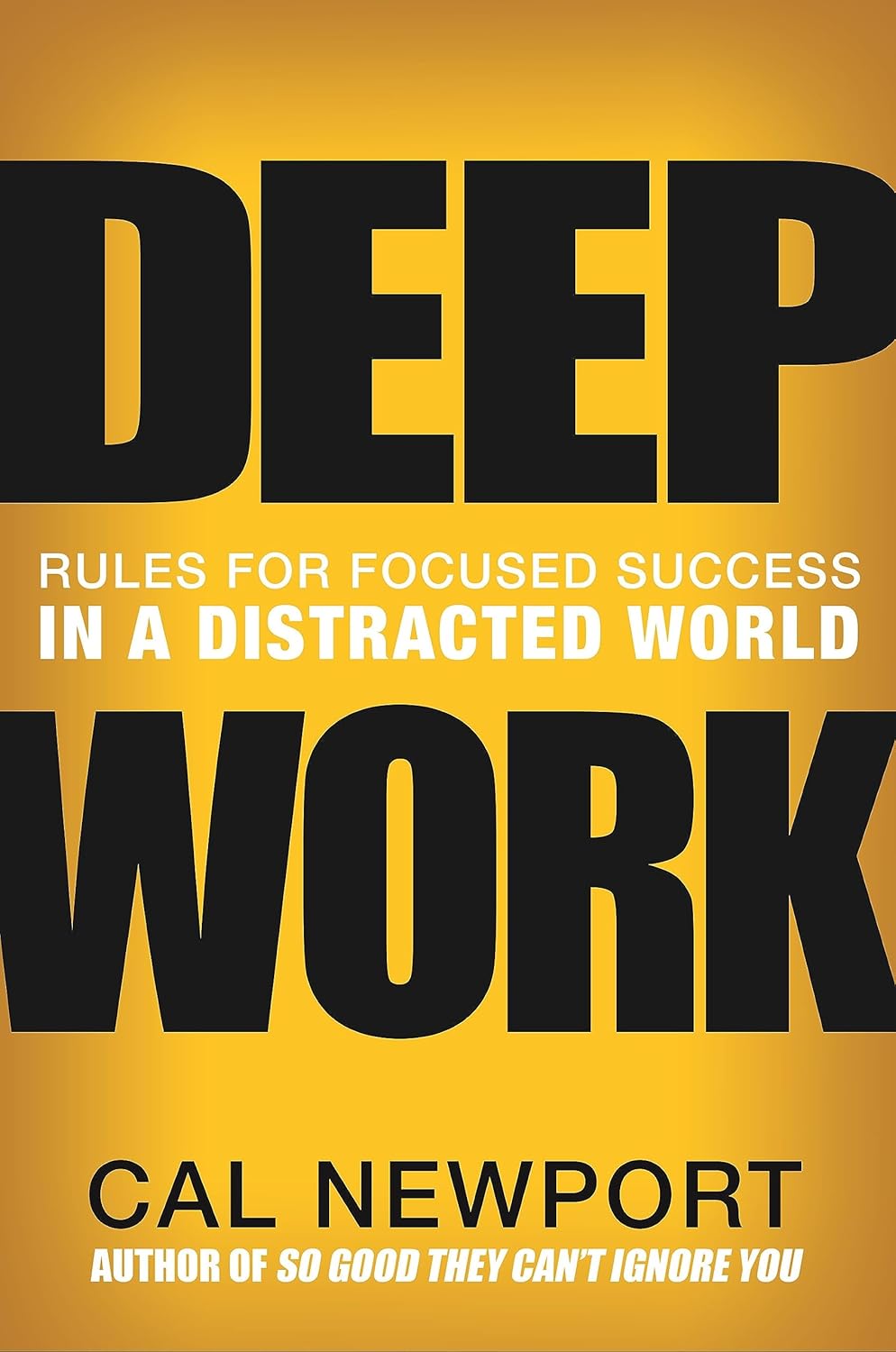
Deep Work: Rules for Focused Success in a Distracted World
Original price was: $30.00.$23.10Current price is: $23.10.
Related Products






AN AMAZON BEST BOOK OF 2O16 PICK IN BUSINESS & LEADERSHIP
WALL STREET JOURNAL BUSINESS BESTSELLER
A BUSINESS BOOK OF THE WEEK AT 800-CEO-READ
Master one of our economy’s most rare skills and achieve groundbreaking results with this “exciting” book (Daniel H. Pink) from an “exceptional” author (New York Times Book Review).
Deep work is the ability to focus without distraction on a cognitively demanding task. It’s a skill that allows you to quickly master complicated information and produce better results in less time. Deep Work will make you better at what you do and provide the sense of true fulfillment that comes from craftsmanship. In short, deep work is like a super power in our increasingly competitive twenty-first century economy. And yet, most people have lost the ability to go deep-spending their days instead in a frantic blur of e-mail and social media, not even realizing there’s a better way.
In Deep Work, author and professor Cal Newport flips the narrative on impact in a connected age. Instead of arguing distraction is bad, he instead celebrates the power of its opposite. Dividing this book into two parts, he first makes the case that in almost any profession, cultivating a deep work ethic will produce massive benefits. He then presents a rigorous training regimen, presented as a series of four “rules,” for transforming your mind and habits to support this skill.
1. Work Deeply
2. Embrace Boredom
3. Quit Social Media
4. Drain the Shallows
A mix of cultural criticism and actionable advice, Deep Work takes the reader on a journey through memorable stories-from Carl Jung building a stone tower in the woods to focus his mind, to a social media pioneer buying a round-trip business class ticket to Tokyo to write a book free from distraction in the air-and no-nonsense advice, such as the claim that most serious professionals should quit social media and that you should practice being bored. Deep Work is an indispensable guide to anyone seeking focused success in a distracted world.
From the Publisher

Customer Reviews
4.6 out of 5 stars 35,330
4.5 out of 5 stars 8,472
4.4 out of 5 stars 233
4.4 out of 5 stars 942
3.7 out of 5 stars 20
Price
$15.99$15.99 $14.99$14.99 $14.99$14.99 $9.89$9.89 $11.99$11.99
Publisher : Grand Central Publishing
Publication date : January 5, 2016
Edition : 1st
Language : English
Print length : 304 pages
ISBN-10 : 1455586692
ISBN-13 : 978-1455586691
Item Weight : 2.31 pounds
Reading age : 5 years and up
Dimensions : 5.8 x 1.35 x 8.55 inches
Best Sellers Rank: #5,373 in Books (See Top 100 in Books) #4 in Personal Time Management #8 in Time Management (Books) #23 in Success Self-Help
Customer Reviews: 4.6 4.6 out of 5 stars (35,330) var dpAcrHasRegisteredArcLinkClickAction; P.when(‘A’, ‘ready’).execute(function(A) { if (dpAcrHasRegisteredArcLinkClickAction !== true) { dpAcrHasRegisteredArcLinkClickAction = true; A.declarative( ‘acrLink-click-metrics’, ‘click’, { “allowLinkDefault”: true }, function (event) { if (window.ue) { ue.count(“acrLinkClickCount”, (ue.count(“acrLinkClickCount”) || 0) + 1); } } ); } }); P.when(‘A’, ‘cf’).execute(function(A) { A.declarative(‘acrStarsLink-click-metrics’, ‘click’, { “allowLinkDefault” : true }, function(event){ if(window.ue) { ue.count(“acrStarsLinkWithPopoverClickCount”, (ue.count(“acrStarsLinkWithPopoverClickCount”) || 0) + 1); } }); });
9 reviews for Deep Work: Rules for Focused Success in a Distracted World
Add a review

Original price was: $30.00.$23.10Current price is: $23.10.
Timothy Kenny –
A persuasive argument + a detailed action plan for how to be a high performing knowledge worker using deep work
Deep Work is the execution/tactical companion to Newport’s last book, So Good They Can’t Ignore You and it doesn’t disappoint.These books should be taken together as a whole because they give you the WHAT, the WHY and the HOW for being an elite knowledge worker.So Good they Can’t Ignore you shows you why building valuable and rare skills, which Newport calls “career capital” is the number one most important thing for finding a job you love (not “finding your passion”). Building that capital allows you to find a job where you can have creative control over your work and more control over your time, which allows you to do “deep work,” aka deliberate practice (and the 10,000 hour rule for expertise, Gladwell, Ericsson and others). There are also 2 other factors, choosing a domain or mission or project where you will have a postive impact on the world, and choosing to work with people who you like being around, which aren’t covered much but Newport assumes you should be able to figure out on your own.Summary of what you need to be So Good They Can’t Ignore You1. Rare and valuable skills (aka career capital)2. Creative control over projects3. Control over your time (which allows you to do deep work, virtuous cycle)4. Work that has a positive impact on the world5. Working with people you enjoy being withHere’s the formula:-Use deep work to learn fast and build up rare and valuable skills.-Then apply these rare and valuable skills to the right projects so that you can build up career capital.-Then cash in the career capital to get more creative and time control over your job.-All the while, try to pick jobs and projects that have a positive impact and allow you to work with good people.-However, these are usually also things that you need to trade in your career capital (rare skills and experience using them) in order to maximize.-Don’t try to save the world or have a big impact until you have the career capital to match. Otherwise you will probably fail. You have to earn all these perks via building career capital by using deep work.So Good They Can’t Ignore You doesn’t spend much time explaining how to actually implement deep work (deliberate practice) into you life. It tells you to focus deeply, stretch yourself cognitively and get constant high quality feedback on your work/output.That’s where Deep Work comes in. Deep Work shows you exactly WHY deep work is so important (as opposed to Shallow Work), especially for modern knowledge workers, and why the way most people work, with constant interruptions from social media, email and their phones, is holding most knowledge workers back from being successful and competitive in today’s job market.The first part of the book argues for why Deep Work is important. If you have already bought into the idea, you can skim this part, but I found the examples and people he featured to be very interesting so it’s worth a read. Just don’t expect a lot of tactics until part 2.Chapter 1 explains why deep work is VALUABLE. Our economy is changing, and the days of doing the same thing over and over for 40 years until you retire are over. Newport lays out an interesting theory for 3 types of workers, Superstars, Owners and High Skill Workers and makes a convincing and important argument for the importance in the future of being able to work at higher levels of abstraction and work with intelligent machines.In this chapter he also makes a case for the two critical skills for knowledge workers:1. Learning Quickly2. Producing at an Elite LevelThis conclusion informs the rest of the book. If you want to be good at these two skills, the most important thing to be good at is deep work.Chapter 2 focuses on why deep work is RARE. He shows how distractions are becoming more and more common for knowledge workers, and that attention is becoming more and more fractures. Newport makes a good case for how complex knowledge work is often hard to measure, so managers measure busyness instead of output that relates to bottom line results (KPIs). Busyness as a vanity metric. People end up optimizing for looking busy instead of getting real work done, and everybody plays along with this charade.Chapter 3 goes into why deep work is MEANINGFUL. Meaning is a key part of Newport’s argument because the whole book links back to the Passion vs. Rare Skills debate…which is a better strategy for finding a job you love? If the job isn’t meaningful, then deep work doesn’t fully answer the question of how to best find a job you love. Newport give 3 theories on why deep work is meaningful, a psychological, neurological and a philosophical reason.That’s it for part 1.In Part 2, Newport tells you how to implement deep work into your day to day life with 4 rules.Rule 1 gives you a bunch of strategies and examples of how to integrate deep work into your schedule. He offers different strategies depending on what kind of work you do. The Grand Gestures part of this chapter is really good, you learn about Bill Gates Think Week and same famous authors who go to secluded islands or build cabins to get a lot of deep work done when necessary. There is also a section here on execution using the 4 Disciplines from Clayton Christensen’s work. The point on lead vs. lag measures is really good.Rule 2 covers the idea of embracing boredom. Newport gives a number of strategies for doing two important things: improving your ability to focus and eliminating your desire for distraction. At first these seem like the same thing but Newport explains why they are actually two different skills. For example, someone who is constantly switching between social media and infotainment sites can block off time for deep work but they won’t be able to focus if they can’t control their desire to always have instant gratification and constant stimulus. The point about making deep work your default, and scheduling shallow work in between is also a game changer.Rule 3 is about social media sites and infotainment sites. This rule isn’t as strategic as the other ones, it’s mostly about making a side argument that these networking sites aren’t as important is you think they are. He gives some good strategies for measuring what sites and services you should include in your day to day life based on the total collection of all the positive and negative effects. This sort of critical thinking and measurement usually doesn’t get applied to these kind of sites.Rule 4 is about draining the shallows, meaning going through the process of eliminating as much as possible shallow work from your daily schedule. This is more tactical chapter, (This and Rule 1 are the most useful of the 4) you learn how to plan out your day, how to stop from bringing your work home with you with an end of day ritual and how to manage your email so that you cut down on the amount of time you spend in your inbox each day. There is also a strategy for how to talk to your boss about deep work so you can get permission to re-arrange your schedule to be more productive.Overall Thoughts:This book, and Newport’s previous book So Good They Can’t Ignore You, are some of the most important books you will read on planning your career.Most people spend little to no time on these decisions, or just go with the flow or with how other people approach things, even though this planning process will affect the next 4 to 5 decades of their life.Most people’s thinking is still stuck in the industrial economy way of thinking…it makes sense thought, our education system is also stuck in this way of thinking. Deep work gives you a solid, actionable plan and doesn’t leave anything out that I can think of.
Ian Mann –
increasing sales is far more likely to be useful than doing taste tests
In 1995 the term “disruptive innovation” was coined by Harvard Professor, Clayton Christensen to describe how certain types of innovation change industries. But this is rare. Most innovation doesn’t amount to much, and fizzles out despite extensive quantitative research and Herculean advertising efforts.In this book, Christensen et al, offer a simple but profound insight which they call the ‘Theory of Jobs to Be Done.’ The purpose of this insight is to shed light on why people adopt an innovation in large enough numbers to make it a success, and how to identify innovations that will be adopted.‘The job to be done’, they assert is the causal mechanism for successful innovation. Using this insight enables companies not only to create but also to predict new innovations that will succeed. Phrasing the innovation in this manner allows for a deep understanding of the customers’ need at a more profound level.To introduce this concept, the authors describe (among other examples,) the “job of a milkshake.” Why would someone “hire” a milkshake? What “job” is the milkshake expected to perform? “We all have jobs we need to do that arise in our day-to-day lives and when we do, we hire products or services to get these jobs done,” the authors explain.If you can answer this question, increasing sales is far more likely to be useful than doing taste tests, demographic surveys and purchase studies.When looking for an answer to this question (an actual case), the researchers were surprised to find that an oddly high number of milkshakes were sold before 9:00 a.m. to people who came to the fast-food restaurant alone. Doing taste tests, demographic surveys and purchase studies would not yield the quality of information that came from asking this question: “Excuse me, please, but I have to sort out this puzzle. What job were you trying to do for yourself that caused you to come here and hire that milkshake?”It turned out that they had long and boring rides to work and needed something to keep the commute interesting. Coffee doesn’t do the job well because it gets cold too quickly, eating bananas makes you feel too full, but hiring a milkshake does the job well. It is thick enough to sip, lasts long enough, and remains pleasurable through the journey.Approaching the study from the ‘job to be done’ perspective is quite different to fast-food restaurants asking a patron to give feedback in one of its customer surveys to the question: “How can we improve this milk shake so you buy more of them?” A single dad coming to a restaurant with his young son would answer the survey very differently to the same man when he buys a milkshake for his morning commute. The milkshake is hired for very different jobs, in two very different circumstances.So how can one identify innovative opportunities if compiling data-rich models only makes businesses “masters of description but failures at prediction”? “We believe Jobs Theory provides a powerful way of understanding the causal mechanism of customer behaviour, an understanding that, in turn, is the most fundamental driver of innovation success,” the authors explain.So how is Jobs Theory to be applied so that you create products that customers will not only want to buy, but will even be willing to pay premium prices for? Simply put, customers don’t buy products or services: they pull them into their lives to resolve highly important, unsatisfied jobs that arise.Jobs are never simply about the function of the service or product. The circumstance is central to their definition, not customer characteristics, product attributes, new technology, or trends. Just think of how you would hire a baby-sitter – who would you trust with your children?“It’s important to note that we don’t ‘create’ jobs, we discover them,” the authors explain. This is a 180 degree shift from viewing innovation as creating what no-one has ever seen before, and then trying to stimulate a need.Jobs can be discovered in many ways. One is just watching the customers you do—and don’t—already have, and looking for the job that they want done. Do many DIY customers in your hardware store need technical assistance?You can also learn much about a Job to Be Done from people who aren’t hiring any product or service to do the Job. Airbnb reports that 40% of their “guests” say they would not have made a trip at all, or would have stayed with family, if Airbnb didn’t exist. As such, Airbnb is not in competition with hotels. There may be an entirely new growth opportunity right in front of you.Are people creating ways of working around a problem or just compensating for it? Banking giant ING saw the segment no bank wants, low net-worth individuals, who want a simple, inexpensive banking facility. They were being chased away by high banking charges and other barriers. ING created ING Direct that has no deposit minimums, is fast, convenient, and secures your money. Of course, you won’t see workarounds if you’re not fully immersed in the context of the consumers’ struggle.There are probably more jobs people do not want to do than jobs they want to do. Negative jobs are often the best innovation opportunities. Because most people don’t want to go to the doctor if they don’t have to, there are now more than a thousand MinuteClinic locations inside CVS pharmacy stores in thirty-three states in America.Innovation can also be identified in the unusual use of products. NyQuil had been on the market for decades as a cold remedy, but some consumers were using it to help them sleep, even when they weren’t sick. This led to ZzzQuil, which offers a good night’s sleep without the other active ingredients consumers didn’t need.Growth can be found where none seems possible. It is dependent on knowing what to look for, and the question to be asked: What is the Job here?There are gems in this easy-to-read book, with many examples of every point they make. No matter your line of work, this is a clever way to look for new business, but it must be done carefully and slowly.Readability Light -+— SeriousInsights High +—- LowPractical High -+— Low*Ian Mann of Gateways consults internationally on leadership and strategy and is the author of Strategy that Works. .
Johnny Photo –
Excellent Wake Up Call For Prioritizing Attention And Focus.
Excellent examination of a trend we all suffer from in today’s digital world: distraction. The inability to focus and work deeply is severely decreasing our work output. It’s also neurologically damaging our ability to focus and work deeply in the future. There are immediate and lasting consequences to today’s frequent distractions. This book is a must read if you value being able to think deeply both today and tomorrow.
Ryan Rodriquez –
Essential Reading for Anyone Serious About Their Craft
Deep Work isn’t just a productivity book; it’s a manifesto for focused, meaningful work in a distracted world. Cal Newport lays out a compelling case for why cultivating deep, undistracted focus is the ultimate competitive advantage in today’s economy. And he doesn’t stop there; he gives you a roadmap to make it happen.This book hits hard if you’re wired for ownership and excellence. Newport challenges the modern obsession with busyness and shallow tasks, and instead calls us back to something ancient and powerful: giving our full attention to a worthy pursuit. Whether you’re building a business, writing a book, or simply trying to be excellent in your craft, this book provides both the mindset and the methods.I’ve implemented several of the strategies Newport outlines, and the results are undeniable. More clarity. More traction. More purpose in the hours I work.If you’re tired of spinning your wheels and want to start producing things that actually matter, Deep Work is required reading. This one earns a permanent place on my bookshelf, and I’ll be recommending it to anyone who’s serious about leveling up.
محمد البلوي –
الكتاب مستعمل استعمال بسيط
nasim akhter –
One of the best books to read. Live saving valuable tips are shared which are worthy for lifetime.
Francisco Javier Nava Rojas –
Es un libro muy completo y realmente sirve para lo que es, si estás enfocado en una maestría o algún proyecto, pero no avanzas o no tienes resultados precisos, éste libro es idóneo para abrirnos la mente en qué estamos fallando.Por parte del vendedor no lo empacó debidamente y llegó con un ligero golpe, además unas manchas en la portada pero quizás sea de la imprenta.
Cliente Kindle –
Dicas úteis e práticas. Antes de terminar de ler o livro, já pude melhorar minha vida aplicando-as, principalmente em relação a diminuição de tempo perdido em redes sociais, e na aplicação de períodos de foco total antes de começar o dia de trabalho/estudo. Os exemplos de pessoas de sucesso que aplicaram os conceitos são uma ótima inspiração também!
H.P.J.M. –
I really resonated with this book. I work in software, and even though my job requires a lot of hard thinking and problem solving, I find myself constantly distracted by a work culture which seems to think it’s ok to be perpetually interrupted.This book has been my guiding light and adopting even half of what it recommends is challenging, but very worthwhile.If you read “So Good They Can’t Ignore You” you might remember Cal Newport highlights the need to develop “career capital”, that is, hard-earned rare and valuable skills, which enable you to get a meaningful / satisfying job.This book is a substantial part of the answer to the question of: “how do I get rare and valuable skills?”.Newport starts the book by arguing quite convincingly that deep work is not only increasingly rare, but increasingly valuable. But let’s rewind a bit, what is “deep” work?Deep work is defined as working in a very focused manner, free from distractions, intensely concentrating on something that hopefully yields a valuable outcome. The output need not be something physical, it could be an insight, an idea, or a skill. Think of straining your brain to solve a puzzle versus copy and pasting things while chatting to a colleague. The former is deep, the latter shallow.Deep work is becoming increasingly rare because of our work culture’s obsession with “connectivity”, open plan offices, and social media. Why are we destroying our ability to work deeply then? Some things stand out, like the fact that it is hard to get metrics for how these things make us less productive, how hard it is to quantify the productivity of a knowledge worker, and how we tend to jump on the latest tech without thinking about alternatives / downsides.The case is made for deep work becoming increasingly valuable partly because of these distractions: if you can do it, you will stand out. But it’s also valuable because of what it leads to: mastery of hard skills, and valuable output.Apart from these extrinsic benefits deep work is also intrinsically meaningful. It can cultivate a sense of craftsmanship and can lead to the fulfilling “flow” state.After the “what” and the “why” the rest of the book focuses on the “how”.Lots of useful ideas and techniques are explored here. The general theme is do what you can and be thoughtful about how you spend your day.For example identify how you can do deep work: is it possible for you to go to the woods for the weekend, or (like most busy people with jobs) do you have some morning/evening time to use well?Make good routines / rituals. Schedule distractions and make focus your default state. Quit (or reduce your time on) social media. Adopt tech with a more critical mindset. Be less available on email etc.To conclude, this book is a shining light in the fog of modern work practices. If you are an attention deprived knowledge worker, it will likely help you a lot. But I can see it benefitting a wider class of people, because our ability to focus is so important.