

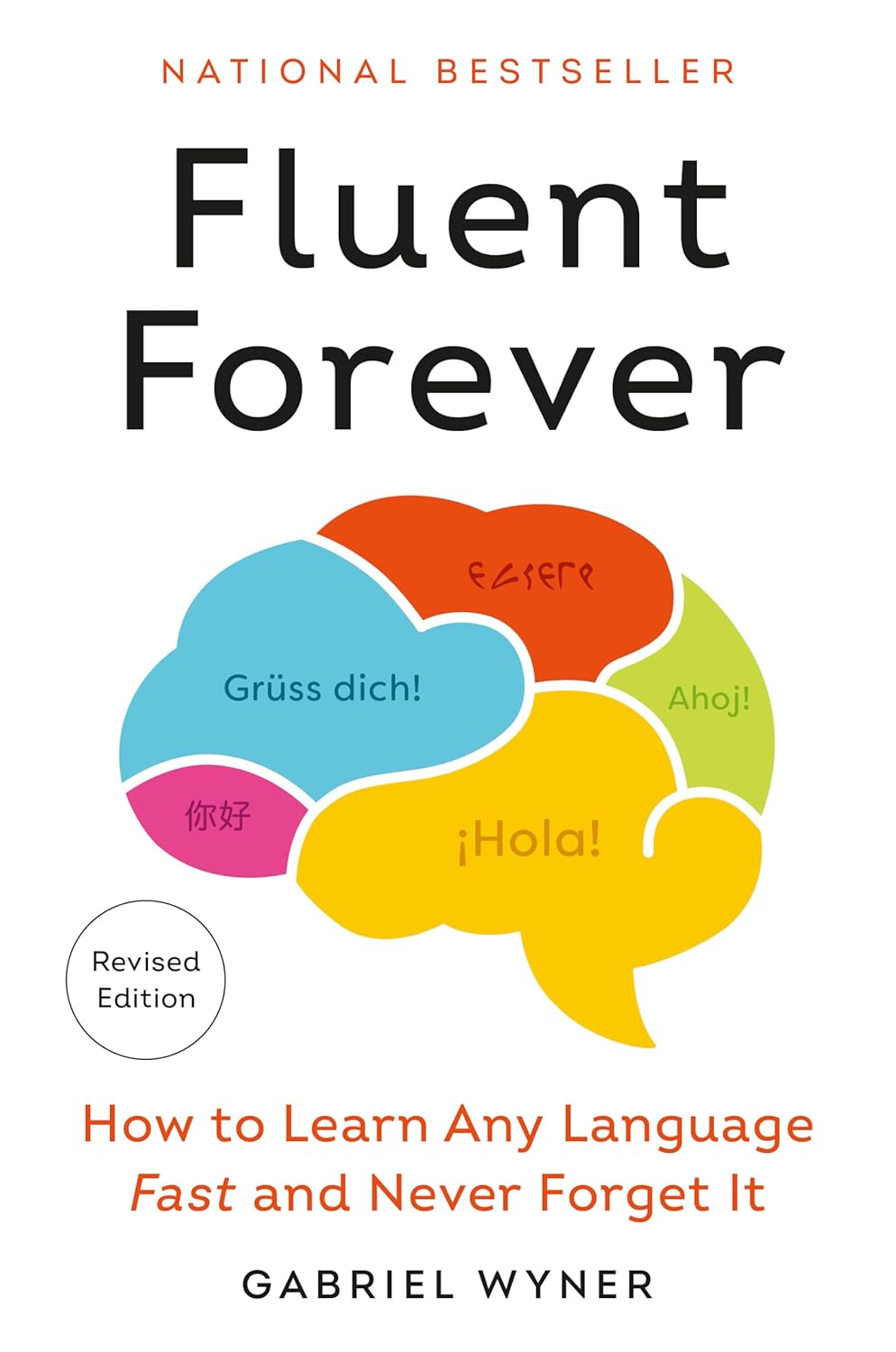
Fluent Forever (Revised Edition): How to Learn Any Language Fast and Never Forget It
Original price was: $17.99.$7.99Current price is: $7.99.
Related Products






The ultimate rapid language-learning guide! For those who’ve despaired of ever learning a foreign language, here, finally, is a book that will make the words stick.At thirty years old, Gabriel Wyner speaks six languages fluently. He didn’t learn them in school — who does? — rather, he learned them in the past few years, working on his own and practicing on the subway, using simple techniques and free online resources. In Fluent Forever Wyner reveals what he’s discovered.
The greatest challenge to learning a foreign language is the challenge of memory; there are just too many words and too many rules. For every new word we learn, we seem to forget two old ones, and as a result, fluency can seem out of reach. Fluent Forever tackles this challenge head-on. With empathy for the language-challenged and abundant humor, Wyner deconstructs the learning process, revealing how to build a foreign language in your mind from the ground up.
Starting with pronunciation, you’ll learn how to rewire your ears and turn foreign sounds into familiar sounds. You’ll retrain your tongue to produce those sounds accurately, using tricks from opera singers and actors. Next, you’ll begin to tackle words, and connect sounds and spellings to imagery, rather than translations, which will enable you to think in a foreign language. And with the help of sophisticated spaced-repetition techniques, you’ll be able to memorize hundreds of words a month in minutes every day. Soon, you’ll gain the ability to learn grammar and more difficult abstract words–without the tedious drills and exercises of language classes and grammar books.
This is brain hacking at its most exciting, taking what we know about neuroscience and linguistics and using it to create the most efficient and enjoyable way to learn a foreign language in the spare minutes of your day.
From the Publisher


ASIN : B00IBZ405W
Publisher : Harmony
Accessibility : Learn more
Publication date : August 5, 2014
Language : English
File size : 41.6 MB
Enhanced typesetting : Enabled
X-Ray : Enabled
Word Wise : Enabled
Print length : 387 pages
ISBN-10 : 9780385348102
ISBN-13 : 978-0385348102
Page Flip : Enabled
Best Sellers Rank: #11,362 in Kindle Store (See Top 100 in Kindle Store) #1 in Memory Improvement (Kindle Store) #1 in Miscellaneous Foreign Language Instruction eBooks #2 in Memory Improvement Self-Help
Customer Reviews: 4.5 4.5 out of 5 stars (3,273) var dpAcrHasRegisteredArcLinkClickAction; P.when(‘A’, ‘ready’).execute(function(A) { if (dpAcrHasRegisteredArcLinkClickAction !== true) { dpAcrHasRegisteredArcLinkClickAction = true; A.declarative( ‘acrLink-click-metrics’, ‘click’, { “allowLinkDefault”: true }, function (event) { if (window.ue) { ue.count(“acrLinkClickCount”, (ue.count(“acrLinkClickCount”) || 0) + 1); } } ); } }); P.when(‘A’, ‘cf’).execute(function(A) { A.declarative(‘acrStarsLink-click-metrics’, ‘click’, { “allowLinkDefault” : true }, function(event){ if(window.ue) { ue.count(“acrStarsLinkWithPopoverClickCount”, (ue.count(“acrStarsLinkWithPopoverClickCount”) || 0) + 1); } }); });
8 reviews for Fluent Forever (Revised Edition): How to Learn Any Language Fast and Never Forget It
Add a review

Original price was: $17.99.$7.99Current price is: $7.99.
Melody –
Engaging and Practical — Perfect for Language Learners on the Go
I loved this book! It’s clear, motivating, and full of practical strategies that make language learning feel achievable. I’ve been listening during my commute, and it’s the perfect companion — easy to follow yet packed with useful insights. I’m especially excited to explore the author’s online resources to put the techniques into practice. Highly recommend for anyone serious about learning (and remembering) a new language!
Thomas Pentzer –
Wyner is an Anki-Ninja!
I’ve been dabbling in learning a second language for some time now, and always seem to lose steam. I had tried various text books, audio courses, and Anki decks that I found in Anki’s database, but never made much progress. That’s where Mr. Wyner’s book came in. I was initially skeptical, but elected to risk the twelve bucks for a copy after I read a guest post by Wyner on Tim Ferriss’ site.In short, it’s worth every penny. Other reviews detail what the book is made up of, so for brevity I won’t include a detailed list. This book’s value, in my opinion, lies in the breadth of techniques Wyner offers the reader. I’m familiar with immersion programs like Middlebury, websites like iTalki, and mnemonic devices, including the PAO system used by memory athletes. However, awareness of such things has only come after years of slogging around on the net, reading books here and there, and talking with professors at my college. Wyner’s book would have shaved years off of my own journey into languages, and he includes many more resources I wasn’t aware of that are worth the price of the book alone (and that’s not even including the FREE resources he links to on his website).Where Wyner truly shines is his mastery of Anki’s software. I have used Anki for some basic vocab stuff before, and had made some flashcards for classes before, but nothing nearly so in-depth as what he recommends. Wyner is truly an Anki-ninja, and clearly one of the beneficent ninjas, as he not only extolls its proper use, but also provides tutorials on how to maximize Anki so that one entry can become up to six flashcards, but also how to make web browsers to the mindless work for you.The icing on the cake is the emphasis on auditory and pronunciation training. By focusing on repeatedly testing minimal pairs (words that are *almost* the same that non-native speakers might not hear the difference between), Wyner asserts that we can indeed begin to hear the difference between speech sounds that we had been unable to distinguish before. He demonstrates how to make Anki cards for this sort of practice, but he’s also in the process of creating “pronunciation trainers” that work within the Anki framework. I don’t mind saying that I’ve pre-purchased the Russian trainer, which will hopefully be out soon.In closing, this book is a great asset for language learners of all sorts. The author wisely avoids getting bogged down in cases, tenses, declensions, etc, as each language has its own unique set of rules to learn. Instead, he brings to light a number of efficient and effective tools that help the learner to spend their time wisely. Having added about a hundred new words into my Russian vocabulary this week through efficient learning, I’m motivated to learn more.
Burkhard Schmorell –
A flawed but useful guide
I am a Board Certified Behavior Analyst who has thought about the topic of second language acquisition extensively, and I was eager to read Wyner’s book as a manual of practical wisdom about language learning. I was delighted by how some of his ideas lined up with ones of my own, but at the same time there are many missteps that I think hinder his readers.On the positive side, Wyner acknowledges that for vocabulary we often learn to translate words from our native language into the foreign one, whereas what we SHOULD be learning is how to seamlessly comment in the foreign language on something we see or feel, without the intermediary step of thinking it out in the native. This jells nicely with ABA research showing that speech-speech connections (intraverbals) are typically weaker than requests (mands) and labeling (tacts), both in terms of retention and in terms of generalization. Wyner is also spot-on to argue against the idea that accent should not be a focus of early learning; the behavior-analytic scientific literature has long shown that errorless learning—getting it right from day one—reduces the likelihood of continued errors after the skill has been mastered. Moreover, Wyner speaks of the importance of forcing oneself to communicate exclusively in the foreign language; having spent time in Dr. Edward Taub’s lab working on ways to test his “learned nonuse” theory of stroke aphasia, I deeply appreciated this insight.But on the negative side, Wyner is firmly entrenched in cognitive neuroscience. Now, while I AM the sort of behavior analyst who is open to ideas in cognitive psychology and neuroscience IF they have practical value (disclaimer: I’m a Relational Frame Theory guy), I also think the sword cuts both ways and cog-neuro guys need to stop ignoring behaviorist ideas and research.Take, for instance, Wyner’s constant refrain that massed grammar drills are ineffective and boring and that spaced repetition is the magic bullet for retaining content. On the contrary, there is a stream of ABA research that shows that massed trials result in superior initial acquisition compared to the interspersed trials Wyner recommends (Hendrickson, Rapp, & Ashbeck, 2014; Majdalany et al., 2014)—or, at the very least, that interspersal probably does not offer any advantage for maintenance (Volkert et al., 2008). There is an equally compelling stream of research that shows that basing a system of target mastery on a single trial—as Wyner’s spaced repetition systems do—typically results in an inaccurate estimate of the student’s skills (Cummings & Carr, 2009; Najdowski et al., 2009; Lerman et al., 2011). While I feel that spaced repetition and Leitner boxes are a valuable technology for consistently scheduling maintenance of previously mastered targets—one that I plan on incorporating into my therapy case load—there just isn’t the research to back it up as a system for *acquisition.* Yes, massed trials can be boring, and no, they don’t seem to offer many advantages in terms of retention; but making 30+ flash cards per day can also be boring, and massed practice is a useful tool for certain jobs.I also find fault with Wyner’s recommendations for memorizing grammar. In short, he advises the use of violent mnemonics and fill-in-the-blank flash cards. What Wyner does not seem to realize—because again, he’s thinking like a cog-neuro guy, not a behavior analyst—is that this introduces the same complications as learning language through translation: it gums up the process with extra steps (in Relational Frame Theory, we would call them “nodes”), and it relies on learning weaker intraverbal relations instead of tacts and mands. What he ought to have done is advise making flash cards that have images that must be described with *sentences.* Yes, mnemonics and fill-in-the-blanks can be useful as PROMPTS if you consistently fail at these full-sentence requests and labels. But to rely on them 100% of the time takes a process that should go like, “See bear riding a unicycle–>comment on bear’s actions,” and belabors it with a middleman, “See bear riding a unicycle–>imagine bear exploding–>comment on bear’s actions.”Along with this come over-simplifications of behavioral science. Wyner repeatedly says, for instance, that “neurons that fire together, wire together” and that the reason why some events are more memorable than others is because they have more associations in the brain. Well, not quite. It is more accurate to say that events that uniquely signal a context in which we can obtain things we find rewarding, wire together with the behavior required to obtain said reward. Events that are contextually irrelevant tend to be forgotten. And it does not really matter how many events are present. What matters is whether the events that *are* present signal a specific reward IN THAT SITUATION. Wyner drops the ball in that he never arrives at the principal of all language-learning principles: Language is contextually functional—language is only learnt if it creates rewarding effects in our current circumstances. Everything else follows from that, and no “layers” of memory or Chomskyan Language Acquisition Device or other theoretical claptrap is necessary.So overall, I give this book four stars. Three because it is highly readable, an additional fourth because it has lots of sound and practical advice and materials, and one lost star because its failure to grasp and apply the central insights of language as *behavior* costs readers what I feel is quite a lot in terms of efficiency.
Mark C. –
I was born in the US, which means I was proficient speaking English but no other languages. I moved to Europe, and learned German the “hard way,” meaning that I did it without really taking meaningful lessons, speaking English most of the time but wanting to speak German. Then I learned a smattering of Russian via audiotapes, which worked ok for directions and restaurants (my husband would like more milk) but not so much for conversation. Now I have taken a job in Slovakia, and there just are not many resources out there for a “small” language with many bigger cousins. Cue Fluent Forever.Positive:1. I really enjoyed reading the book and the author’s style. Light hearted and funny. Really a joy to read2. I am 100% sure that the system will work as advertised. completely convinced that someone will learn a language in record time.Neutral (real life)1. There are no shortcuts in life. Same here. The system requires to painstakingly create flashcards by hand or via a program called Anki. And then practice daily. The end result will be to learn the language as quickly as possible. It is just A LOT OF WORK. And that is the difficulty. It takes an incredible amount of discipline to use this system.Negative1. The web tool the author recommends – forvo.com – no longer allows the downloading of audio files for the correct pronunciation. Not a dealbreaker by any means, but it would be nice if the author updated the website to indicate this.I have started and stopped several times. I am starting again now. It might be easier when learning the language is an absolute necessity, or for a person of leisure who has extra time to drudge away creating and practicing flashcards. The reality (for me) is that the international language of business in English, so it difficult to justify the time investment because I want to build a business and want to devote as much time as possible to that, let alone spend quality time with my family.Having said that, I would recommend this book without reservation for anyone who REALLY WANTS to learn a language. Having tried a few different ways to get somewhat proficient at a few languages, this way is certainly the best that I have experienced. If only I could do it myself.
Thiago Pereira do Vale –
Book very good, I learned a lot insight about it. I’ll read this book again.
The Warwick Reader –
I was slightly sceptical about this book prior to buying/reading as I thought it might not be that beneficial due it’s bias about learning and remembering “any” language rather than just the specific language I am studying, but wow – how wrong am I. This book is an invaluable resource that explains what happens in your mind when you learn a language, and how you can train your mind to be far more efficient, and therefore learn far more than you could without having read the book.In a very simple style, and in places rather humorous text which makes this book fun to read, the author takes you through the processes of what happens in your mind when you learn a new language, and how you can overcome your minds “natural barriers” to learning. By explaining each process or learning stage in detail, and often with well researched (but not overly complicated) examples and charts, the author lays a strong and logical foundation which you can use to start efficiently learning your chosen language or subject.The main methodology emphasises the creation and use of flashcards as the key aid to learning, which might sound tedious and a route that you might have attempted previously, but the author takes the time to explain the benefits and why this process is important. It also allows you to determine your individual learning speed as you can select the words or areas of interest that you want to study and focus on, and also takes you through the process of building the flashcards themselves (in either electronic or paper based format) – as ever, there are pros and cons with each, but again the book will highlight the drawbacks and advantages of each, and allow you to make an insightful decision about which media will be the most beneficial to your leaning style.The layout of the book was also perfect for me, nice short chapters and sections that encouraged you to continue reading, but which also provided natural “stopping” points to review and take in what you have read. The book is also full of fun facts and trivia about language (again, it gives many different examples of all languages rather than focusing on just the one) and the format works incredibly well on my Kindle Paperwhite, with no distorted text (even when using Chinese or Russian lettering) and clear easy to read tables, charts and images.A couple of points worth mentioning, these are not negatives about the book but just something to be aware of: Firstly the book is shorter than I expected, the first 2/3 is the actual text of the book while the second 1/3 is reference material based on the first section (i.e. how to make flashcards, the key 625 words to learn first etc.), however, I still felt the main body of the book was in enough detail and didn’t leave me feeling short changed by my purchase. Secondly, the text often directs you to the author’s website for additional resources such as short videos or pronunciation guides. This might sound like a marketing ploy, but is actually very beneficial – the website is a treasure trove of free information and advice, and also has sections for each language so you can focus on the your specific area of study (i.e. for me it’s Russian). Used in conjunction with the book, the website will add considerable depth to your study.This book is an absolute essential if you are just about to start learning your first foreign language. It will help you understand your minds learning process, and what natural barriers stand in your way. It will provide you with clear and concise targets that will help form the “backbone” of your study, and take you through each stage with well researched and logical techniques which are also rather fun. The book effortlessly explains everything you need to start learning, and most importantly for me, it gives me the confidence, knowledge and enthusiasm required to approach learning my desired language. A really well thought out book that should be an integral part of anyone’s language learning toolkit.
Anya –
While this book does not teach you any language, it does teach you a strong process for going about to learn your language of choice.The first bit is how memory works, not so much a mnemonic memory system like Harry Lorrayne or Domenic O’Brien, but rather the basics of memory such as cramming for tests and the results thereof. The idea it presents, is that the longer we go before attempting to recall information, the better it will stick in the long-term (if we’re still able to recall that information).The core of the book is a memory technique called SRS (something like Strategic Recall System). We basically construct flash cards, with an image on one side and our word (or phrase, gender, context, grammatical rule, etc) on the other. There are several ‘levels’ in the system, with new material placed into ‘level one’ on a daily basis. Anything that is reviewed successfully moves up to the next level. Anything that has been forgotten gets moved back down to level one. Level one is cleared each day (worked through until everything is in level two). Over time, various levels are worked… Day 1, do Levels 1 and 5. Day 2, do Levels 1 and 3 and 7… (or whatever, I just made those up). The rotation is complete every 64 days.If you remember something successfully, at successively greater delays, after enough repetitions it is part of your long-term memory. Anything that was previously remembered but has been forgotten, will be easier to learn the second time (as demonstrated in the early sections of this book), so having the answer to whatever you’re attempting to recall… available as an immediate reminder (on the opposite side of your flash card), reinforces the connection.This book details where to get your images, which words to go for first, which languages are easiest/hardest for a native English speaker (which doesn’t imply you cannot go for a harder language first). It details the importance of the sounds of the language, and how to learn to differentiate between (currently) very similar sounds, until your ear naturally recognizes the distinction between them. It (and the authors website) has free recommendations on tools (not free) for your language, for example a pronunciation guide, and grammar guide, a phrase book, a frequency dictionary, etc… that are good options for your language. The author’s site has free tools, for listening to numerous languages.The approach is logical and the reasons for that approach are explained. I’ve decided to pick up French and Spanish, as an exercise in keeping my mind active. I’m already looking ahead to which additional languages I’d like to do next.
Dawid Izydor –
I really liked the intro about how learning works and it gave me a lot of really nice insight into improving on learning. However after a couple of chapters you start getting referenced to the autor’s website rather often – where you can buy his anki cards.Honestly, if you like theoretical knowledge about learning then this book is great but you could also skip it, go directly to authors website and just buy his anki cards instead