
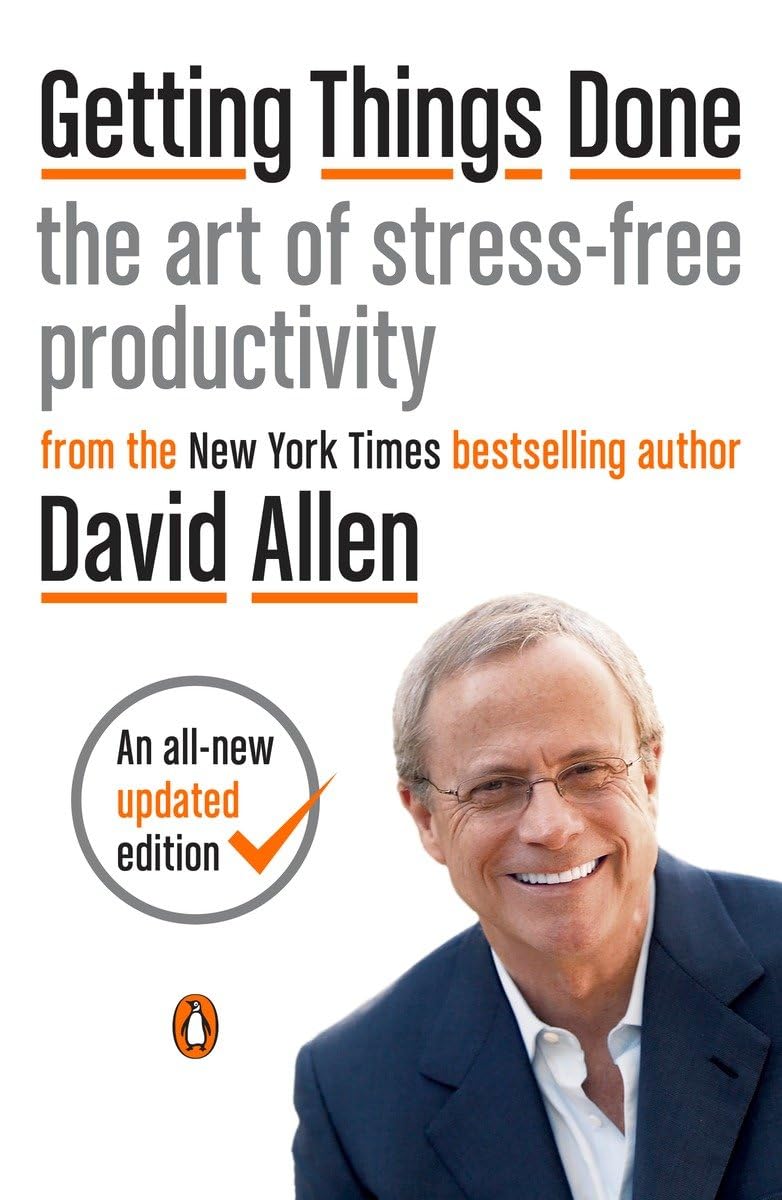
Getting Things Done: The Art of Stress-Free Productivity
Original price was: $20.00.$9.74Current price is: $9.74.
Related Products



One of Daniel Pink’s 13 Books to Read Before 30
The book Lifehack calls “The Bible of business and personal productivity.”
“A completely revised and updated edition of the blockbuster bestseller from ‘the personal productivity guru'”—Fast Company
Since it was first published almost fifteen years ago, David Allen’s Getting Things Done has become one of the most influential business books of its era, and the ultimate book on personal organization. “GTD” is now shorthand for an entire way of approaching professional and personal tasks, and has spawned an entire culture of websites, organizational tools, seminars, and offshoots.
Allen has rewritten the book from start to finish, tweaking his classic text with important perspectives on the new workplace, and adding material that will make the book fresh and relevant for years to come. This new edition of Getting Things Done will be welcomed not only by its hundreds of thousands of existing fans but also by a whole new generation eager to adopt its proven principles.
From the Publisher

Publisher : Penguin Books
Publication date : March 17, 2015
Edition : Revised ed.
Language : English
Print length : 352 pages
ISBN-10 : 0143126563
ISBN-13 : 978-0143126560
Item Weight : 11.2 ounces
Dimensions : 5.52 x 0.8 x 8.38 inches
Best Sellers Rank: #3,655 in Books (See Top 100 in Books) #2 in Time Management (Books) #4 in Personal Time Management #76 in Motivational Self-Help (Books)
Customer Reviews: 4.5 4.5 out of 5 stars (10,528) var dpAcrHasRegisteredArcLinkClickAction; P.when(‘A’, ‘ready’).execute(function(A) { if (dpAcrHasRegisteredArcLinkClickAction !== true) { dpAcrHasRegisteredArcLinkClickAction = true; A.declarative( ‘acrLink-click-metrics’, ‘click’, { “allowLinkDefault”: true }, function (event) { if (window.ue) { ue.count(“acrLinkClickCount”, (ue.count(“acrLinkClickCount”) || 0) + 1); } } ); } }); P.when(‘A’, ‘cf’).execute(function(A) { A.declarative(‘acrStarsLink-click-metrics’, ‘click’, { “allowLinkDefault” : true }, function(event){ if(window.ue) { ue.count(“acrStarsLinkWithPopoverClickCount”, (ue.count(“acrStarsLinkWithPopoverClickCount”) || 0) + 1); } }); });
9 reviews for Getting Things Done: The Art of Stress-Free Productivity
Add a review

Original price was: $20.00.$9.74Current price is: $9.74.
Canadian eReader –
This is the go-to book for the GTD methodology
Self help is not a genre of books I read very often, but I made an exception for David Allen’s Getting Things Done: The Art of Stress-Free Productivity. One of my goals for 2017 was to become better organised and to be more productive. I first learned about the GTD methodology through Carl Pullein’s YouTube channel that I follow. I’ve been working on this for around six weeks now, so it’s too early to tell, but I’m happy with what I’ve learned so far.Getting Things Done, or GTD, is a productivity methodology based on a few deceptively simple concepts. Now, I’m still very new to GTD, but this is how I see it. One of the fundamental ideas behind GTD is that the human brain is excellent at processing ideas and being creative, but not a great storage facility. A key part of GTD is getting all ideas, projects and commitments out of your brain and into a trusted system or external brain.There are five activities to GDT: Capture, Clarify, Organise, Reflect and Engage. If I can take from the GTD website, this translates to:Capture: Collect what has your attention. For me, this means adding all my ideas, commitments and to-dos in my list manager application of choice, Todoist. I really love this application and regret that I don’t have it at work. I try to capture everything from my doctor’s appointments, to buying cat food for Lushka to a reminder to ask my husband if we have picture hooks. I’m planning a trip to Europe this summer, so any time I think of something like oh, I must remember to get Swiss francs, into Todoist it goes.Clarify: Process what it means. Here I can’t be any more concise than or as clear as the workflow diagram on the GTD website:GtdHonestly, if I take away nothing more from my experience with GTD than the two minute rule (if you can do it in two minutes, do it now, otherwise delegate it or defer it) and the discipline to define the next physical action to move a task along it will have been worth it.Organise: Put it where it belongs. This is probably the area of GTD that’s least intuitive for me – I’m not very organised! At the very least, I try to put any appointments on my calendar, any tasks in the appropriate section of Todoist, and potentially relevant non-actionable information in Evernote. One interesting aspect of GTD is the use of contexts. This means organising your tasks not by priority but by the tools, location, and/or person you need to be able to complete them successfully. So, for example, in my Taxes 2016 list I have an item; pick up tax receipt from pharmacy. I tagged that as “pharmacy” along with other items like pick up Polysporin and drop off new prescription. So when I go to the pharmacy I just check that tag to be reminded of all the things I have to accomplish while I’m there. Similarly, while planning my trip to Europe I have a context of Susanne, the friend I’m visiting. Any time I think of something I need to ask her, I add it to that list of things to discuss next time I call or email her.Reflect: Review your to do list and calendar frequently. The idea here is to keep your “external brain” current with everything that you need to accomplish. If you don’t add to it or clear our stale items, your real brain will no longer trust your system and it will break down. Most GTDers do a review at least once a week.Engage: Simply do. Pick the tasks that are available to you based on your contexts and get cracking!The book itself is very well written and the edition I have was updated in 2015 to include discussion of new technology (not specific applications) and how it impacts the GTD workflow.if you are interested in improving your productivity and generally getting things done you could do a whole lot worse than to check out this book.I gave Getting Things Done: The Art of Stress Free productivity five stars out of five.
Krishna Rao –
Even if you are motivated and hard-working, it can still be hard to get things done. This book with help.
This is a life-changing book. I am not in business but have to function in various domains: working scientist with 20-30 discrete, concurrent, collaborative projects at any given time; teacher; physician; mentor; member of various administrative committees; family man; and avid hobbyist with multiple pursuits. I don’t need to read more of the usual inspirational / motivational crap; I’m already highly motivated and willing to work hard, but just needed something to help me organize and get a handle on all the demands placed on me. I’d used calendars and to-do lists like most people but this was not enough.The central message of this book of getting one unified system in place for all projects / tasks in your life and getting things quickly off your mind and into the system is simple yet profound. There is an upfront cost on the order of days, especially if you have a lot on your plate, to get started with such a system. Once you do this, however, keeping it going really only involves a few minutes a day and about 30-60 minutes once a week during a step he calls the weekly review. The key elements that I found helpful: 1) Immediate processing of tasks as they come in (do it if quick, delegate it to others if appropriate, or put it in your system with the appropriate flags; 2) Contexts. it doesn’t make sense to look at a list of errands that can only be done on the computer when you are traveling without one or walking the dog. Having each task be assigned to a context (which can be a virtual or physical location) and being able to pull a context-specific list when you are in that context is incredibly helpful; and 3) Next actions. There is a distinction drawn between things that need to happen next (i.e. in the next week) and things that just need to happen at some point in the future. Everything gets tracked, but not everything needs to show up on your context-specific list; just the “next actions.”This helped me get my life in order and relieved a lot of stress. I no longer worry constantly about what I should be doing because I always know, in any specific context at home or at work, what tasks I have already decided need to happen. Since I also put everything into the system that I trust and know works, I also don’t miss things the way I used to.
Mel –
Easy to follow and to “take action”
I bought the paper-covered book, which was recommended by my friend. I had only read a few pages to get the summary of it, and I’ve already read a lot of useful advice given, very inspirational. It also included step-by-step action that readers can follow! Continue to look forward to reading more and commenting.
Giovanni Molliner –
Such a great tool to change how you organize your life
This book has given me tools and techniques that I have applied to all areas of my life and every day something comes up that I have taken from this book.
Cliente Amazon –
Já conhecia o método do GTD por leituras em blogs especializados, mas ler o livro e entender as ideias de seu criador foram esclarecedoras para finalmente colocar o sistema para rodar plenamente. Mais do que um sistema, David Allen ensina axiomas e dá dicas de como manter os trilhos e ser mais produtivo sem se tornar estressante. Vale a leitura e aplicação para uma vida mais plena
alok pole –
Excellent read for every professional
NoneOfYourBusiness –
Just by reading it, I am just convinced that it should be mandatory to read it a few times starting middle-school, really.Scientiffically, your brain is not very good at remembering all the things you have to remember out of the blue. having those thoughts marked somewhere helps your brain realease stress, and save a lot of energy.Having a proactive approach and do the think-work in the front-end (when you idea arrives, or when you realize you remembered that you have something to do) really changes your whole life…I hope the author is having a great life, and I thank him a LOT for writing this, and make it accessible.
Dhillon –
Great book, I recommend
Víctor –
ACTUALIZACION: 2021Al escribir esta review había empezado a aplicar algunos de los primeros consejos e ideas y noté una mejoría en la forma de gestionar el tiempo y acabar proyectos y tareas pendientes. Esto hizo que fuese dejando el libro y dedicarme a otras cosas, sin acabarlo completamente. Esto fue un error.El libro da todo su potencial cuando lo lees sin pausa. No significa que no vayas aplicando algunas de las ideas y pensando como ir aplicandolas a tu dia a dia, pero sí que no debes perder de vista el objetivo, que no es otro que aprender de forma consistente cómo mejorar la organización personal y profesional del tiempo y el trabajo.Lo anterior es importante tenerlo claro: hay que dedicarle esfuerzo a pensar sobre cómo aplicar las ideas del libro a tu vida y tu flujo de trabajo, proyectos, etc. No basta con leer el libro, sino que hay que dedicarle algo de esfuerzo en diseñar tu sistema de organización. Pero los beneficios son enormes, así que animo a hacerlo.En particular, aproveché una semana de vacaciones para dedicarme a leerlo a fondo desde el principio, tomando notas en lugar de intentar crear sobre la marcha un sistema de organización a medio hacer. Lo mejor es ir apuntando las ideas o formas de usar sus consejos y esperar a aplicarlo hasta acabar el libro, porque cuando ves el conjunto global, te das cuenta que no son ideas sueltas, sino que es un sistema de principios completo. Por tanto, cuando lo acabes tendrás una idea mucho mejor y más completa de cómo montar tu propio sistema de organización. Y que conste que lo reelerás más de una vez para revisar conceptos y adaptar el sistema a los cambios que ocurran al pasar el tiempo. De ahí que actualice esta review: voy a releerlo para reajustar y volver a ser igual de eficiente como cuando lo acabé la primera vez.————————————————————————————-Cuando compré el libro, sabía que tenía un problema con mi sistema de organización. Así que me puse a leerlo inmediatamente. Lo cierto es que tenía algunas dudas, porque había leído otros del mismo tema que no pasaban de expresar lo obvio y de sugerir sistemas que le funcionaban al autor, pero no se adaptaban a mí. Pero este libro sí es bueno.No es como los anteriores, una simple guía de recetas. Sino que desmenuza los fundamentos básicos e, incluso, la psicología que implica un buen sistema de organización. Además, explica en cada paso el motivo de cada proceso o cada sugerencia. Lo que me encanta del libro es que no ofrece un sistema dise;ado y definido, sino que por medio de ejemplos va hasta el principio general que quiere explicar y eso permite que uno pueda adaptar o modificar las ideas a su propia forma de trabajar y a su propio tiempo. Quizá esto haga que algunas partes se hagan más largas, pero es muy recomendable.Lo que más me impactó fue la parte psicológica. En el libro explica uno de los principales problemas que tiene la gente que fue buscando su ayuda y es dejar tareas o cosas en una lista de pendientes, sin pararse a determinar las acciones que han de realizar para finalizar esa tarea. Como ejemplo: la tarea “solucionar problema con factura luz” debería dividirse en realidad en varias, siendo la primera, probablemente “Localizar número de atención al cliente de la compania”, luego llamar (para algunas personas, eso requiere planificar la llamada en su agenda diaria), y de ahí, depende de la respuesta, se seguirán más pasos o no. Lo que comenta es que al compactar tantas tareas en un solo item, en realidad estamos obligandonos a dedicar mucho espacio mental a esa tarea y salvo que tengamos tiempo de sobra, probablemente se nos atasque un buen tiempo en la lista. De la otra forma, un dia damos por cerrada la tarea de localizar el numero. Otro, cerramos el de la llamada, otro el de enviar los datos que nos hayan pedido… Y el efecto psicologico de sentir que vamos resolviendo el problema es brutal. Porque ya no es el mismo item desde hace dias, sino que es el mismo asunto, pero con acciones mas concretas y simples.El libro esta lleno de ideas de este tipo que, una vez leídas, suenan muy obvias, pero es algo en que mucha gente (al menos yo) fallaba constantemente. Un libro imprescindible para cualquier persona con poco tiempo o que tiene problemas para gestionar su tiempo de forma eficiente.Como nota final diré que aún no he terminado el libro (llevo más de la mitad) porque es un proceso, no solo una lectura. Sin embargo, ya puedo confirmar que he mejorado la gestión de mis obligaciones y del tiempo en general, así que no puedo más que recomendarlo.