

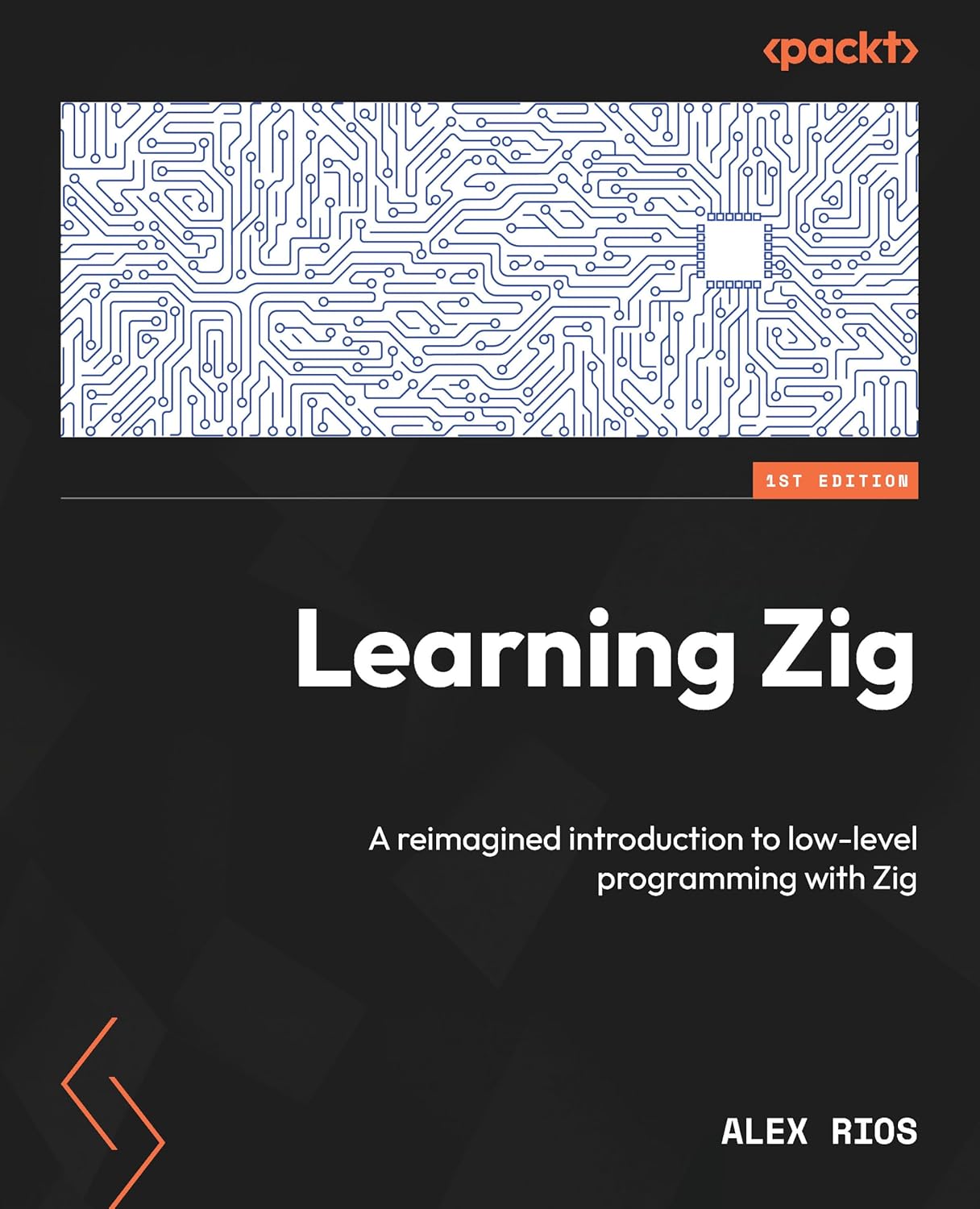
Learning Zig: A reimagined introduction to low-level programming with Zig
$44.99
Related Products


Master Zig’s blend of safety and performance by building real-world systems applications, and learn memory management through to compile-time execution to create reliable software with full control and zero hidden behaviors
Key FeaturesWrite high-performance code with Zig’s clear, no-surprises approach to control flowDiscover memory management techniques to get complete control without sacrificing safety or introducing complexityBuild portable apps with Zig’s powerful build system and seamless C interoperability for real-world problem-solvingPurchase of the print or Kindle book includes a free PDF eBookBook Description
System programming has long forced developers to choose between safety and performance, but Zig changes the game with its no hidden control flow philosophy and explicit resource management. If you’ve struggled with memory leaks, undefined behavior, or cryptic compiler errors, Zig offers an alternative that puts you back in control.
Alex Rios, a seasoned software engineer with experience building high-throughput systems across fintech, telecom, and gaming industries, brings his unconventional system design approach and offers insight into Zig, as someone who’s seen the limitations of existing languages firsthand.
You’ll get to grips with Zig’s safety-centric design fundamentals, which will guide you through setting up your app development environment and writing your first programs. You’ll then explore Zig’s distinctive features in depth, such as explicit error handling, manual memory management, and compile-time execution. The book tackles each topic with a blend of technical depth and wit, ensuring you grasp not just the how but also the why behind Zig’s design decisions.
By the end of this book, you’ll be ready to build a complete application that interacts with the OS, third-party libraries, and C dependencies, as well as engage with Zig’s growing community and contribute to its ecosystem.
What you will learnFind out how to maintain low-level control over system resourcesSet up a Zig development environment across different operating systemsOrganize maintainable projects with proper structure and build systemsImplement error handling using Zig’s unique approach to managing failuresLeverage Zig’s standard library effectively for everyday programming tasksBuild applications that use files, external libraries, and C codeCross-compile and package Zig applications for multiple platformsWho this book is for
This book is for developers looking to master efficient and safe programming with Zig. The target audience includes system programmers exploring manual memory management and safety features, embedded systems developers building high-performance software, WebAssembly enthusiasts creating web applications, programmers transitioning from Go or JavaScript for better control over memory and performance, and C/C++ developers seeking simplicity and low-level control without sacrificing safety or performance.
Table of ContentsSafety FirstSetting Up Your PlaygroundYour First Zig ProgramControl Flow, Loops, and Other Forms of Digital DominationFunctions for the Efficient ProgrammerTesting Your Zig CodeOrganizing DataError HandlingMemory ManagementThe Standard LibraryPackaging and Distributing Your Zig MasterpiecesSophisticated TopicsReal-World Projects Built with Zig
Publisher : Packt Publishing
Publication date : November 7, 2025
Language : English
Print length : 502 pages
ISBN-10 : 1835085121
ISBN-13 : 978-1835085127
Item Weight : 1.88 pounds
Dimensions : 7.5 x 1.14 x 9.25 inches
Best Sellers Rank: #399,632 in Books (See Top 100 in Books) #158 in Introductory & Beginning Programming #284 in Software Development (Books) #510 in Programming Languages (Books)
Customer Reviews: 4.7 4.7 out of 5 stars (4) var dpAcrHasRegisteredArcLinkClickAction; P.when(‘A’, ‘ready’).execute(function(A) { if (dpAcrHasRegisteredArcLinkClickAction !== true) { dpAcrHasRegisteredArcLinkClickAction = true; A.declarative( ‘acrLink-click-metrics’, ‘click’, { “allowLinkDefault”: true }, function (event) { if (window.ue) { ue.count(“acrLinkClickCount”, (ue.count(“acrLinkClickCount”) || 0) + 1); } } ); } }); P.when(‘A’, ‘cf’).execute(function(A) { A.declarative(‘acrStarsLink-click-metrics’, ‘click’, { “allowLinkDefault” : true }, function(event){ if(window.ue) { ue.count(“acrStarsLinkWithPopoverClickCount”, (ue.count(“acrStarsLinkWithPopoverClickCount”) || 0) + 1); } }); });
4 reviews for Learning Zig: A reimagined introduction to low-level programming with Zig
Add a review

$44.99
Raydelto Hernandez –
Very well written Zig book.
This book is very well written, from Alex’s experience. It is written in a way that is easy to understand it. You can get the most out of it if you already know C, as it is often used as reference throughout the book. I enjoyed the comparison that Alex makes throughout the book between Rust and Zig. Alex explains in the book why he, being a Go developer, decided to use Zig for a project which led him to delve into this friendly yet powerful language.This book has awakened in me a passion for this awesome language, which I now have in my repertoire for future software architecture desicions. I highly recommend this book to all programmers who want to create high performant & memory-safe software.
Om S –
A Helpful Beginner’s Guide to Learning Zig
This book gives a clear and friendly introduction to Zig for anyone new to the language.It explains memory management, errors, and system-level concepts in a way that feels easier to follow.The examples are practical and show how Zig works without surprising behavior.I liked that it covers real-world projects and shows how to work with C code too.Some parts could be more detailed, but it’s still a useful starting point.Overall, a good book if you want to understand Zig’s approach to safe and fast programming.
Jonathan Reeves –
Mastering Zig: Safety, Control, and Performance Without Compromise
This book positions itself as both a practical introduction to Zig and a manifesto for a new way of thinking about system programming—and it largely succeeds on both fronts. From the opening chapter, Safety First, the author makes it clear that this isn’t just another “learn a language” guide. Instead, it’s a carefully structured argument for Zig’s philosophy: no hidden control flow, explicit memory management, and a strong commitment to correctness without sacrificing speed.Alex Rios brings a convincing voice to the material. His background in fintech, telecom, and gaming comes through in the examples and trade-offs he highlights. Rather than presenting Zig as a silver bullet, he treats it as a pragmatic tool for developers who are tired of memory leaks, undefined behavior, and inscrutable compiler errors. The book feels grounded in reality, full of insights that clearly come from hard-earned experience rather than theory alone.One of the book’s biggest strengths is how approachable it makes Zig’s core ideas. Early chapters walk you through setting up your development environment and writing your first programs without overwhelming you, while later sections gradually introduce more advanced topics such as compile-time execution, manual memory management, and Zig’s distinctive error handling model. Each topic is handled with clarity and just enough humor to keep the material engaging without becoming distracting.The chapters on error handling and memory management deserve special mention. Zig’s explicit approach can feel intimidating to developers coming from higher-level languages, but the book breaks these concepts down in a way that makes them not only understandable, but appealing. By the time you reach the more advanced sections, you’re no longer questioning why Zig does things differently—you’re starting to appreciate the power that difference gives you.The practical reach of the book is another major advantage. This isn’t just about syntax and theory; it’s about building real software. You’ll learn how to work with files, integrate third-party libraries, interact with C code, and package cross-platform applications. By the final chapters, you’re not just reading about Zig—you’re applying it in real-world projects that mirror what you’d encounter in production environments.Overall, this is an excellent and well-rounded guide to Zig. It respects the reader’s intelligence, doesn’t shy away from complexity, and rewards curiosity with genuine understanding. If you’re interested in a language that gives you control without sacrificing safety, this book is a thoughtful, practical, and highly recommended starting point.
Paul Pollock –
Great Introduction to Zig
I’m new to Zig, but I come from a deep background in Dynamics 365 F&O, Power Platform, and Generative AI—so I’m used to high-level abstractions, rapid prototyping, and platforms that handle a lot of complexity for you. Learning Zig was a refreshing change of pace. The book’s tone is approachable and witty, making the world of systems programming feel accessible even if you’re more familiar with business apps and cloud automation than with pointers and memory management.What stood out to me is how the author explains not just the “how,” but the “why” behind Zig’s design—like explicit error handling, manual memory management, and the absence of hidden control flow. The book is packed with hands-on examples, practical quizzes, and a real-world project (a file monitoring tool) that ties everything together. If you’re used to the Power Platform’s drag-and-drop or AI’s high-level APIs, you’ll appreciate how Zig gives you full control, but with modern safety features and a surprisingly friendly learning curve.If you already know how to code and want to understand what’s happening under the hood—maybe to build faster, more reliable integrations or just to expand your technical horizons—this book is a great starting point. It’s not for total beginners, but if you’re curious about systems programming and want a resource that’s both practical and entertaining, Learning Zig is easy to recommend.