
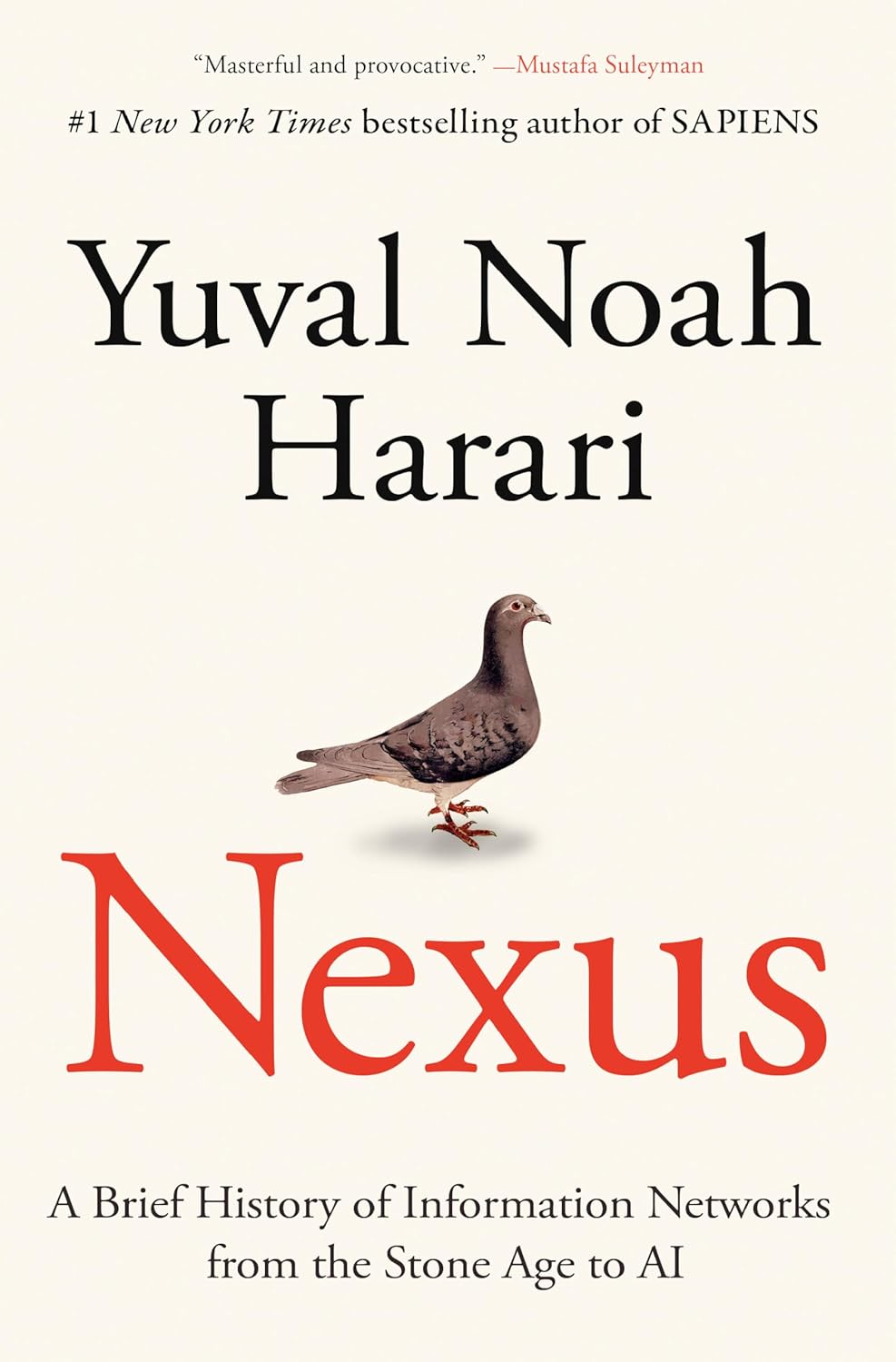
Nexus: A Brief History of Information Networks from the Stone Age to AI
Original price was: $35.00.$14.45Current price is: $14.45.
Related Products



#1 NEW YORK TIMES BESTSELLER • From the author of Sapiens comes the groundbreaking story of how information networks have made, and unmade, our world.
“Strikingly original . . . A historian whose arguments operate on the scale of millennia has managed to capture the zeitgeist perfectly.”—The Economist
“This deeply important book comes at a critical time as we all think through the implications of AI and automated content production. . . . Masterful and provocative.”—Mustafa Suleyman, author of The Coming Wave
For the last 100,000 years, we Sapiens have accumulated enormous power. But despite all our discoveries, inventions, and conquests, we now find ourselves in an existential crisis. The world is on the verge of ecological collapse. Misinformation abounds. And we are rushing headlong into the age of AI—a new information network that threatens to annihilate us. For all that we have accomplished, why are we so self-destructive?
Nexus looks through the long lens of human history to consider how the flow of information has shaped us, and our world. Taking us from the Stone Age, through the canonization of the Bible, early modern witch-hunts, Stalinism, Nazism, and the resurgence of populism today, Yuval Noah Harari asks us to consider the complex relationship between information and truth, bureaucracy and mythology, wisdom and power. He explores how different societies and political systems throughout history have wielded information to achieve their goals, for good and ill. And he addresses the urgent choices we face as non-human intelligence threatens our very existence.
Information is not the raw material of truth; neither is it a mere weapon. Nexus explores the hopeful middle ground between these extremes, and in doing so, rediscovers our shared humanity.
From the Publisher


Publisher : Random House
Publication date : September 10, 2024
Language : English
Print length : 528 pages
ISBN-10 : 059373422X
ISBN-13 : 978-0593734223
Item Weight : 2.31 pounds
Dimensions : 6.5 x 1.55 x 9.53 inches
Best Sellers Rank: #5,686 in Books (See Top 100 in Books) #2 in Cultural Anthropology (Books) #4 in Artificial Intelligence & Semantics #5 in History of Civilization & Culture
Customer Reviews: 4.6 4.6 out of 5 stars (9,291) var dpAcrHasRegisteredArcLinkClickAction; P.when(‘A’, ‘ready’).execute(function(A) { if (dpAcrHasRegisteredArcLinkClickAction !== true) { dpAcrHasRegisteredArcLinkClickAction = true; A.declarative( ‘acrLink-click-metrics’, ‘click’, { “allowLinkDefault”: true }, function (event) { if (window.ue) { ue.count(“acrLinkClickCount”, (ue.count(“acrLinkClickCount”) || 0) + 1); } } ); } }); P.when(‘A’, ‘cf’).execute(function(A) { A.declarative(‘acrStarsLink-click-metrics’, ‘click’, { “allowLinkDefault” : true }, function(event){ if(window.ue) { ue.count(“acrStarsLinkWithPopoverClickCount”, (ue.count(“acrStarsLinkWithPopoverClickCount”) || 0) + 1); } }); });
8 reviews for Nexus: A Brief History of Information Networks from the Stone Age to AI
Add a review

Original price was: $35.00.$14.45Current price is: $14.45.
Gary Moreau, Author –
Like everything else, AI exists in context
Harari is an extremely lucid author who excels at distilling the complex into the simple. As in all his books, he seamlessly takes the reader from the distant past to the present to the future. In this case his subject is information and the networks we use to manage and disseminate it. As such it is, but isn’t, a book about AI. “My goal with this book is to provide a more accurate historical perspective on the AI revolution.”In many ways, it is a book about politics, although the author never names names or talks in terms of blue and red. And his canvas is global and spans history. He does, however, talk about democracy, populism, totalitarianism, and such, terms that are being bandied about a lot in the US this election year. And that, I suspect, is why the reviews of the book vary so widely. We are a polarized nation and want to inject politics into just about everything.Harari, however, is not a politician or political commentator. He is an historian who, of course, has not defined that history. His job is to spot the patterns. And in this case the pattern has a political implication. “Democracy and dictatorship are typically discussed as contrasting political and ethical systems. This chapter seeks to shift the terms of the discussion, by surveying the history of democracy and dictatorship as contrasting types of information networks.”Which ultimately, of course, brings us to AI. The author correctly notes that AI is different from all prior information networks (e.g., printing, the telegraph, the Internet, the pre-modern church, etc.) in that it is the first network capable of acting independently of humans. And, as a result, it deserves special consideration, both for its opportunity and its menace.Adding a bit of gravity and urgency to the matter, Harari notes: “The main argument of this book is that humankind gains enormous power by building large networks of cooperation, but the way these networks are built predisposes us to use that power unwisely. Our problem, therefore, is a network problem.”Harari, among many other prominent voices, as a result, argues that we must manage the future application of AI. I agree. Our tech leaders, unfortunately, have shown themselves to be as independent of oversight as AI itself. And given the enormous amounts of capital that AI will undoubtedly unleash, my personal fear is that Silicon Valley, at Wall Street’s urging, will unleash AI before there is any public consensus on its application. After all, that is what they have done at every step of the digital revolution. They routinely release powerful new products that must almost immediately be updated to fix flaws and security oversights in their design. The earliest pioneers of the internet, as but one example, now readily admit that they did not foresee the degree to which it could be abused by malevolent actors. With AI, however, we may not get the chance to address the problems in retrospect.As part of its mission, the book also offers a plethora of insights into several important underlying currents of thought and conviction important to current culture. Some of my favorite quotes:“But power isn’t wisdom…”“The naïve view [of information] thinks that disagreements about values turn out on closer inspection to be the fault of either the lack of information or deliberate disinformation.”“History isn’t the study of the past; it is the study of change.”“However, democracy doesn’t mean majority rule; rather, it means freedom and equality for all.”“It is particularly crucial to remember that elections are not a method for discovering truth. Rather, they are a method for maintaining order by adjudicating between people’s conflicting desires.”“…information isn’t truth.”In the end, I believe it is an author’s job, with few exceptions, not to tell us what to believe, but to make us think. And with this book, in addition to his many others, this author has done just that. I do believe, therefore, that this book is worth every reader’s time. You won’t agree with everything he says. I didn’t, either. And it is true that the higher you take the camera the simpler the landscape looks, to the point of causing you to make erroneous conclusions about what you see. Not all patterns have meaning. Sometimes they are just patterns.
Bill Breuer –
What will happen when our knowledge of our world will be shaped by AI, a medium with its own agenda?
This is a beautifully written and elegantly reasoned account of how humanity was shaped by revolutions in the way information and knowledge were recorded by and transmitted among humans. Until now, all these media were fixed and passive, in that they necessitated a human interpreter and inevitably have been used for both good and evil. Today we depend on AI to digest and interpret the continual avalanche of information flooding us. This wonderful book looks with a clear and unbiased eye at the potential of AI to be used for both good and evil and is not afraid to look into how this might occur in the future. It is impressively researched, full of illuminating examples from human history and simply a pleasure to read.
A. Menon –
Definitely worth reading though not a good compass for navigating the future
Nexus is the latest book by Yuval Noah Harari in which he explores some of the existential questions that concern technology and humanity and their interaction. Starting from a perspective of information and its role in increasing participation or strengthening control the work weaves together a lot of topics to try to give a perspective on how technology is impacting society in some positive but many detrimental ways. He then pursues the topic of AI which he alters the acronym to Alien intelligence to highlight the intrinsic difference in computational schemes that goes into machine technologies and highlights a multitude of scenarios that seem plausible but highly concerning about the embedding of more technology into our social structure. It is a thought provoking book that highlights rational concerns on our future in a technology fueled world but it offers no real policy vision on what to do about it. It does serve as a strong reminder that there are severe consequences to some of our technology roadmaps and they are already impacting us but again what to do about it is the real question not what are imaginable scenarios.The book is split into three parts starting with human networks. The author in his usual style implicitly pokes fun at humanity’s social structure and history of gravitating to mythology and shows how much of history has been about using information and story to create order. Human stories create networks of common purpose far beyond the family unit and thus has been the basis of creating networks that allow for coordination on a scale that no other species can replicate. This is a powerful concept introduced and is also then discussed in the context of democracy and autocracy. The author highlights that the information structure of a democracy is that of greater participation in the information network and in autocracy it is a centralized one. These different style focus on truth and order with different priorities. The author brings up how in autocratic, mimicking religious frameworks the systems are built on the timelessness of the regime for providing solutions and thus infallibility is a pillar of the governance structures. Democracy being an evolving system by construction is more fluid with the potential to get carried in different directions at different times. The author makes it a strong point to highlight that democracy is not majoritarianism but is about the rights of citizens for themselves not the rights of citizens over others.The author moves onto computers and their influence. He highlights the distributed nature of them as well as their permanence in the infrastructure we depend on. The author starts to highlight how the control of this network has changed interaction structures as well as changed the likelihood of survival of autocratic regimes relative to the past. In particular the information gathering networks of today can be processed in real time unlike in the past when piles of papers would be the product of surveillance that the state didn’t have the capacity to process. The author also highlights that networks can perpetuate bias and be error prone.From here the author moves on to the influence of technology on politics and its clear deterioration in recent times. He gives a multitude of scenarios in which platforms with no editorial review that promote user engagement are mere platforms to perpetuate hate and sensationalism. These examples all highlight how the “objective function” that many algorithms are trained to maximize have a negative relationship with human welfare. There is also little consequence of this given the weak regulatory oversight. Despite this problem the author is able to highlight that oversight itself solves little because we don’t know the consequences of changing goals given the complexity of mapping the dynamics of the underlying ecosystem to their conclusions. The author uses some examples where AI evades boundaries to achieve goals highlighting the increasing difficulty in constraining AI in practice. Overall the book highlights the concerns many people have about the direction of technology and the speed at which technology has been disruptive. Unfortunately despite such concerns resonating they do not offer sufficient concern to stop progress nor a blueprint for a dependable oversight structure, which is probably impossible to achieve anyway. This leaves us unfortunately unsettled and without clear solutions.Nexus was a stronger work than Homo Deus and up there with Sapiens. As usual he will likely have an audience which dislikes his style and willingness to poke fun at some of humanities mythologies but the content is deep and the argument construction is well thought out. I definitely think this is a worthwhile read but be prepared to come out of it with no further wisdom on what to do about it.
TheRecorder –
Generally I think I’ve been keeping up with AI developments. That is, until I hear about and test its next mind-bending ability. At which point I realise I was naive in thinking AI would never get this far.That’s where this book comes in.Nexus is partly a history of technologies that convey human thought – from spoken word, stone tablets and books, through to computers, algorithms and AI. Harari has pinned down what was transformational about each technology, how it changed the landscape, and also how it was inevitably misused and exploited by humans. It’s a lot of background, which I wasn’t sure about at first, but by the end it definitely pays off because of the context provided. The book is very accessible and that does mean some repetition when bridging between stories. If you’re new to the field, or are listening to the audiobook, or are dipping in and out, you’ll probably appreciate that memory-jogging.It’s a very thought-provoking read. I didn’t know as much about its historical accounts as its modern ones, and Harari’s style is clear and passionate without straying into emotional even if the subject matter is. The book is also thoroughly researched – I say that not only because of the numerous references, but because when Harari discusses topics I do know well (e.g. algorithms and 21st century), I pretty much always find myself in agreement with the text, which is rare for me. That reassurance meant I was able to get through it very quickly (especially the 2nd half).So why do I say “probably” in my review title? Well, if your job is future forecasting and you have some inside view of this tech that means you see it months or years in advance, then it is mainly the number of striking historical parallels that may enrich your view. But in fact I reckon this book’s content is near-essential for much of the population, just like how we study and learn from major historical or scientific developments. We are all going to be affected by it more and more, unless you live totally off-grid forever. Is there a greater revolution in this time in history than the technological one(s)? This book says no.Today, you can certainly argue about AI’s lack of personality and finesse, its influence in the political spheres and the controversy about the rights of artists and creators it has leveraged/exploited. (I always question now how much of the YouTube video I’m watching was conceived by a human or an AI, and how that affects trust.) But rightly or wrongly, the result is a staggering rate of development 24/7 which can almost be scary. And right now it’s still in its infancy.In a nutshell, I’d say get a hold on this topic while it’s still manageable. That’s what I’m trying to do, and this book deepened my perspective hugely.Received in excellent condition. I wanted a paper copy for quicker reference, though I originally heard the audiobook instead.
Cliente de Kindle –
A must read for every thinking person. The history of the violence-breeding Facebook algorithm in Myanmar I believe it was is particularly shocking. The positive feedback nature of tiktok and the like, rewarding our confirmation biases, may provide a rather simple and disturbing explanation of why tribes like Democrats and Republicans are drifting further and further apart.
Metin Simsek –
Its not as good as sapience and deus
Philippe –
Nous confronte à la réalité de façon concise, clair et précise.
Eric Roelandt –
The evolution of information…From spoken language over writing, printing to the internet.Absolutely worthwhile reading.