
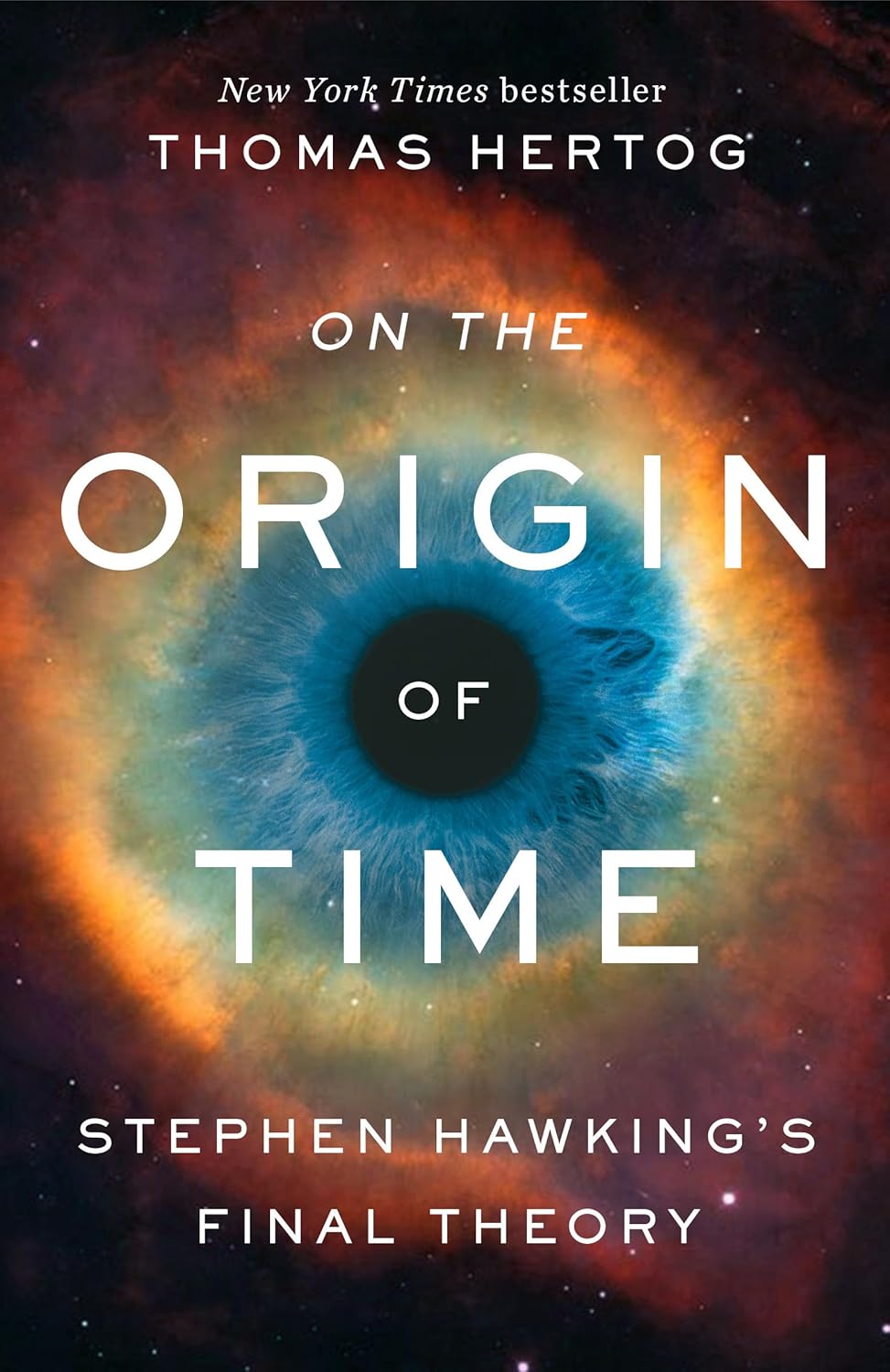
On the Origin of Time: Stephen Hawking’s Final Theory
$4.99
Related Products






NEW YORK TIMES BESTSELLER • Stephen Hawking’s closest collaborator offers the intellectual superstar’s final thoughts on the cosmos—a dramatic revision of the theory he put forward in A Brief History of Time.
“This superbly written book offers insight into an extraordinary individual, the creative process, and the scope and limits of our current understanding of the cosmos.”—Lord Martin Rees
Perhaps the biggest question Stephen Hawking tried to answer in his extraordinary life was how the universe could have created conditions so perfectly hospitable to life. In order to solve this mystery, Hawking studied the big bang origin of the universe, but his early work ran into a crisis when the math predicted many big bangs producing a multiverse—countless different universes, most of which would be far too bizarre to harbor life.
Holed up in the theoretical physics department at Cambridge, Stephen Hawking and his friend and collaborator Thomas Hertog worked on this problem for twenty years, developing a new theory of the cosmos that could account for the emergence of life. Peering into the extreme quantum physics of cosmic holograms and venturing far back in time to our deepest roots, they were startled to find a deeper level of evolution in which the physical laws themselves transform and simplify until particles, forces, and even time itself fades away. This discovery led them to a revolutionary idea: The laws of physics are not set in stone but are born and co-evolve as the universe they govern takes shape. As Hawking’s final days drew near, the two collaborators published their theory, which proposed a radical new Darwinian perspective on the origins of our universe.
On the Origin of Time offers a striking new vision of the universe’s birth that will profoundly transform the way we think about our place in the order of the cosmos and may ultimately prove to be Hawking’s greatest legacy.
From the Publisher


ASIN : B09N73FX8Q
Publisher : Bantam
Accessibility : Learn more
Publication date : April 11, 2023
Language : English
File size : 52.4 MB
Screen Reader : Supported
Enhanced typesetting : Enabled
X-Ray : Enabled
Word Wise : Enabled
Print length : 338 pages
ISBN-13 : 978-0593128459
Page Flip : Enabled
Best Sellers Rank: #105,953 in Kindle Store (See Top 100 in Kindle Store) #23 in Astrophysics & Space Science (Books) #27 in Cosmology (Books) #39 in Cosmology (Kindle Store)
Customer Reviews: 4.5 4.5 out of 5 stars (989) var dpAcrHasRegisteredArcLinkClickAction; P.when(‘A’, ‘ready’).execute(function(A) { if (dpAcrHasRegisteredArcLinkClickAction !== true) { dpAcrHasRegisteredArcLinkClickAction = true; A.declarative( ‘acrLink-click-metrics’, ‘click’, { “allowLinkDefault”: true }, function (event) { if (window.ue) { ue.count(“acrLinkClickCount”, (ue.count(“acrLinkClickCount”) || 0) + 1); } } ); } }); P.when(‘A’, ‘cf’).execute(function(A) { A.declarative(‘acrStarsLink-click-metrics’, ‘click’, { “allowLinkDefault” : true }, function(event){ if(window.ue) { ue.count(“acrStarsLinkWithPopoverClickCount”, (ue.count(“acrStarsLinkWithPopoverClickCount”) || 0) + 1); } }); });

Terry Bollinger –
A good argument against simplistic reductionism
To my surprise, this book is not a glorification of the multiverse concept — Marvel has that turf well-covered these days, yes? — but a thoughtful and considered navigation of the terrifyingly dark and murky waters between Aristotelian absolutism and profligate quantum possibilities. There is, for example, this striking line from the final chapter: “The multiverse evaporates like snow before the sun in quantum cosmology.” I had no idea that the thoughts of Hawking and his associates on the multiverse were this nuanced towards the end of his life.I was fascinated to discover that Hawking vacillated from a bottom-up universe early in his life to a top-down universe later. It would have been fascinating to discuss with him the non-binary alternative that he seems never to have considered: the Matryoshka universe, in which different levels of certainty, complexity, and existence exist simultaneously and nested within each other, with the most robust forming the exterior, and the most significant complexity on the interior. And even without stating that, and despite Hertog declaring a top-down only strategy, he and Hawking and their associates nonetheless seem to have considered, perhaps without recognizing it, a decidedly Russian-doll-like concept in quotes like this one: “… there isn’t the slightest ontological difference between the fact that Christian religions dominated Western Europe … and the value of the anomalous magnetic moment of the electron in the standard model of particle physics. They are both frozen accidents, just at widely different levels of complexity.”It makes sense that the least time-like and most encompassing of Hawking’s “frozen accidents” also form the most stable and encompassing of the layers, and perhaps this is why Hawking refers to this as a top-down universe. Just as a frozen alphabet enables communication and the formation of new levels of linguistic complexity, Hawking’s earliest frozen accidents become the Standard Model of particle physics, allowing us to see and understand the most distant reaches of the visible universe. Also, a fully emergent universe enables the interplay of particles, space, and time, allowing levels of space to proceed those that we know from a classical perspective, just as some simpler particles, such as quarks, join together into more complex particles such as protons and neutrons.Perhaps a top-down universe versus a Matryoshka universe is more a matter of linguistic connotation and preference. Top-down better conveys the concept of a tree with the diversification of complexity in the higher branches than the more linear implication of nested dolls. On the other hand, top-down has an unfortunate connotation of premeditated design that is not what Hawking intended, yet it comes to mind quickly for anyone reading the phrase.However one describes Hawking’s final and more nuanced concept time, this book is a worthy and thought-provoking read.
Doctor Moss –
A Methodological Reversal of Cosmological Theory
Thomas Hertog was a student and then collaborator with Stephen Hawking, working with him right up to Hawking’s death in 2018. This book is a kind of scientific memoir, recounting their thinking together. What makes the book especially interesting is the methodological turn that Hawking and Hertog make, abandoning traditional scientific objectivity. Their approach, in their own terms, flips the perspective from which cosmological theory should be carried out, from that purely objective perspective to an observer-centric, even subjective perspective.There’s more to the book, but I’ll focus on that methodological flip. It’s really the core idea of the book.Hertog starts with a framing question — the question of “fine tuning”. Why and how did the universe produce conditions so well-tuned for the development of life, and, to bring the questions back full circle, of intelligent observers and theorizers of itself? The constants of nature, the strengths of the various forces and other factors, are so finely tuned that even slight variations would have produced a universe empty of galaxies, without the elements of life, or even a universe that would have collapsed upon itself well before galaxies, stars, planets, and life could have developed.Hertog follows a historical path, tracing the history of cosmological thought with an obvious emphasis on what has led to current challenges and stalemates. I appreciated his emphasis on the role of Georges Lemaitre. Lemaitre, a fascinating figure in part because he combined his scientific career with his life as a Catholic priest, was the originator of many core ideas in modern cosmology, including the “primeval atom” (aka “big bang”) and a cosmological model that incorporated the expansion of the universe with a big bang beginning.The current situation in cosmological theory is challenged by the need to merge our best account of gravity, Einstein’s general relativity, with our best account of microreality, quantum theory, to account for the dynamics of the early moments of the universe, the expansion from something like Lemaitre’s primeval atom. The best evidence we have for those earliest moments is the measurement of their energetic remnants, in the cosmic microwave background radiation. Those measurements, the temperature of the remaining energy from the big bang and its minuscule but crucial variations in different directions, provide the best tests we have. Many theoretical proposals and speculations, from the mostly-accepted theory of cosmic inflation to the much more controversial approaches to string theory try to fill the gaps, but nothing has yet passed the tests of mathematical consistency. causal history, and empirical validity.What Hertog and Hawking propose is not a better theory, it’s a different kind of theory, with a different understanding of what science does. The key distinction running through their thoughts is that between “bottom-up” and “top-down” cosmological theories.“Bottom-up” theories are traditional, causality-centered models of how the universe evolved. Within those theories, we run into a big problem, the improbability of our universe (and therefore of us) — the fine-tuning problem. Given that the universe’s history is one of quantum probabilities stacked and networked endlessly together, what kind of universe is likely to have been produced? Not ours, it turns out — specifically the required value for dark energy, governing the strength of the expansion of the universe, would have to be especially and improbably suited to the development of a universe with galaxies like ours, with stars like ours, producing the stable elements we are made of.“Top-down” theories ask a different, even the opposite question. Instead of how the current state of the universe developed from its origin, they ask what history of the universe follows from its current state. This question is, as Hertog says, observer-centric. It starts with the presence of an observer, and asks historical questions leading back from that observer. Thus it traces paths through the past of probabilities realized to a beginning, guided by the current state, as opposed to tracing paths forward from an origin hoping to get where we are now.This is an abandonment of the traditional task of science, to produce an objective account of reality. This approach is tainted by subjectivity, by its starting point with an observer within the reality it attempts to describe.What justifies such a radical methodological reversal?First, there’s the failure of the bottom-up approach. The bottom-up approach fails to explain how we got to the current state. Unless you add multiverse theory and an anthropic principle.Multiverse theory is well motivated by the physics described in bottom-up approaches. I won’t go into details, but the idea is that multiple universes are implied by that physics, not just one, each of those universes realizing different possible values for dark energy. So we have multiple possible universes realized, not just one improbable universe realized. The anthropic principle picks out the universe we observe around us as, necessarily, one of the members of the set of those universes that support the formation of galaxies, stars, and the elements that make us up. It couldn’t be otherwise.But, according to Hertog and Hawking, that anthropic principle has little explanatory value. We are in the type of universe we are in because we couldn’t be in the other ones. You’ll have to let your own thinking settle for you whether that explains anything.The second justification for going top-down in theorizing stems from the picture of reality that quantum mechanics gives us, and particularly the picture given us by a non-standard interpretation of quantum mechanics.Standard interpretations present a picture of an observer conducting experiments that reveal a probabilistic character to the behavior of the particles he observes. The non-standard interpretation (Everettian, named for the physicist who originated it, Hugh Everett) rejects the separation between observer and what she observes — after all, the observer is herself part of the same probabilistic, quantum universe as the particles she observes. She is a quantum phenomenon just as much as the phenomena she observes, and her observations are just as much events in that shared quantum universe as the events she observes. In fact, her observations, the questions she asks and the measurements she takes mix with the particles she observes to produce the results she observes. It’s an observer-relative universe demanding an observer-relative theory.Hertog calls the subjectivity inherent in top-down theorizing “a delicate subjective touch,” saying, “Observers—in this quantum sense—acquire a sort of creative role in cosmic affairs that imbues cosmology with a delicate subjective touch. Observership also introduces a subtle backward-in-time element into cosmological theory, for it is as if the act of observation today retroactively fixes the outcome of the big bang ‘back then.’”Top-down theorizing itself still allows us to ask the question, what do we find when we do follow observations back in time, to the “beginning”? Hertog says that we find no ultimate theory of the universe from beginning to end, a causal story of how the universe came to be and came to be what we see today. That theory would be one that was “of” the universe rather than “in” the universe, and the only theories we can have are theories “in” the universe.In fact, what he claims we find, in the theory that he and Hawking were pursuing at Hawking’s death, was a theory in which what we call the laws of physics themselves evolve, emerging (in my words) as the conditions of sense-making in our theorizing. If you ask what came before what allows us to make sense of the universe, you’re asking a question that can’t be answered. Hertog says, “Our top-down perspective reverses the hierarchy between laws and reality in physics.”I should say that the theoretical framework that Hawking and Hertog were employing at that point is “holographic physics,” which I can’t begin to explain (because I don’t understand it well enough). So I won’t embarrass myself by trying.Hertog doesn’t pull back from his conclusion that there is no final, absolute theory, or to paraphrase him, no Archimedean point outside the universe from which to understand the whole of it. Instead of a final theory, we can construct numerous top-down theories based on different questions and different observations, leading again back to the limit of theorizing withinin rather than from outside of the universe.This is a humanistic turn as well as a turn away from pure objectivity. He cites extensively the remarks of the philosopher Hannah Arendt from a 1963 talk on “The Conquest of Space and the Stature of Man,” in which Arendt emphasizes this recognition that science is the work of scientists within the phenomena they study. Paraphrasing again, knowing is an activity that contributes to the creation of its objects.That to Hertog is the lesson of a thorough attempt at quantum cosmology, incorporating the inextricable role of the observer.Hertog has written a book for a “general audience,” but it’s not one that overly abandons precision and mathematical expression to make its points accessible. This is much more about method than mathematical theory.The fate of what Hertog is talking about here may be unlike how physicists like to think theories are evaluated. It may be rejected on inertial methodological rather than empirical grounds. The practitioners of science may be loathe to give up the idea of an absolute, objectivist theory, and in fact there’s no great movement to rally around “top-down” theorizing as a result of Hertog’s and Hawking’s work. Physicists, including (infamously) Hawking himself, often have strong allergic reactions to what they think of as philosophical thought.
Atinam –
An excellent exposition of one of the most fascinating and difficult subjects. A worthy successor to Hawking’s A Brief History of Time.
Luis Rodríguez Caba –
Se podría decir que es el último libro de Stephen Hawking ya que le pide al autor en un momento de la investigación que es hora de escribir un libro.Cuenta como es la colaboración que les une para buscar una explicación del origen del universo dando detalles de las reuniones e ideas sobre las que desarrollar la teoría.Básicamente conciben una explicación que ellos llaman de arriba-abajo hasta el principio de todo que incluiría la génesis de las propias leyes físicas. Basada en la hipótesis de no-frontera,predice que el principio del universo llevado tan lejos en el tiempo como es posible se mezclaria con el espacio dentro de una esfera de altas dimensiones, encerrando el universo dentro de la nada.El origen del tiempo en la teoría final de Hawking es todo lo que puede ser contado del pasado.Ideas especulativas para deleite de lectores que les guste la cosmología. Muy interesante.
Amr Hefny –
Came in good condition
Robin Primo –
Really nice!
Debyani Saha –
Interesting book