
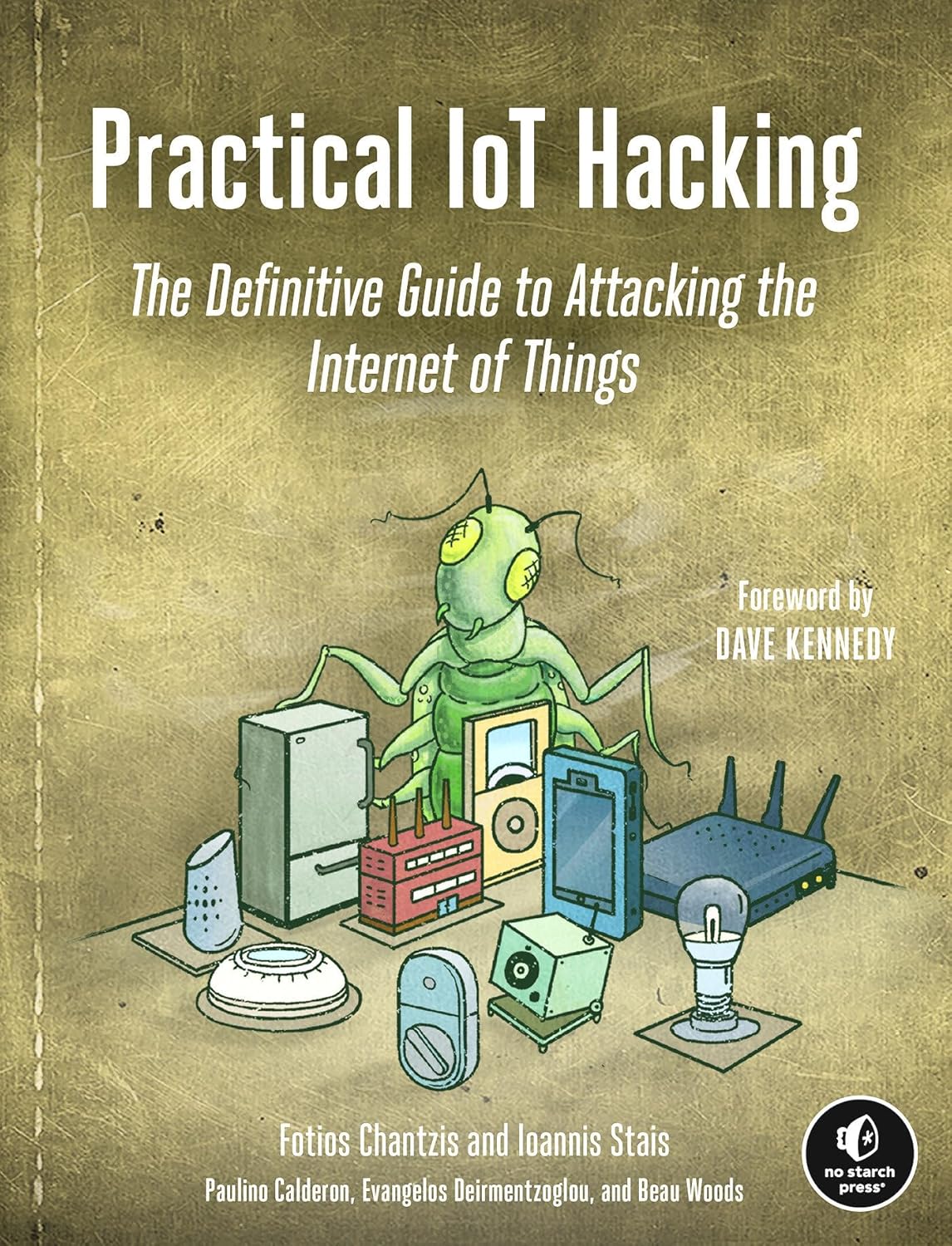
Practical IoT Hacking: The Definitive Guide to Attacking the Internet of Things
Original price was: $59.99.$47.59Current price is: $47.59.
Related Products





Written by all-star security experts, Practical IoT Hacking is a quick-start conceptual guide to testing and exploiting IoT systems and devices.
Drawing from the real-life exploits of five highly regarded IoT security researchers, Practical IoT Hacking teaches you how to test IoT systems, devices, and protocols to mitigate risk.
The book begins by walking you through common threats and a threat modeling framework. You’ll develop a security testing methodology, discover the art of passive reconnaissance, and assess security on all layers of an IoT system. Next, you’ll perform VLAN hopping, crack MQTT authentication, abuse UPnP, develop an mDNS poisoner, and craft WS-Discovery attacks.
You’ll tackle both hardware hacking and radio hacking, with in-depth coverage of attacks against embedded IoT devices and RFID systems.
You’ll also learn how to:
Write a DICOM service scanner as an NSE moduleHack a microcontroller through the UART and SWD interfacesReverse engineer firmware and analyze mobile companion appsDevelop an NFC fuzzer using Proxmark3Hack a smart home by jamming wireless alarms, playing back IP camera feeds, and controlling a smart treadmill
The tools and devices you’ll use are affordable and readily available, so you can easily practice what you learn. Whether you’re a security researcher, IT team member, or hacking hobbyist, you’ll find Practical IoT Hacking indispensable in your efforts to hack all the things
REQUIREMENTS: Basic knowledge of Linux command line, TCP/IP, and programming
From the Publisher


‘Hits the Mark’
“I recommend this book to anyone technical who manufactures IoT devices or anyone with IoT devices in their homes or enterprise. At a time when securing our systems and protecting our information has never been more important, this book hits the mark.”
—Dave Kennedy, founder of TrustedSec, Binary Defense

‘A Precious Resource’
“This book is everything you would want to learn from the subject masters—it is an authoritative and a precious resource that both IoT security researchers and developers will want keep close by. I recommend this book for anyone interested in making IoT more secure.”
—John Moor, Managing Director, IoT Security Foundation

‘Superbly Approachable’
The authors are immediately credible on the topic, the content is superbly approachable, and it’s obvious this book and its readers will have a meaningful positive impact on the topic.”
—Robert M. Lee, CEO and Co-Founder of Dragos, Inc. and Senior SANS Instructor
About the Authors
Fotios (Fotis) Chantzis (@ithilgore) is laying the foundation for a safe and secure Artificial General Intelligence (AGI) at OpenAI. Previously, he worked as a principal information security engineer at Mayo Clinic, where he managed and conducted technical security assessments on medical devices, clinical support systems, and critical healthcare infrastructure. He has been a member of the core Nmap development team since 2009, when he wrote Ncrack under the mentorship of Gordon “Fyodor” Lyon, the original author of Nmap, during the Google Summer of Code. He later worked as a mentor for the Nmap project during the Google Summer of Code 2016 and 2017 and has authored a video course about Nmap. His research on network security includes exploiting the TCP Persist Timer (you can find his paper on the topic published in Phrack #66) and inventing a stealthy port scanning attack by abusing XMPP. Fotis has presented at notable security conferences, including DEF CON. Highlights of his work can be found at his site sock-raw.org.
Ioannis Stais (@Einstais) is a senior IT security researcher and head of red teaming at CENSUS S.A., a company that offers specialized cybersecurity services to customers worldwide. Ioannis has participated in more than 100 security assessment projects, including the assessment of communication protocols, web and mobile banking services, NFC payment systems, ATMs and point-of-sale systems, critical medical appliances, and MDM solutions. He holds a master’s degree in computer systems technology from the University of Athens. His research currently focuses on the development of machine learning algorithms for improving vulnerability research, the enhancement of fuzzing frameworks, and an exploration of the current threats in mobile and web applications. He has presented his research at security conferences such as Black Hat Europe, Troopers NGI, and Security BSides Athens.
Paulino Calderon (@calderpwn) is a published author and international speaker with over 12 years of experience in network and application security. When he isn’t traveling to security conferences or consulting for Fortune 500 companies with Websec, a company he co-founded in 2011, he spends peaceful days enjoying the beach in Cozumel, Mexico. He loves open source software and has contributed to many projects, including Nmap, Metasploit, OWASP Mobile Security Testing Guide (MSTG), OWASP Juice Shop, and OWASP IoT Goat.
Evangelos Deirmentzoglou (@edeirme) is an information security professional interested in solving security problems at scale. He led and structured the cybersecurity capability of the financial tech startup Revolut. A member of the open source community since 2015, he has made multiple contributions to Nmap and Ncrack. He is currently researching a cybersecurity PhD focusing on source code analysis, which he has previously applied for many major US technology vendors, Fortune 500 companies, and financial and medical institutions.
Beau Woods (@beauwoods) is a cyber safety innovation fellow with the Atlantic Council and a leader with the I Am The Cavalry grassroots initiative. He is also the founder and CEO of Stratigos Security and sits on the board of several nonprofits. In his work, which bridges the gap between the security research and public policy communities, he ensures that any connected technology able to impact human safety is worthy of our trust. He formerly served as an entrepreneur in residence with the US FDA and a managing principal consultant at Dell SecureWorks. He has spent the past several years consulting with the energy, healthcare, automotive, aviation, rail, and IoT industries, as well as with cybersecurity researchers, US and international policymakers, and the White House. Beau is a published author and frequent public speaker.
Who Should Read This Book
No two people share identical backgrounds and experience. Yet analyzing IoT devices requires skills spanning nearly every domain of expertise, because these devices combine computing power and connectivity into every facet of our world. We can’t predict which parts of this book each person will find the most compelling. But we believe that making this knowledge available to a broad population gives them power to have greater control over their increasingly digitizing world.
This book is initially for hackers (sometimes called security researchers), although we expect that it will be useful to others as well, such as the following individuals:
• A security researcher might use this book as a reference for experimenting with an IoT ecosystem’s unfamiliar protocols, data structures, components, and concepts.
• An enterprise sysadmin or network engineer might learn how to better protect their environment and their organization’s assets.
• A product manager for an IoT device might discover new requirements their customers will assume are already present and build them in, reducing cost and the time it takes the product to reach the market.
• A security assessor might discover a new set of skills to better serve their clients.
• A curious student might find knowledge that will catapult them into a rewarding career of protecting people.
This book was written assuming the reader already has some familiarity with Linux command line basics, TCP/IP networking concepts, and coding.

About the Publisher
No Starch Press has published the finest in geek entertainment since 1994, creating both timely and timeless titles like Python Crash Course, Python for Kids, How Linux Works, and Hacking: The Art of Exploitation. An independent, San Francisco-based publishing company, No Starch Press focuses on a curated list of well-crafted books that make a difference. They publish on many topics, including computer programming, cybersecurity, operating systems, and LEGO. The titles have personality, the authors are passionate experts, and all the content goes through extensive editorial and technical reviews. Long known for its fun, fearless approach to technology, No Starch Press has earned wide support from STEM enthusiasts worldwide.
Publisher : No Starch Press
Publication date : April 9, 2021
Language : English
Print length : 464 pages
ISBN-10 : 1718500904
ISBN-13 : 978-1718500907
Item Weight : 1.99 pounds
Dimensions : 7.05 x 1.18 x 9.25 inches
Best Sellers Rank: #442,912 in Books (See Top 100 in Books) #192 in Computer Hacking #253 in Cloud Computing (Books) #294 in Computer Network Security
Customer Reviews: 4.7 4.7 out of 5 stars (221) var dpAcrHasRegisteredArcLinkClickAction; P.when(‘A’, ‘ready’).execute(function(A) { if (dpAcrHasRegisteredArcLinkClickAction !== true) { dpAcrHasRegisteredArcLinkClickAction = true; A.declarative( ‘acrLink-click-metrics’, ‘click’, { “allowLinkDefault”: true }, function (event) { if (window.ue) { ue.count(“acrLinkClickCount”, (ue.count(“acrLinkClickCount”) || 0) + 1); } } ); } }); P.when(‘A’, ‘cf’).execute(function(A) { A.declarative(‘acrStarsLink-click-metrics’, ‘click’, { “allowLinkDefault” : true }, function(event){ if(window.ue) { ue.count(“acrStarsLinkWithPopoverClickCount”, (ue.count(“acrStarsLinkWithPopoverClickCount”) || 0) + 1); } }); });
11 reviews for Practical IoT Hacking: The Definitive Guide to Attacking the Internet of Things
Add a review

Original price was: $59.99.$47.59Current price is: $47.59.
Tyler Granger –
IoT guide
Practical IoT Hacking, penned by a team of five highly regarded security researchers, is an indispensable, detailed blueprint for mastering modern connected device security. This guide addresses the urgent demands of the rapidly growing Internet of Things (IoT)—devices like smart cameras and speakers are often rushed to market without sufficient security testing. The book is geared toward an expert-level audience in digital hacking, immediately establishing a robust methodology for threat modeling. Despite its challenging nature, Practical IoT Hacking remains a powerful, five-star resource for tech professionals serious about a career in penetration testing. Practical IoT Hacking is the definitive blueprint for mastering modern connected device security. It directly addresses the urgent demands of the rapidly growing Internet of Things (IoT), where devices like smart cameras and speakers are often rushed to market without sufficient testing.
Cliente Amazon –
All OK.
All OK.
Choochoo –
Easy to grasp
Very clear to understand. Highly recommended.
Pat –
A lot of information to get.
As I said a lot of information to learn. Will take time to get through it but good information.
Juan Jacobo Tibaquira Murillo –
This book should be in your personal library
This book is highly recommended. It shows you possible scenarios and technologies that you can find in an IoT environment, taking you from how the technologies works, which would be its main threats, as well methodologies, techniques, tools, gadgets, and everything you might need to exploit them, all this with real cases and practical examples. If you want to hack/secure IoT, this is the book you must have.
Idan –
Should have included required hardware list at least at the beginning of the book
What’s the point of finding out that you need to buy some device only when you get to a specific page?seems like the book isn’t really focused on “practicality”
Beatriz –
Pedido entregado en la fecha indicada. Llegó en perfectas condiciones. El precio de este libro es algo elevado, pero en la línea de otros vendedores/tiendas, etc. Algo a destacar es que ofrecen dos opciones de compra, una la opción de libro para kindle, y la segunda opción, la clásica opción de libro en papel de tapa blanda. Totalmente recomendable.
うみねこcafe –
たまに満足に読めもしないのに英語の本を買ってしまいますが、この本を買ったのはしばらく前で、どうも、この本は邦訳が出た他のno starchの「Practical」シリーズの本を読んで、このシリーズが面白そうだったので買ったようです。いつもどおりのno starchのマンガ的なイラストの表紙の本でサブカル的なGEEK向けの本だと思ってしまいがちですが例によって中身は至って真面目です。ちょっとだけ読んだところでは、最初いきなり医療機器の話から始まっていて、IoTに医療機器が含まれることは完全に頭から漏れていたので目を開かされました。医療機器の場合、攻撃を受けた機器の種類によっては致命的な事態も当然想定されるわけなので、IoTのセキュリティの対象としての医療機器の重要性に遅まきながら気付きました。医療機器に関する部分以外については(良くは読んでいないので明言はできませんが)データハウスから出ている書名に「ハッキング」や「ハッカー」の文字が入っている本に同様の話は載っているかも知れませんが、医療機器の話はなかったと思うので、医療機器のセキュリティに関心があればお勧めしたいと思います。
Julio Becker –
Livro perfeito para quem deseja entender mais sobre vulnerabilidades em IOT
Alberto Cardenas –
En mi opinión es un libro excelente y en mi caso desquito su costo con los primeros 2 capitulos ya que son temas con los que estoy trabajando y tener un panorama de como crear modelados de amenazas para dispositivos IoT me sirvió bastante.
Kirito Yuuki –
It’s little updated and I would like to start reading when I’m not busy doing other important things first.😎