

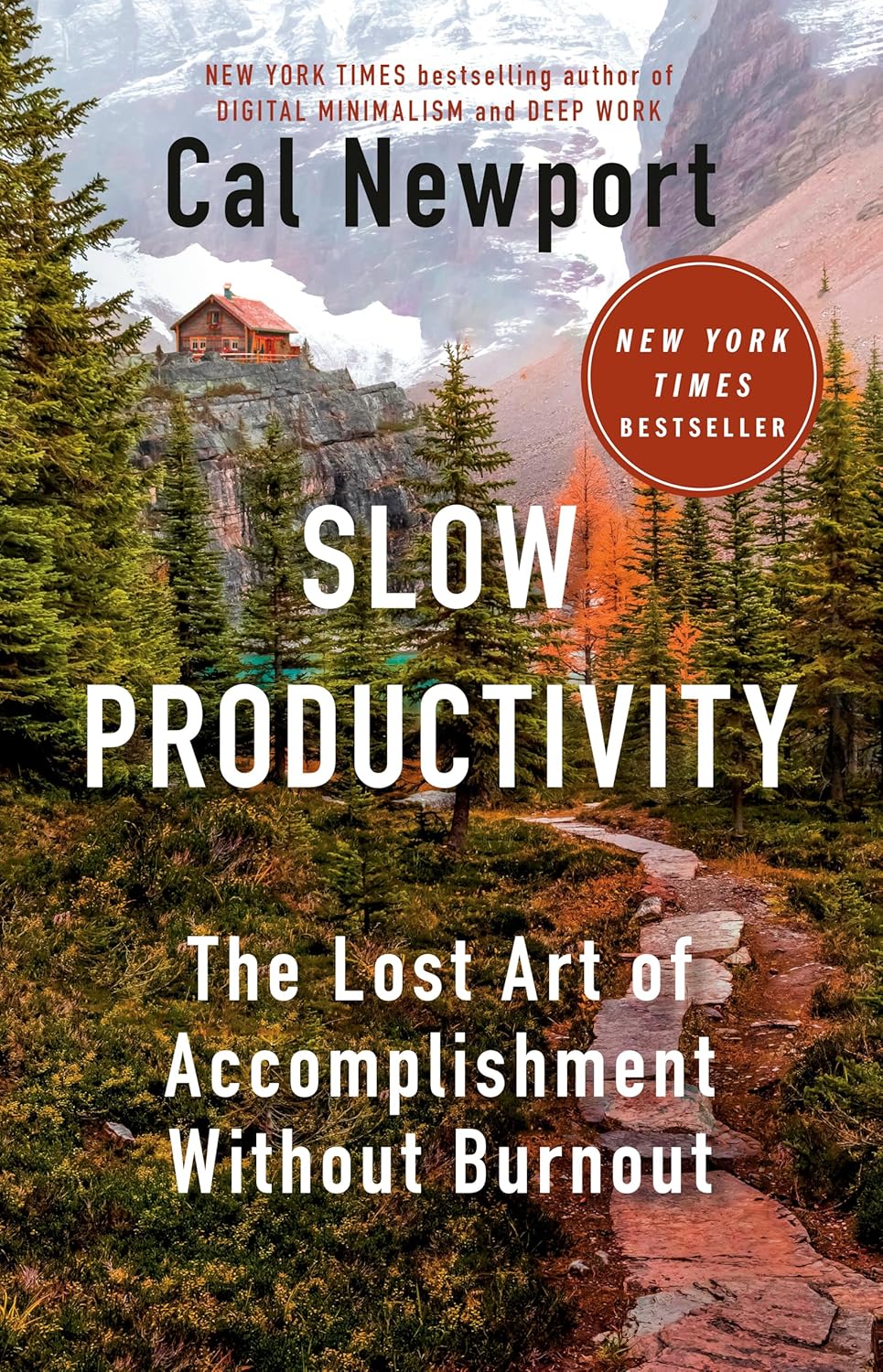
Slow Productivity: The Lost Art of Accomplishment Without Burnout
Related Products




A New York Times, Washington Post, USA Today, and IndieBound bestseller
“Brilliant and timely” — Oliver Burkeman
~ Do Fewer Things. Work at a Natural Pace. Obsess over Quality. ~
From the New York Times bestselling author of Digital Minimalism and Deep Work, a groundbreaking philosophy for pursuing meaningful accomplishment while avoiding overload
Our current definition of “productivity” is broken. It pushes us to treat busyness as a proxy for useful effort, leading to impossibly lengthy task lists and ceaseless meetings. We’re overwhelmed by all we have to do and on the edge of burnout, left to decide between giving into soul-sapping hustle culture or rejecting ambition altogether. But are these really our only choices?
Long before the arrival of pinging inboxes and clogged schedules, history’s most creative and impactful philosophers, scientists, artists, and writers mastered the art of producing valuable work with staying power. In this timely and provocative book, Cal Newport harnesses the wisdom of these traditional knowledge workers to radically transform our modern jobs. Drawing from deep research on the habits and mindsets of a varied cast of storied thinkers – from Galileo and Isaac Newton, to Jane Austen and Georgia O’Keefe – Newport lays out the key principles of “slow productivity,” a more sustainable alternative to the aimless overwhelm that defines our current moment. Combining cultural criticism with systematic pragmatism, Newport deconstructs the absurdities inherent in standard notions of productivity, and then provides step-by-step advice for cultivating a slower, more humane alternative.
From the aggressive rethinking of workload management, to introducing seasonal variation, to shifting your performance toward long-term quality, Slow Productivity provides a roadmap for escaping overload and arriving instead at a more timeless approach to pursuing meaningful accomplishment. The world of work is due for a new revolution. Slow productivity is exactly what we need.
From the Publisher


Publisher : Portfolio
Publication date : March 5, 2024
Language : English
Print length : 256 pages
ISBN-10 : 0593544854
ISBN-13 : 978-0593544853
Item Weight : 12.6 ounces
Dimensions : 5.65 x 0.94 x 8.58 inches
Best Sellers Rank: #9,905 in Books (See Top 100 in Books) #6 in Time Management (Books) #11 in Human Resources (Books) #94 in Success Self-Help
Customer Reviews: 4.3 4.3 out of 5 stars (3,211) var dpAcrHasRegisteredArcLinkClickAction; P.when(‘A’, ‘ready’).execute(function(A) { if (dpAcrHasRegisteredArcLinkClickAction !== true) { dpAcrHasRegisteredArcLinkClickAction = true; A.declarative( ‘acrLink-click-metrics’, ‘click’, { “allowLinkDefault”: true }, function (event) { if (window.ue) { ue.count(“acrLinkClickCount”, (ue.count(“acrLinkClickCount”) || 0) + 1); } } ); } }); P.when(‘A’, ‘cf’).execute(function(A) { A.declarative(‘acrStarsLink-click-metrics’, ‘click’, { “allowLinkDefault” : true }, function(event){ if(window.ue) { ue.count(“acrStarsLinkWithPopoverClickCount”, (ue.count(“acrStarsLinkWithPopoverClickCount”) || 0) + 1); } }); });

James A. Thomason III –
Great advice about slowing down and getting things right
Clearly taking the lessons to heart from this book, I finished this book, picked up and read a completely different one, and then am only now finally getting around to posting a review.This book is a retort against the common tech refrains of moving fast and breaking things and shipping now now now and how if you don’t have a fortune in VC funds at your unicorn startup by your mid 20s that you might as well just give up. To start with, as a direct pushback, he does a great job of arguing against all of the pseudo-productivity that we can all be guilty of. And this’ll sound controversial, but that’s stuff like excessive meetings or minute jira tickets or lots of detailed documents. He’s not necessarily arguing against them, but he’s making a strong argument that all of that stuff helps give us an illusion of being productive. I mean, you spend 3 hours working with your jira board, and it sure feels like you had a productive day and need a break, right? But it’s support work – it doesn’t actually move product forward or actually ship code or respond to user feedback. It’s just busyness. And while it can definitely be useful in helping drive the actual work forward, it’s when we start mistaking the support process for the actual work itself that we get ourselves into trouble. Especially once we get overwhelmed by the support work to the point of deferring the necessary stuff.And the rest of the book then goes into three major tenets – Work at a natural pace. Do fewer things. Obsess over quality. That’s his secret sauce.So instead of trying to get 8 billion things done as quickly as possible and toss as much stuff over the wall, focus on doing fewer things that you can be super passionate about and do really well. The more excited and interested you can be about those things, the easier they are to stick with, and the better quality product you’re going to produce at the end. You still need to ship at the end of the day, but you shouldn’t be so stressed out as you’re going along.As someone that will admit to several side projects which I have been tinkering with off and on for years or even more than a decade (or almost two decades for a few of them), it was nice reading something that just re-emphasizes that it can be okay to take your time with stuff and worry about getting it right and not be so frantic about the busywork. Definitely recommended.
Matt W. –
A series of solid methods for more sustainable productivity
Slow Productivity comes out after a wave of books challenging modern work culture and how it demands constant connectivity and effort at the price of an increasing risk of burnout. Newport’s solution isn’t a systemic one – though he does talk about the different issues people face in the world of work today, this book is primarily how one can edit one’s own personal productivity approach for accomplishment at a slower, more sustainable pace. If you’re looking for a book that addresses the greater problem, this isn’t it. Newport’s also up front in the type of reader the book best serves – namely, knowledge workers with a sense of autonomy about their time, and while this doesn’t imply it best serves white men in these sort of roles, it can be easy to assume that’s the case. He does ask that you implement his suggestions as much as you’re able, and often that you keep it on the down-low so as to not set off any superiors who might not understand what you’re trying to do.The overarching ideas aren’t new (do less, take longer, focus on quality) but Newport does give good, concrete suggestions for implementing them. He backs this up with stories about notable people in the past who worked in the manner he suggests. Often he says that it seems unlikely modern workers can reach the level of sustainable work that Georgia O’Keefe or John McPhee were able to do, and that can be true in some cases. You’ll get the most mileage out of Slow Productivity if you’re willing to look at it primarily as a way to enhance your own work above all, and you’re willing to tailor his suggestions to meet your needs. Again, if you’re looking for a book to address the greater systemic problems with work, this one will disappoint.Also, the writing can get pretty dense for the subject matter. It’s not impenetrable by any means, but compared to other productivity books covering the same kind of subject matter, it definitely reads more like, well, the kind of paper a computer science professor would write. Not a deal-breaker, but it might seem a little too stuffy.Overall I liked this book. I’ve followed Newport for years but I wanted to be fair. It’s a good volume to add to the existing productivity material out there, especially if you’re always hungry for new tactics as I am, but if you’re not you might get less mileage out of the stories of people who worked in way saner conditions than we do now.
Richard Buurstra –
Cal Newport is awesome. Highly recommend “Deep Work” but this book is the opposite. In my opinion just a book to collect money. You learn principles; Do less, thats a good one. Obsesse over quality (the funny part, this book is everything but quality) I actually threw this book away, still love you though. Read Deep Work and get to work 🙂
yash –
Good but i wish the author did not use so many analogies to get to the freakin point. It is a taste thing where some people like taking knowledge when it comes from a storytelling point of view and some do not. That being said there are many little nuggets of wisdom in this book.
deusmenor –
I got this shortly after burning myself and ended up being laid off anyway. This is a good way to show you that working long hours is not always the best.
C_o –
It sticks to the typical self-help format- part 1 is the problem, part 2 is the solution- each section is littered with successful examples that are massaged enough to fit the book’s conclusion, while no mention is made that, for every one of those cherry-picked examples, there are dozens of successes that don’t fit the book’s thesisIt’s a complete cliché.But if there’s one author for whom I’ll suspend disbelief and give it a chance, it’s Cal Newport. Despite the contrived examples that are a hard sell, I like its thesis, concept, and conclusions. I’m not sure yet as to what extent I’ll apply its content: I’ll need another read to make this plan.