
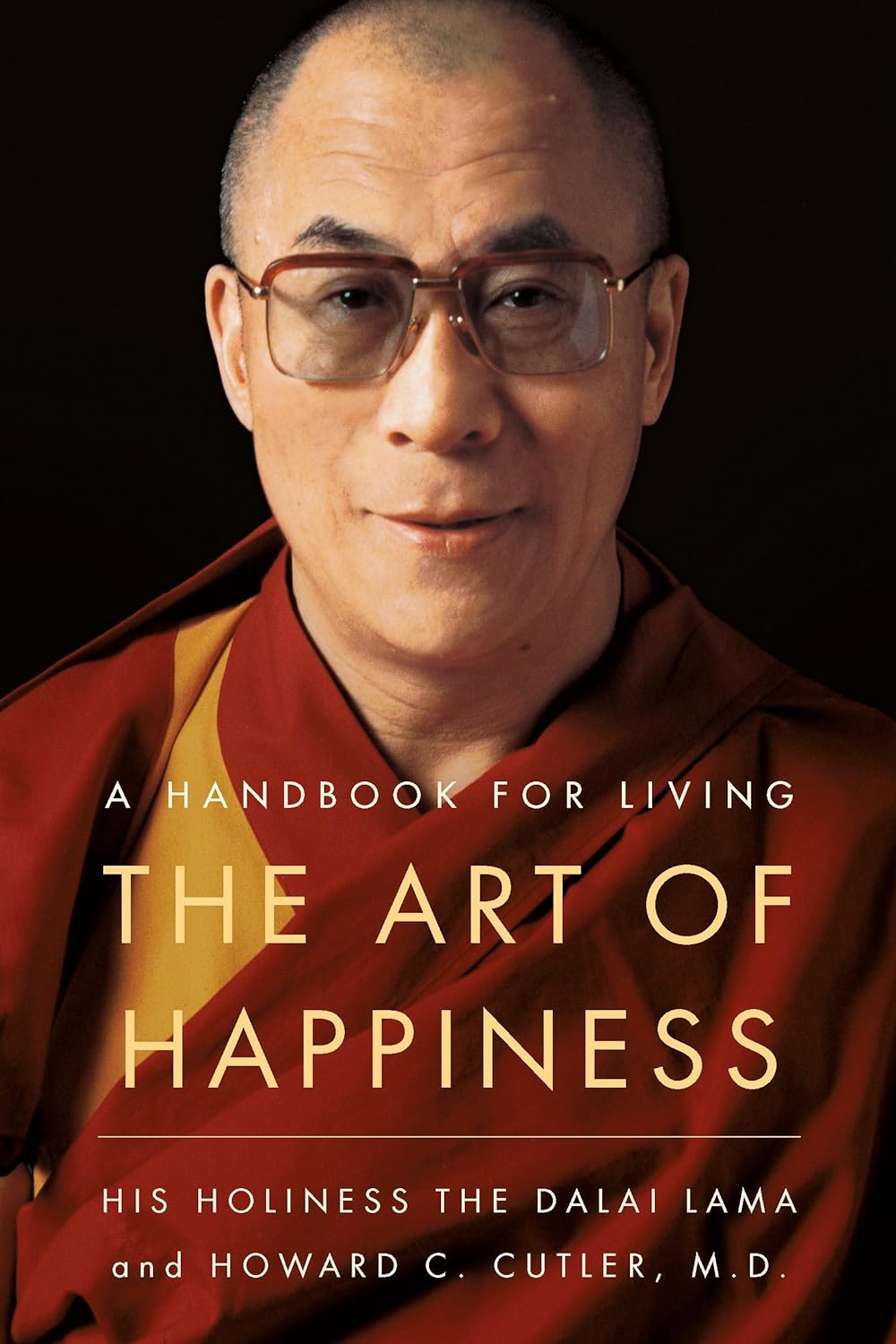
The Art of Happiness: A Handbook for Living
Original price was: $17.00.$9.91Current price is: $9.91.
Related Products



Available for the first time in trade paperback, the multi-million copy bestselling guide to happiness from His Holiness the Dalai Lama.
Nearly every time you see him, he’s laughing, or at least smiling. And he makes everyone else around him feel like smiling. He’s the Dalai Lama, the spiritual and temporal leader of Tibet, a Nobel Prize winner, and a hugely sought-after speaker and statesman. Why is he so popular? Even after spending only a few minutes in his presence you can’t help feeling happier.
If you ask him if he’s happy, even though he’s suffered the loss of his country, the Dalai Lama will give you an unconditional yes. What’s more, he’ll tell you that happiness is the purpose of life, and that the very motion of our life is toward happiness. How to get there has always been the question. He’s tried to answer it before, but he’s never had the help of a psychiatrist to get the message across in a context we can easily understand.
The Art of Happiness is the book that started the genre of happiness books, and it remains the cornerstone of the field of positive psychology.
Through conversations, stories, and meditations, the Dalai Lama shows us how to defeat day-to-day anxiety, insecurity, anger, and discouragement. Together with Dr. Howard Cutler, he explores many facets of everyday life, including relationships, loss, and the pursuit of wealth, to illustrate how to ride through life’s obstacles on a deep and abiding source of inner peace. Based on 2,500 years of Buddhist meditations mixed with a healthy dose of common sense, The Art of Happiness is a book that crosses the boundaries of traditions to help readers with difficulties common to all human beings. After being in print for ten years, this book has touched countless lives and uplifted spirits around the world.
Publisher : Riverhead Books
Publication date : July 21, 2020
Language : English
Print length : 336 pages
ISBN-10 : 1573227544
ISBN-13 : 978-1573227544
Item Weight : 9.2 ounces
Dimensions : 5.39 x 0.67 x 8.19 inches
Best Sellers Rank: #8,175 in Books (See Top 100 in Books) #34 in Meditation (Books) #70 in Spiritual Self-Help (Books) #245 in Personal Transformation Self-Help
Customer Reviews: 4.7 4.7 out of 5 stars (11,093) var dpAcrHasRegisteredArcLinkClickAction; P.when(‘A’, ‘ready’).execute(function(A) { if (dpAcrHasRegisteredArcLinkClickAction !== true) { dpAcrHasRegisteredArcLinkClickAction = true; A.declarative( ‘acrLink-click-metrics’, ‘click’, { “allowLinkDefault”: true }, function (event) { if (window.ue) { ue.count(“acrLinkClickCount”, (ue.count(“acrLinkClickCount”) || 0) + 1); } } ); } }); P.when(‘A’, ‘cf’).execute(function(A) { A.declarative(‘acrStarsLink-click-metrics’, ‘click’, { “allowLinkDefault” : true }, function(event){ if(window.ue) { ue.count(“acrStarsLinkWithPopoverClickCount”, (ue.count(“acrStarsLinkWithPopoverClickCount”) || 0) + 1); } }); });
8 reviews for The Art of Happiness: A Handbook for Living
Add a review

Original price was: $17.00.$9.91Current price is: $9.91.
Mykle McKiernan –
An enlightening blend of psychology, philosophy, and practical wisdom.
I appreciated the book’s format—a thoughtful dialogue between the Dalai Lama and psychiatrist Howard Cutler aimed at translating ancient insight into modern life. The premise of “how to be happy” sounds simple, yet the conversation quickly becomes deeper and more nuanced.Through stories and reflection, the book shows how suffering, compassion, and perspective shape our experience far more than circumstances. The Dalai Lama’s guidance is spiritual without drifting into abstraction, while Cutler grounds the ideas with relatable, real-world examples. Their exchanges feel human, even funny at times, which keeps the insights accessible.The book dismantles two persistent myths: that happiness is something life delivers to us, and that peace comes from avoiding discomfort. Instead, it frames happiness as a skill—one built through empathy, resilience, and intentional mental training.If you value books that linger in your mind long after you close them, this one earns the space. It doesn’t promise perfection; it offers a way to live more lightly with imperfection. I’m happier for having read it.
Konrei –
It is not enough to be compassionate. You must act—H.H. The Dalai Lama
His Holiness has the amazing ability to say things that are both simple and profound. After listening to the XIV Dalai Lama or reading his words, I often find myself saying, “Why didn’t I think of that?” Why not indeed? A previous reviewer states that this is a wonderful book but that it’s hard to “get” the idea of being compassionate to ALL beings regardless of their own actions. It IS hard to “get” that. The Dalai Lama has been a Buddhist monk for the last 71 years, and HE works at it every single day. The Buddha himself, after his Enlightenment, didn’t say, “Well, since I’m one with all that is I guess I can retire now.” Nope. Shakyamuni began teaching. And he kept practicing, whether through sitting meditation or through workaday tasks. His practice matured him. He may have come up with the Four Noble Truths on Day One and he may have taught them throughout his life, but there’s a great deal of evolution between those original thoughts and the Parinirvana Sutra uttered on his deathbed. He would have heartily endorsed the Dalai Lama’s call to Happiness and accepted Tenzin Gyatso as a worthy Dharma successor.But, I digress. Unlike many of the Dalai Lama’s earlier books this one is geared specifically toward and for the general public. Just as you don’t have to be Jewish to enjoy Levy’s Rye, you don’t have to be a Buddhist to appreciate this book. As a matter of fact, although every idea in this book is quintessentally Buddhist, every idea in this book is, more importantly, quintessentially human. The Dalai Lama’s basic thesis is that we are all born to be happy. Reading this, I kept being reminded of Jefferson’s words, “Life, liberty, and the pursuit of happiness.” It’s too bad that our modern culture conflates “Happiness” with “Pleasure” (which is far more fleeting) and that “Pleasure’s” main attribute is “Money” and lots of it, or the things that “Money” can buy. Not that “Money” is unimportant, but the idea that “Money can’t buy Happiness” is a core idea here, and is proven over and over again.This book and its sequels grew out of a series of personal interviews between the Dalai Lama and noted Psychologist Howard C. Cutler, who has become an important exponent of the Positive Psychology Movement of the last decade. Positive Psychology focuses not on what’s wrong with an individual but on what’s right and how to reinforce what’s right through positive practices—essentially, Cutler’s approach amounts to a primer on classical Buddhist Psychology. The Dalai Lama speaks here, but it is Cutler who amplifies and expounds on the Dalai Lama’s core ideas in a Western idiom. His Holiness does detail certain meditative practices as well.According to the Dalai Lama (and most Positive Psychologists), Happiness is not the end result of a thought process but is the process itself. Acting kindly, compassionately, mindfully and with awareness result in a person being, in effect, happy, even in the face of the day-to-day toxicity of much of our culture. His Holiness also believes that Happiness is highly contagious, and that it will spread virally if only we maintain our positive practices.Yes, it is hard to remain “happy” in the face of dealing with obnoxious bill collectors or dishonest repairmen, but that is where compassion comes in. Compassion is not a form of blind forgiveness—I don’t have to say, “It’s okay” to the mugger who’s just stolen my wallet—but, rather, it is a form of understanding that bad things do occur, that although they may occur to me, the universe is not personally out to get me, and that the mugger who mugged me, the bill collector who cursed me or the repairman who overcharged me, is acting out of their own unhappiness. I don’t have to turn any cheeks or allow it to happen ever again. I don’t have to embrace them as misguided souls. I don’t have to let it fester and make me sick and angry either. I just have to grasp the idea that the mugger, the bill collector and the repairman are all human, like me, and all subject to the same faults and foibles that I am. Sound tough? It sure is. That’s why it’s a lifelong practice.Anybody coming here for a bullet-point approach to solving all of life’s problems or to be reassured by pop-psychology tripe will be disappointed in this book. This is a substantive popular work that gives back to the reader exactly what the reader puts in.
David Wilder –
Excellent Advice to Achieve True Happiness
Having been a student of Mahayana Buddhism for the past couple years, I had been meaning to read a book by the fourteenth Dalai Lama, and was overjoyed to purchase this one after being alerted that the Kindle edition had gone on sale by the excellent ebook deal-alerting service Bookbub. Since it was the first book by the current Dalai Lama that I ever read, I wasn’t sure what to expect but I did expect it to be of high quality—especially since it is his most well-known book. Fortunately, it did not disappoint me in the slightest!The Art of Happiness: A Handbook for Living was co-authored by psychiatrist Howard Cutler, who posed questions to the Dalai Lama over the series of many interviews. Cutler provides the setting and context for their meetings and also incorporates his own reflections on the issues raised in their discussions. In addition, transcriptions from several of the Dalai Lama’s teachings are scattered throughout the book. It was first published in 1998, and I read the ten-year anniversary edition that was published in 2008 which includes a new preface and introduction.The book delves into the concept of using various techniques to train the mind in order to achieve true happiness. In the preface, His Holiness the Dalai Lama states, “If you want others to be happy practice compassion; and if you want yourself to be happy practice compassion.” This focus on developing compassion is consistent throughout the book and is a main focus in many of the answers that the Dalai Lama gives to Cutler’s questions. It seems that this is a sort of prerequisite for cultivating happiness, a foundation upon which all of the other advice is based upon.Another point that is made time and time again is that happiness comes down to one’s state of mind more than by external events. There are a plethora of examples provided in the book, such as how lottery winners do not sustain their initial delight over a longterm period and instead return to the level of moment-to-moment happiness they were accustomed to prior to winning the lottery. Or how studies have shown that people who are struck by tragic events like cancer and blindness typically recover to their normal level of happiness after a reasonable adjustment period. Psychologists label this process “adaptation”, which simply refers to the tendency of one’s overall level of happiness to migrate back to a certain baseline.From a Buddhist perspective, the root causes of all suffering are ignorance, craving, and hatred. The book fleshes out this idea and suggests methods for one to overcome them. For example, the Dalai Lama advises, “We cannot overcome anger and hatred simply by suppressing them. We need to actively cultivate the antidotes to hatred: patience and tolerance.”Overall, I was very impressed by this book. When I first started reading it I wished that the Dalai Lama had been the sole author, however I eventually grew to appreciate Cutler’s additions. That’s mainly because I did not realize that the book was co-authored until after I started reading it, so I had unknowingly and unintentionally set an improper expectation for myself. However, by the end of the book I had overlooked the co-authoring aspect entirely and focused more on the book’s content, which is excellent. I would advise this book to anyone who is interested in the Dalai Lama, Buddhism, mindfulness, or becoming truly happy.Namaste.
Merche –
La filosofía budista merece todos mis respetos y en particular la figura del Dalai Lama, después de todo lo que ha pasado, en su proclama de fomentar los estados mentales positivos, como la comprensión, la amabilidad y la compasión, en el camino a una mejor salud psicológica y felicidad. La lectura es sencilla y práctica. El texto ha sido preparado por un psiquiatra norteamericano, a partir de las entrevistas y conversaciones, con el Dalai a lo largo de varios años, por lo que en numerosas ocasiones plantea las formas y puntos de vista occidentales frente al budismo.Desde mi punto de vista una lectura obligada.
Kenneth W Kramme –
Surprisingly pragmatic and moving account of interviews with the Dalai Lama by an American Psychiatrist. “Simple” but powerful values of compassion, empathy and tolerance— that I will continue to attempt to weave into my daily thoughts and behaviour. An important book — especially in today’s times where it appears that many people have lost their moral compasses.
sohia –
Reading it every day can keep calm. It is impressive.
Isha Nag –
To all those who can practice what they read.Has components of living a good life at a personal level and at a spiritual level to live peacefully, joyfully with community.The book is easy to read as it is written in a conversation style.
Amazon Kunde –
The Art of Happiness: A Handbook for Living ist ein bemerkenswertes Buch, das einen tiefgreifenden Einblick in die Suche nach Glück und innerer Zufriedenheit bietet. Geschrieben von dem Dalai Lama und dem Psychiater Howard C. Cutler, stellt es eine inspirierende Anleitung für ein erfülltes Leben dar.Das Buch präsentiert eine Kombination aus buddhistischer Weisheit und westlicher Psychologie, die einen einzigartigen Ansatz für das Verständnis und die Erreichung von Glück bietet. Es regt dazu an, die eigene Wahrnehmung von Glück zu überdenken und bietet praktische Werkzeuge, um eine positive Einstellung zu entwickeln und schwierige Situationen zu bewältigen.Die Weisheit des Dalai Lama strahlt in jedem Kapitel des Buches. Seine klaren und einfühlsamen Botschaften ermutigen den Leser, sich mit sich selbst und anderen in Verbindung zu setzen, um wahres Glück zu finden. Die gemeinsamen Dialoge mit Howard C. Cutler bringen auch die westliche Perspektive ein und bieten interessante Einblicke und Anregungen.The Art of Happiness ist leicht verständlich geschrieben und enthält zahlreiche praktische Beispiele, Übungen und Fallstudien. Diese helfen dabei, die Konzepte in den Alltag zu integrieren und schrittweise positive Veränderungen herbeizuführen.Das Buch behandelt auch Themen wie Mitgefühl, Beziehungen, Arbeit und die Bedeutung von Selbstreflexion. Es bietet eine ganzheitliche Herangehensweise an das Glück und ermutigt den Leser, sich selbst besser kennenzulernen und die eigene Lebensführung zu gestalten.Insgesamt kann ich The Art of Happiness: A Handbook for Living wärmstens empfehlen. Es ist eine Quelle der Inspiration und eine wertvolle Ressource für jeden, der nach einem tieferen Sinn des Lebens sucht und nachhaltige Freude und Erfüllung finden möchte. Es ist ein Buch, das man immer wieder zur Hand nehmen kann, um neue Erkenntnisse und Weisheit zu entdecken.