

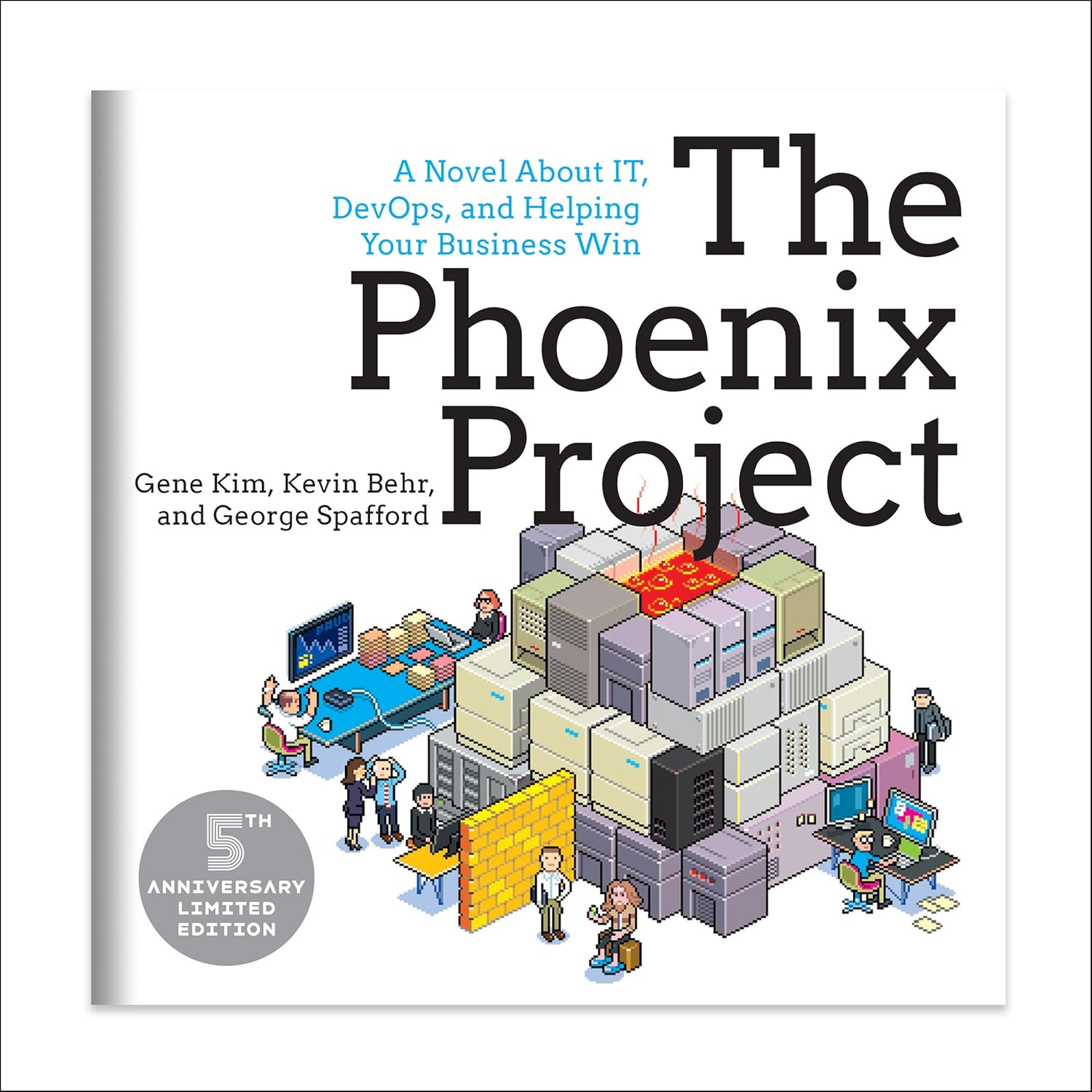
The Phoenix Project: A Novel about IT, DevOps, and Helping Your Business Win 5th Anniversary Edition
$0.00
Related Products





Five years after this sleeper hit took on the world of IT and flipped it on its head, the fifth anniversary edition of The Phoenix Project continues to guide IT in the DevOps revolution. In this newly updated and expanded edition of the best-selling The Phoenix Project, co-author Gene Kim includes a new afterword and a deeper delve into the Three Ways as described in The DevOps Handbook.
Bill, an IT manager at Parts Unlimited, has been tasked with taking on a project critical to the future of the business, code named Phoenix Project. But the project is massively over budget and behind schedule. The CEO demands Bill must fix the mess in 90 days, or else Bill’s entire department will be outsourced.
With the help of a prospective board member and his mysterious philosophy of the Three Ways, Bill starts to see that IT work has more in common with manufacturing plant work than he ever imagined. With the clock ticking, Bill must organize work flow, streamline interdepartmental communications, and effectively serve the other business functions at Parts Unlimited.
In a fast-paced and entertaining style, three luminaries of the DevOps movement deliver a story that anyone who works in IT will recognize. Listeners will not only learn how to improve their own IT organizations, they’ll never view IT the same.
PLEASE NOTE: When you purchase this title, the accompanying PDF will be available in your Audible Library along with the audio.
7 reviews for The Phoenix Project: A Novel about IT, DevOps, and Helping Your Business Win 5th Anniversary Edition
Add a review

$0.00
KenHui –
Karate Kid Meets DevOps
First of all, I loved the book! With The Phoenix Project, Gene Kim, Kevin Behr, and George Spafford has written one of the most thought-provoking IT books I’ve read in recent years.The Phoenix Project is actually a novelization of DevOps principles rather than a strict how-to book on transforming IT Operations. It is written in the tradition of IT Novels such as the Stealing The Network series, which I read voraciously when I was learning about Information Security. I find the idea of using the genre of fiction to teach IT theory to be extremely effective, especially the concepts of DevOps, which are foreign to so many who are in the “traditional” IT space. The Phoenix Project provides a vivid use case that describes the dysfunctional relationship which exists, not only between traditional IT and the Lines of Business, but between different groups within IT itself. But not only does the book describe the problem, it offer a path to follow in order to transform IT into a true partner to the Business.The protagonist in The Phoenix Project is Bill Palmer, newly promoted to VP of IT Operations for Parts Unlimited, a leading automotive parts manufacturer and retailer. The problem is that Palmer has been promoted because his managers were fired due to the failures of the IT department, particularly in completing a software initiative, called The Phoenix Project. This Phoenix Project is a software suite, developed in-house, designed to integrate manufacturing and retail while allowing Parts Unlimited to be more agile and nimble in accommodating to changes in market conditions. The project is intended to save the company, which has missed earning consistently and has fallen behind its main competitor; unfortunately, the project is millions of dollars over-budget and years late in delivery. Palmer is thrown on to the proverbial sinking ship and quickly caught up in one emergency after another and soon realizes that unless something quickly changes, The Phoenix Project is doomed to failure and along with it, Parts Unlimited. However, Palmer finds himself ill-equipped to understand and to implement the necessary changes to right the ship, especially when there is so much distrust and infighting within the IT organization and with the Lines of Business.Then Palmer meets the enigmatic Erik Reid, a potential board member with some very unusual ideas for how to run IT Operations. Palmer is understandably skeptical but is soon drawn in as Reid takes him down the rabbit hole; through a series of encounters and events, Reid enlightens Palmer as to what is the true mission of IT and what must be done to make IT work as a partner to the Business. The truths that are discovered not only change Palmer but the entire culture of IT at Parts Unlimited.I had two different reactions as I was reading The Phoenix Project. The first half of the book often made me reflexively reach for the Maalox as I found myself standing in Palmer’s shoes, reliving outages caused by buggy code and miscommunication between IT departments. The second half of the book reads like the script from The Karate Kid, as we see Erik Reid, Aka. Mr. Miyagi, guide Bill Palmer, Aka. young Daniel, down the path to enlightenment about not only the methodology of DevOps but the cultural shift that is required for change. Sometimes the lessons involve seeing tasks that seem to have little value to sound IT Operations, but Reid is able to masterfully walk Palmer through the process until he sees the proper connections between Manufacturing Plant operations and IT Operations.That relationship between Manufacturing Plants and IT was, for me, the key insight provided by the book. As Erik Reid succinctly states to Bill Palmer, “If you think IT Operations has nothing to learn from Plant Operations, you’re wrong. Dead wrong. Your job as VP of IT Operations is to ensure the fast, predictable, and uninterrupted flow of planned work that delivers value to the business while minimizing the impact and disruption of unplanned work, so you can provide stable, predictable, and secure IT service.” This is one of the best definition of IT Operations and also one of the most insightful statements on resource management that I’ve read to date. After all, what can be more basic to resource management, rather it be a data center, software development team, Cloud, or people, than ensuring they deliver value through the completion of planned work? Yet I would argue that because this is not the ultimate goal of many IT shops, they are easily sidetracked by the urgent and prevented from doing what is important.The rest of the book shows how Palmer, with help from Reid, is able to inculcate a new culture in the IT department at Parts Unlimited so they can focus on the mission of saving the company by enabling the business of the company. Along the way, they learn about the four categories of work (business projects, internal IT projects, changes, and unplanned work), the Three ways, and the importance of Kanban. Each new discovery by Palmer and team is a call to action for IT departments that know they cannot maintain the status quo and must transform themselves to meet the demands of the current business environment.I look forward to learning more and applying the principles from books such as the Phoenix Project. Now if only I could find a portable version of a Kanban Board!
William Hertling –
What The Goal did for lean manufacturing, The Phoenix Project will do for managing IT
The Phoenix Project belongs to that rare category of books: a business novel. It’s written as fiction but it teaches us something serious. The most well known book in this category is The Goal: A Process of Ongoing Improvement by Dr. Eliyahu M. Goldratt. The Goal is a long-term best selling business book and required reading for nearly every MBA student for the last twenty-five years.What The Goal did for lean manufacturing, The Phoenix Project will do for managing IT.Bill Palmer is the reluctant protagonist who is thrust into managing IT Operations. He inherits a world of hurt: new business innovation projects are so far behind that the corporation’s ability to remain competitive is threatened; standard business functions like payroll, data storage, and point of sale systems suffer from recurrent outages like lights flickering during a storm; and the whole IT organization is so buried firefighting that critical maintenance is neglected.I immediately resonated with the situation. In fact, if you work in a business of any size, in IT or not, you’ll quickly find similarities.In my day job, over the years I’ve found myself wondering why small startups can outcompete two hundred person strong development teams, why certain deployments are multi-day affairs that nearly always fail, why we must wait months for to release software, why the releases that do get to the light of day are nearly always missing key features, and why we seem incapable of fixing bugs so awful that we drive our customers away.In The Phoenix Project, the protagonist Bill Palmer encounters all of this and more. It’s written as a fast-paced business thriller (I couldn’t put it down and spent much of Christmas day hiding from my kids to read — in fact, once I hit the halfway point, I literally did not stop reading it except for bathroom breaks.) But it’s also a serious business book about managing IT.Through an enigmatic board member, Bill is forced to question his assumptions about IT. What is the role of IT Operations, and even all of IT? What are the four kinds of work that IT must do? What’s the silent killer of all planned work? What does the business need?Through comparisons with how work is managed in a factory and examples from The Goal, authors Gene Kim, Kevin Behr, and George Spafford show how the time tested techniques of lean manufacturing (also the Toyota Production System) apply to IT work. By applying these principles, Bill Palmer is able to:- Speed up the time it takes from implementation to deployment by reducing work in progress- Increase the amount of useful work completed by reducing dependencies on key resource bottlenecks, whether those are people, hardware, or systems- Reduce outages by addressing technical debt on fragile IT systems (such as old databases, tricky routers, etc.)- Increase the IT contribution to the business by gaining a better understand of the business requirements, and focusing effort on those features that make the largest beneficial impact to the business.One of the authors, Gene Kim, is the original creator of Tripwire, a widely used tool for managing IT changes; cofounder of the company by the same name; and author of The Visible Ops Handbook: Implementing ITIL in 4 Practical and Auditable Steps. I’ve seen him give talks on these concepts to a packed audience and receive a standing ovation.For years, I’ve wanted to be able to bring these types of ideas back to my company because I’m convinced we could be ten or a hundred times more effective and delight our customers if only we could overcome our IT dysfunctions.I’m thrilled to see them now in written form. If there was one book I’d want every employee of my company to read, it would be this one.
Gosia –
Great book, very pleasant to read but also full of interesting cases.
K K –
Highly recommend this book for anyone who has any dealings with IT, whether you are a business person, manager or IT professional. Easy to read and understand the concepts since the entire book is an example of implementing DevOps within IT. And the cover is beautiful!
jonoble –
If you work in IT (heck, even if your business has any IT – so that’s all of you), then you should read this book.Regardless of your specific role, I’m certain that you’ll learn something useful (and more importantly, actionable). I’ve changed my approach to doing a few things already based on lessons I’ve taken from the book and I still need to process some more ideas around how to do stuff better. I expect that I’ll be reading it at least one more time through so that I don’t miss anything that I could make use of.One month ago, I’d never heard about this book. Of all the interesting and useful things that I took away from the Microsoft Global MVP Summit this November, I suspect that this will have the greatest impact. Fellow PowerShell MVP Steven Murawski often talks about DevOps and recommends this book in his presentations. He’s such a fan of the book that he brought a bunch of copies to give out and I was very glad to receive one after hearing him extol its virtues.Having read the first few chapters on the flight back from Seattle, on landing I purchased the Kindle edition from Amazon UK so that I could carry it around on my Kindle and phone in order to reduce the barriers to being able to consume it!Personally, I love the approach that this book takes. By encompassing so much useful information about ITSM, DevOps methodologies and much more in a novel with an engaging storyline, I was able to read it much more easily and quickly that many of the dry technical texts that bog down our industry. I think that it also helped me to digest the information and apply it to my work situation more easily, even though I work in a significantly different type of organisation to that in the story.The bottom line is that this isn’t just a good book, it’s an important book. You should read it at the first available opportunity. We’ll all be the better for it.
Ulysses Almeida –
O livro conta a história do departamento de TI de uma empresa americana. Como o departamento sai do caos total para um fluxo orquestrado, alinhado e entregando valor ao negócio da empresa, que nada tem a ver com TI. É interessante ver que apesar de tratar de uma empresa privada americana, o setor de TI retratado se assemelha a muitos setores de TI do Brasil, incluindo de órgãos públicos.Em fim. O livro é muito bom. Por se tratar de uma história de ficção com personagens interessantes a leitura flui muito bem. A fluidez da leitura é semelhante ao do livro “A meta”, que eu também recomendo. Não é um livro que vai te dar detalhes de como resolver os problemas da TI. Muita das soluções adotadas no livro não são tão simples de serem adotadas na vida real. Mas mesmo assim o livro enche o leitor de motivação para ajudar no desafio de promover mudanças em seu local de trabalho!
Amazon Customer –
This book looks like telling about the devops first but actually it tells us trusted relationship among all department is the most important for Business to achieve the goal. I really enjoyed it.