

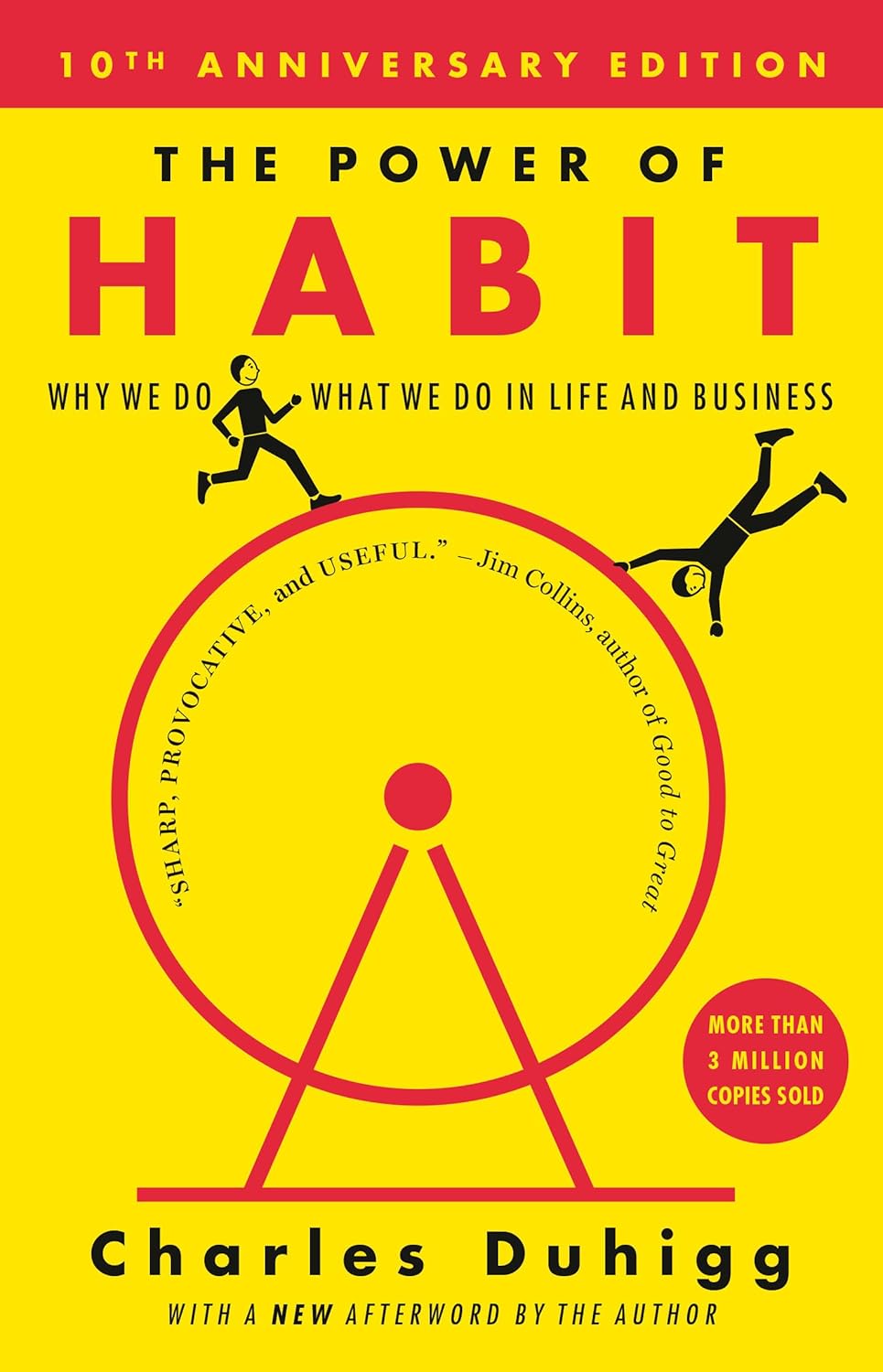
The Power of Habit: Why We Do What We Do in Life and Business
Original price was: $20.00.$11.26Current price is: $11.26.
Related Products






NEW YORK TIMES BESTSELLER • MORE THAN 3 MILLION COPIES SOLD • This instant classic explores how we can change our lives by changing our habits.
“Few [books] become essential manuals for business and living. The Power of Habit is an exception.”—Financial Times
A WALL STREET JOURNAL AND FINANCIAL TIMES BEST BOOK OF THE YEAR
In The Power of Habit, award-winning business reporterCharles Duhigg takes us to the thrilling edge of scientific discoveries that explain why habits exist and how they can be changed. Distilling vast amounts of information into engrossing narratives that take us from the boardrooms of Procter & Gamble to the sidelines of the NFL to the front lines of the civil rights movement, Duhigg presents a whole new understanding of human nature and its potential. At its core, The Power of Habit contains an exhilarating argument: The key to exercising regularly, losing weight, being more productive, and achieving success is understanding how habits work. As Duhigg shows, by harnessing this new science, we can transform our businesses, our communities, and our lives.
With a new Afterword by the author
From the Publisher


Publisher : Random House Trade Paperbacks
Publication date : January 7, 2014
Language : English
Print length : 416 pages
ISBN-10 : 081298160X
ISBN-13 : 978-0812981605
Item Weight : 2.31 pounds
Dimensions : 5.19 x 0.88 x 7.98 inches
Best Sellers Rank: #3,301 in Books (See Top 100 in Books) #7 in Business Processes & Infrastructure #10 in Popular Social Psychology & Interactions #56 in Personal Transformation Self-Help
Customer Reviews: 4.6 4.6 out of 5 stars (39,759) var dpAcrHasRegisteredArcLinkClickAction; P.when(‘A’, ‘ready’).execute(function(A) { if (dpAcrHasRegisteredArcLinkClickAction !== true) { dpAcrHasRegisteredArcLinkClickAction = true; A.declarative( ‘acrLink-click-metrics’, ‘click’, { “allowLinkDefault”: true }, function (event) { if (window.ue) { ue.count(“acrLinkClickCount”, (ue.count(“acrLinkClickCount”) || 0) + 1); } } ); } }); P.when(‘A’, ‘cf’).execute(function(A) { A.declarative(‘acrStarsLink-click-metrics’, ‘click’, { “allowLinkDefault” : true }, function(event){ if(window.ue) { ue.count(“acrStarsLinkWithPopoverClickCount”, (ue.count(“acrStarsLinkWithPopoverClickCount”) || 0) + 1); } }); });
7 reviews for The Power of Habit: Why We Do What We Do in Life and Business
Add a review

Original price was: $20.00.$11.26Current price is: $11.26.
Mr Snappy –
Habit formation, change, use and abuse (and some fun stories)
New York Times investigative reporter Charles Duhigg has assembled a compelling set of stories about the overarching influence habit plays in our lives, its neurological underpinnings, how habits develop, how they may be altered, and how they may be used to undermine us. Duhigg’s curiosity leads him to variegated and interesting applications of the concept of habit formation, from Tony Dungy’s quest for a super bowl ring to the selling of Pepsodent, a milestone in advertising history.These stories of corporate manipulation are among Duhigg’s most persuasive. Most appalling was his story of an Iowa housewife who married early and accomplished little, except that she was adept at gambling. Her humdrum life became rewarding when she was able to order comped suites for friends’ weddings because Harrah’s valued her patronage so highly. Her anxiety was always relieved when she sat down at the black jack table. Harrah’s casino showered her with personal attention. Even after she went bankrupt, Harrah’s continued to call, making offers of benefits she could not refuse. Finally, after many hard knocks, she was given a second chance when her parents left a nice inheritance. Of course, she continued to answer Harrah’s calls (they got upset when she declined to come) and gambled the inheritance away.Then there is Boutique Target, spending vast sums to find statistical changes in spending patterns when women get pregnant. Once identified as a likely pregnancy (when her receipts show increased purchases of lotions, expanded waist pants, etc.), a woman begins to receive relevant discount offers, subtly hidden within coupon books. Pregnant women are “a gold mine,” leading to infant, child, and family expenditures worth thousands. The Boutique is going to be sure they get their share of the action. Like Harrah’s, they take advantage of customer habit to influence purchases to their benefit.To the good, Duhigg recounts the story of a young man named Travis whose drug-addicted parents taught him none of the social skills required for success or even for holding down a menial job. He was a bright kid who knew that when the house was clean, that meant mom and dad had switched from heroin to meth and things were about to get seriously out of control. Travis dropped out of school, failed at McDonald’s, then got a break when he was hired as a barista at Starbucks.It seems that Starbucks had determined that world domination was based on convincing large numbers of people to pay four dollars a throw for a cup of coffee. This meant not only the addition of special nutrients such as heavy cream and sugary Italian flavoring, but also the emphatic recognition of the customer’s personal value to the outlet. Starbucks taught its baristas to show care and consideration for customers. Travis took fifty hours of in-house courses, equivalent of a college semester, learning habits of positive customer relations. He wrote out and memorized the LATTE method: Listen to the customer. Acknowledge their complaint. Take action by solving the problem. Explain why the problem occurred. Travis paid attention. At age 26, he managed two Starbucks outlets, had no debt and a 401K. Travis had been socialized by a corporation.The first third of the book deals with habit formation (cue, craving, routine, reward) and an appendix tells the reader how to change habits. The program is a bit reductive and sounds like cognitive behavioral therapy by another name, which it pretty much is. Nuances of interpersonal differences, the effects of various psychological states and diagnoses, the limits imposed by life circumstance, these are not factors that Duhigg treats in detail.To his credit, Duhigg deals with higher functions than the simple changing of unconscious processes, like changing a pattern of cookie eating in the afternoon (a rather facile but helpful piece about his own habit change). His discussion of the success of Alcoholics Anonymous includes speculations that belief is sometimes necessary to overcome a life-long, pervasive habit, such as alcohol addiction. It is insufficient to deal with the physical addiction and to replace the habit with a new routine (e.g., calling a sponsor or going to a meeting instead of a bar).The application of a belief that things can get better has been shown to assist addicts who suffer stress or temptation. Duhigg points out that when the chips were down, Tony Dungy’s football team failed to apply the positive habits that had taken them to the playoffs. They failed to believe that the habits would work in the clutch. After Dungy lost a son, the team thereafter came together for his sake and won the Superbowl. Duhigg attributes the win to belief. It seems equally likely that this success came from increased motivation and affiliation among team members rallying around their beloved coach.In my experience, clients often change when they embrace values more important to them than the rewards of a self-destructive habit. Rather than drinking, the client chooses to establish habits consistent with enhancing a child’s life. A four-decade smoker stops cold turkey when his new love demands kissing sweet breath. It is the researcher’s job to perform the experiments necessary to establish such a point. Duhigg, as a reporter, has done a yeoman’s job of ferreting out the available findings and interviewing the authors. He cannot be held responsible for what social science has not yet ascertained.What Duhigg does best is to spin a fine story, from Paul O’Neill turning Alcoa around by concentrating on habits of safety to the seeming exclusion of everything else (he knew that establishment of habits of safe production would lead to habits of efficient production), to the story of Travis’s socialization at Starbucks. If he goes a bit far afield by shoe horning the Montgomery bus boycott into a story of habit change, so what? It’s still a fun story and well worth reading. The world may not change, but lots of people will be better off for having read this book.
C. Ash –
Now I Understand How to Create Lasting Change
Following a prologue in which a subject transforms utterly transforms herself, Duhigg lays out the structure of the book. “Part One: The Habits of Individuals” is broken into three chapters.Chapter 1, “The Habit Loop” describes the (wait for it…) the habit loop, which is the foundation for everything that follows. This is a 3-step process, in which a cue triggers a routine which is reinforced by a reward. Duhigg does a great job of describing the science that describes this pattern, and the science which explains it, without making the information so dry that you can’t absorb it.Chapter 2, “The Craving Brain,” examines individuals who suffered neurological damage and the impact that habits had on their ability to perform various functions and routines. This chapter had heart: imagining the daily lives of these individuals and their caregivers brought some real drama to the study of how habits operate in our brains. The point of the chapter was basically that habits are surprisingly delicate, to use Duhigg’s term, and can be easily disrupted, with the right information.Chapter 3, “The Golden Rule of Habit Change: Why Transformation Occurs” focused on the coaching career of of NFL coach Tony Dungy, and how he used his understanding of habits to transform the Tampa Bay Buccaneers and the Indiana Colts. The Golden Rule is You can’t extinguish a bad habit, you can only change it. Midway through Chapter 3 Duhigg breaks away from NFL to consider Alcoholics Anonymous. If Chapter 2 is the heart of Part One, then Chapter 3 is the soul: both AA and Dungy’s football program achieve their greatest success when the people operating under their respective guidance both arrive at belief in something greater than the individual. Duhigg shares more than that in this chapter, but there is a ton of information in this chapter about how habits can be disrupted to make way for more positive patterns.In Chapter 4, “Keystone Habits, Or the Ballad of Paul O’Neill: Which Habits Matter Most,” Duhigg offers Paul O’Neill of Alcoa to illustrate how altering a single habit in an organization (albeit in a highly focused and disciplined manner) can transform the total organization.Chapter 5, “Starbucks and the Habit of Success,” opens with a powerful story of a young man who was raised by drug addicts, and his subsequent struggles to maintain his employment. His pattern of failure changed when he went to work at Starbucks. This chapter discusses the importance of willpower and its limitations, how willpower can be strengthened, and planning for success.Chapter 6, “The Power of a Crisis,” uses the examples of doctor error in a Rhode Island hospital, which Duhigg asserts was made inevitable by the toxic atmosphere in the workplace, and a fire in King’s Cross Station, London, which was made inevitable by strictly observed divisions of labor, to provide opportunities for transforming the cultures of those two organizations into something stronger and more effective than could have been created as Paul O’Neill did, just by sheer force of leadership.Chapter 7, “How Target Knows What You Want Before You Do” is probably the most widely read section of the book, as it was excerpted by the New York Times (Duhigg’s employer) and Forbes, among others. It’s readable and informative, and fairly creepy in disclosing how much information we unwittingly distribute about ourselves, and how unlikely we are to curtail the activities that make it possible for Target to know a woman is pregnant before any of her immediate family members do.Several reviewers have described these sections as “filler,” but I found that they addressed complaints common to people who claim to want to change their habits but lack willpower, and provided guideposts to an attentive reader for what qualities set one up for success. I did not find these sections to be filler, but powerful illustrations of how a thorough understanding of the mechanisms behind habits can provide the tools for large scale change, and a discussion of the nature of personal responsibility. Although the sections were more directly addressing corporate bodies, the information was driven by the individuals within those organizations and therefore applicable to me and my own private attempts to alter my habits.Part Three was an interesting summing up. Chapter 8, “Saddleback Church and the Montgomery Bus Boycott” addressed the components that made those movements (if one can call a mega-church a movement) successful. The Montgomery Bus Boycott, particularly, was really interesting: we celebrate Rosa Parks’s heroism, deservedly, but the fact is, several other individuals had made similar stands without sparking the Civil Rights Movement. Duhigg’s explanation for why Parks had the right stuff to make it happen makes for informative reading (the short version being, Parks was a genuinely nice and widely connected member of Montgomery society).Chapter 9, “The Neurology of Free Will: Are We Responsible for Our Habits?” puts all the preceding information in perspective. It contrasts Brian Thomas, an Englishman who killed his wife while sleepwalking, with Angie Bachmann, a compulsive gambler who lost many hundreds of thousands of dollars. He describes the neurology of sleepwalking activity and of a compulsive activity such as gambling (or drinking, or binge eating) and concludes that habits are under are control and can be altered, which argues for self-awareness and personal responsibility.The information provided in the body of the book was enough for me to understand how to create a road map for how to change my habits, but Duhigg did provide a digest of the material in his Appendix, “A Reader’s Guide to Using These Ideas.” Overall, I found this book to be both readable and powerful, and I look forward to implementing what I’ve learned to further my own goals.
Kindle Customer –
I absolutely love this book!It is well written, clear and incredibly helpful to understand ourselves, and how our brain works.I use this new knowledge every day.Thank you.
Edgar –
Lo recomiendo, aún no lo concluyó pero está muy bueno el libro
Abdulrahman –
الكتاب مهم جدا لان فهمك سيكولوجية العاده و قدرتك على انك توقف عاده زي التدخين او تبني عاده زي الجيم العادات هي الي بتشكل شخصيتك حياتك فلوسك انصح جدا بيه لو الانجليزي بتاعك كويس
Batuhan –
Nem veya ıslaklıktan dolayı kitap kabarmış bir şekilde elime ulaştı
Marce –
Lectura super interesante, te permite entender el ciclo que nuestro cerebro realiza cada vez que una “pista” te lleva a realizar la rutina (el hábito en sí) y la recompensa. Claro recorrido para aquellos que quieren entender un poco más acerca del cerebro humano, sin entrar en la neurociencia técnica y profunda (pero entendiendo a la vez!)