
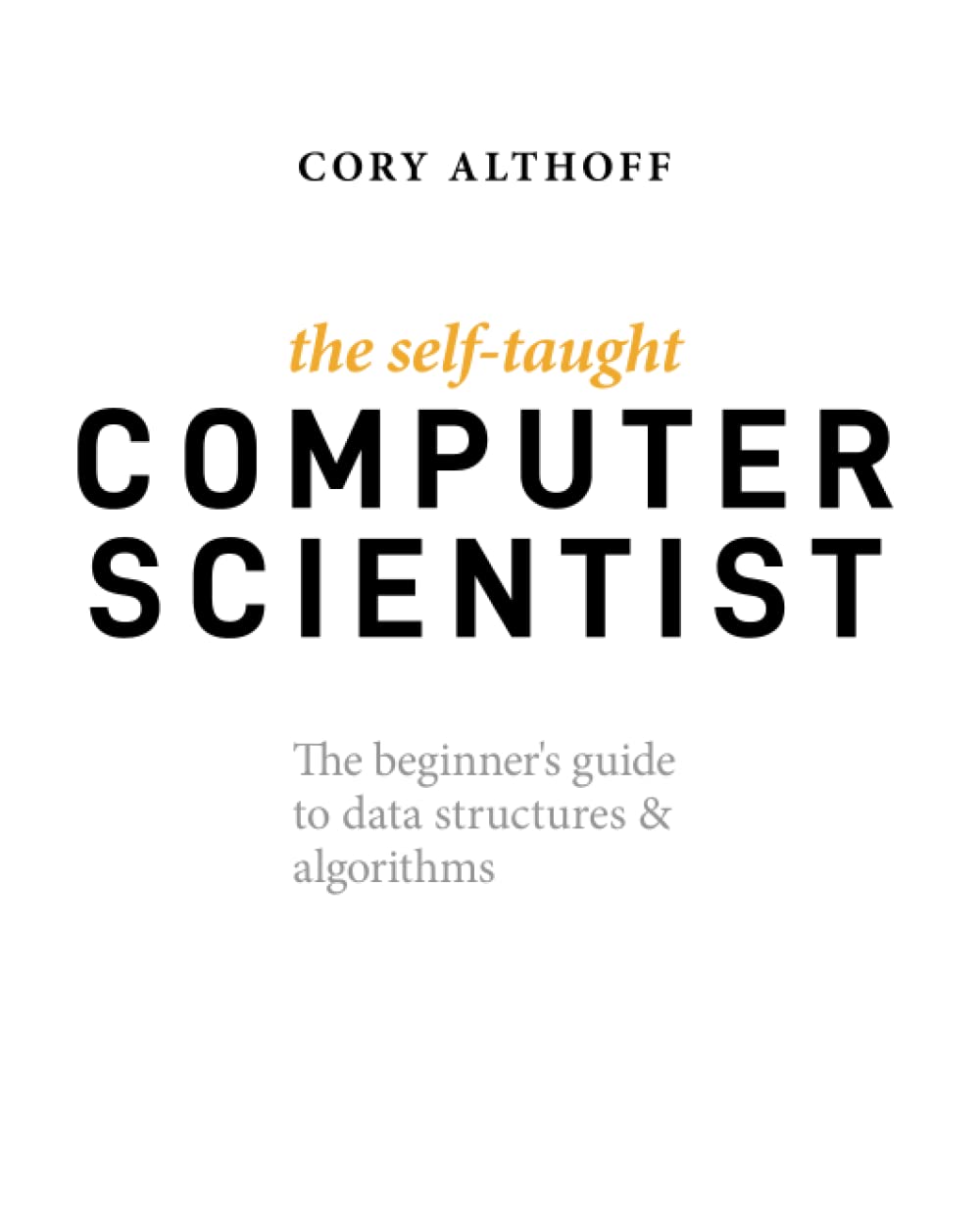
The Self-Taught Computer Scientist: The Beginner’s Guide to Data Structures & Algorithms
Original price was: $32.00.$18.98Current price is: $18.98.
Related Products



The follow-up to Cory Althoff’s bestselling The Self-Taught Programmer, which inspired hundreds of thousands of professionals to learn to program outside of school!
Fresh out of college and with just a year of self-study behind him, Cory Althoff was offered a dream first job as a software engineer for a well-known tech company, but he quickly found himself overwhelmed by the amount of things he needed to know, but hadn’t learned yet. This experience combined with his personal journey learning to program inspired his widely praised guide, The Self-Taught Programmer. Now Cory’s back with another guide for the self-taught community of learners focusing on the foundations of computer science.
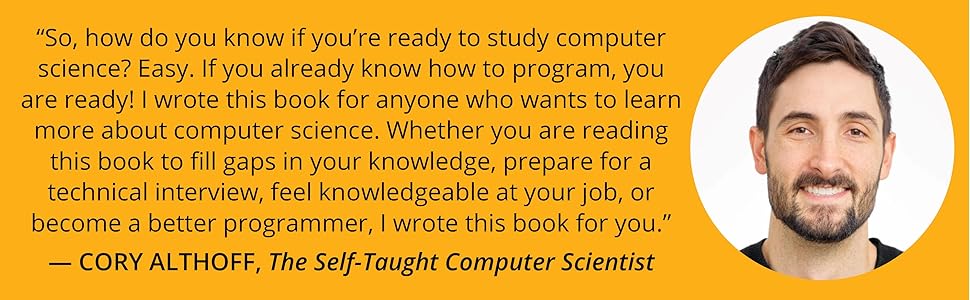
The Self-Taught Computer Scientist introduces beginner and self-taught programmers to computer science fundamentals that are essential for success in programming and software engineering fields. Computer science is a massive subject that could cover an entire lifetime of learning. This book does not aim to cover everything you would learn about if you went to school to get a computer science degree. Instead, Cory’s goal is to give you an introduction to some of the most important concepts in computer science that apply to a programming career. With a focus on data structures and algorithms, The Self-Taught Computer Scientist helps you fill gaps in your knowledge, prepare for a technical interview, feel knowledgeable and confident on the job, and ultimately, become a better programmer.
Learn different algorithms including linear and binary search and test your knowledge with feedback loopsUnderstand what a data structure is and study arrays, linked lists, stacks, queues, hash tables, binary trees, binary heaps, and graphsPrepare for technical interviews and feel comfortable working with more experienced colleaguesDiscover additional resources and tools to expand your skillset and continue your learning journey
It’s as simple as this: You have to study computer science if you want to become a successful programmer, and if you don’t understand computer science, you won’t get hired. Ready for a career in programming, coding, or software engineering and willing to embrace an “always be learning” mindset? The Self-Taught Computer Scientist is for you.
From the Publisher

Cory Althoff’s Four Tips for Preparing for a Technical Interview
Give It Time
There is no steadfast rule, but I recommend that you give yourself at least two to three months to prepare. It also depends on how competitive the companies you are applying to are. If you’re applying to one of the FAANG companies (Facebook, Amazon, Apple, Netflix, or Google), it is not unheard of for hopeful engineers to spend six months or more preparing for their technical assessments.
Be Dedicated
I recommend dedicating at least a few hours a day to solving problems on LeetCode, one of my favorite resources for preparing for technical interviews. It has hundreds of data structure and algorithm practice problems as well as solutions.
Get Competitive
One of the hardest parts about technical interviews is the unnatural environment they take place in. Usually, when you are programming, you don’t have someone standing over your shoulder evaluating you. Programmers are also not used to solving problems in short time periods. Competitive programming is the best solution I’ve found to prepare for coding in this type of environment. Try a website like Codeforces when you are ready to compete against other programmers to solve computer science problems.

Try It Out
Once you’ve used competitive programming to get used to solving challenging technical problems quickly, you should try a few mock interviews with a software engineer. If you can’t find a friend to help, you can try hiring a software engineer on a freelance platform like Upwork or Codementor.
Publisher : Wiley
Publication date : October 19, 2021
Edition : 1st
Language : English
Print length : 224 pages
ISBN-10 : 1119724414
ISBN-13 : 978-1119724414
Item Weight : 2.31 pounds
Dimensions : 7.4 x 0.6 x 9.1 inches
Best Sellers Rank: #215,117 in Books (See Top 100 in Books) #70 in Data Processing #75 in Computer Programming Languages #128 in Python Programming
Customer Reviews: 4.6 4.6 out of 5 stars (148) var dpAcrHasRegisteredArcLinkClickAction; P.when(‘A’, ‘ready’).execute(function(A) { if (dpAcrHasRegisteredArcLinkClickAction !== true) { dpAcrHasRegisteredArcLinkClickAction = true; A.declarative( ‘acrLink-click-metrics’, ‘click’, { “allowLinkDefault”: true }, function (event) { if (window.ue) { ue.count(“acrLinkClickCount”, (ue.count(“acrLinkClickCount”) || 0) + 1); } } ); } }); P.when(‘A’, ‘cf’).execute(function(A) { A.declarative(‘acrStarsLink-click-metrics’, ‘click’, { “allowLinkDefault” : true }, function(event){ if(window.ue) { ue.count(“acrStarsLinkWithPopoverClickCount”, (ue.count(“acrStarsLinkWithPopoverClickCount”) || 0) + 1); } }); });
11 reviews for The Self-Taught Computer Scientist: The Beginner’s Guide to Data Structures & Algorithms
Add a review

Original price was: $32.00.$18.98Current price is: $18.98.
Gino –
Clear as Day
DISCLAIMER:Got the book today (10/19/2021) and got 4 chapters in.I had been waiting for a book like this from a writer like Cory. I’m a fan of his previous work but this book is special to me. Read on…I am a self taught data engineer and I always felt lacking in the topics this book covers. When I finish the book I will update the review. For now, if you’re on the fence… Give him your money.The code sections are well written and simple to understand. I really love the way he lays things out where he shows how to write an algorithm such as a search tree but also explains how to do the same thing using methods or imported libraries.The concepts are straightforward to follow and I feel as if I can get to work and directly apply his theory to my prod code. Very grateful for his work.
Rayner Soto –
Best book ive read so far on Data Structures and Algorithms
I’ve been looking through countless youtube videos and websites trying to figure out how to better comprehend data structures & algorithms. The explanations in this book are concise and paint a picture so you vividly remember each term and what each term looks like physically. It’s a 10/10 will be buying his other books as well.
Elizabeth Howell –
Helpful
Good helpful information
Booger Man –
A bit underwhelming
I originally recommended this book for beginners in my review. I had read a few early sections that seemed ok. I’ve become more disappointed as I keep reading.A great example is the chapter on heaps. He confuses the definition with one specific application of a heap when he defines it as “a tree based structure on which each node keeps track of two pieces of information: a value and its priority.” By using such a narrow definition, I’m afraid the generality of this structure and its other applications could be lost to the reader.Wikipedia offers a much better definition: a “tree that satisfies the heap property: in a max heap, for any given node C, if P is a parent node of C, then the key (the value) of P is greater than or equal to the key of C.”What’s more, after walking the reader through a visual example of how items are ordered in a heap, he never provides any code to implement one. Instead, he shows how to use Python’s built in library. Since this book is supposed to be for “self taught computer scientists” and not “self taught Python coders,” this seems to be an egregious oversight.It would also be helpful if the author would describe why algorithms work the way they do instead of simply providing solutions. The book feels very much like an answer key instead of a textbook. Complexities are simply provided without explanation.Additionally, I’ve found a number of typos throughout the book. Overall, the book comes across as a rough draft that was published with no peer review or critique from peers.While there’s certainly some value here for beginners, I’m hesitant to recommend it because it seems to have a narrow perspective and relies too heavily on Python’s capabilities instead of teaching the underlaying algorithms.I won’t say this couldn’t be helpful to people. It definitely could be the text that provides the key insight someone needs as they’re wrestling with a problem, and it’s a decent overview of basic structures and algorithms. But it’s more of a jumping off point to go find what topics you need to learn.
NYC –
And I’m not even a programmer
Enjoy this book a lot for helping to understand some of the challenges for creating economical (not wasting memory or resources) code. In tech, but not as a programmer. Which is nice. 😉
Wm –
Best Price
Good price.
Alex –
A Valuable Resource For All Programmers
The book is very effective in breaking down rather difficult topics that I myself have found during my studies of computer science. One of the most helpful parts of Cory’s book for me is his explanation of sorting algorithms AND when they can be applied. In my lectures, they only really talked about how the same sorting algorithms work. I enjoy Cory’s prose in his book and it has immensely helped me bridge gaps in my own understanding of data structures and algorithms.
Patrick –
Good introductory book
Helped me learn how sort algorithms work. The doting chapter on Elon Musk did not age well in 2022.
Darshan Unadkat –
Gook book to cover the basics for beginners but would be even better if there were more advanced examples and explanations covered
Customer H –
Sandeep –
Poor quality printing. Seems like photocopy