

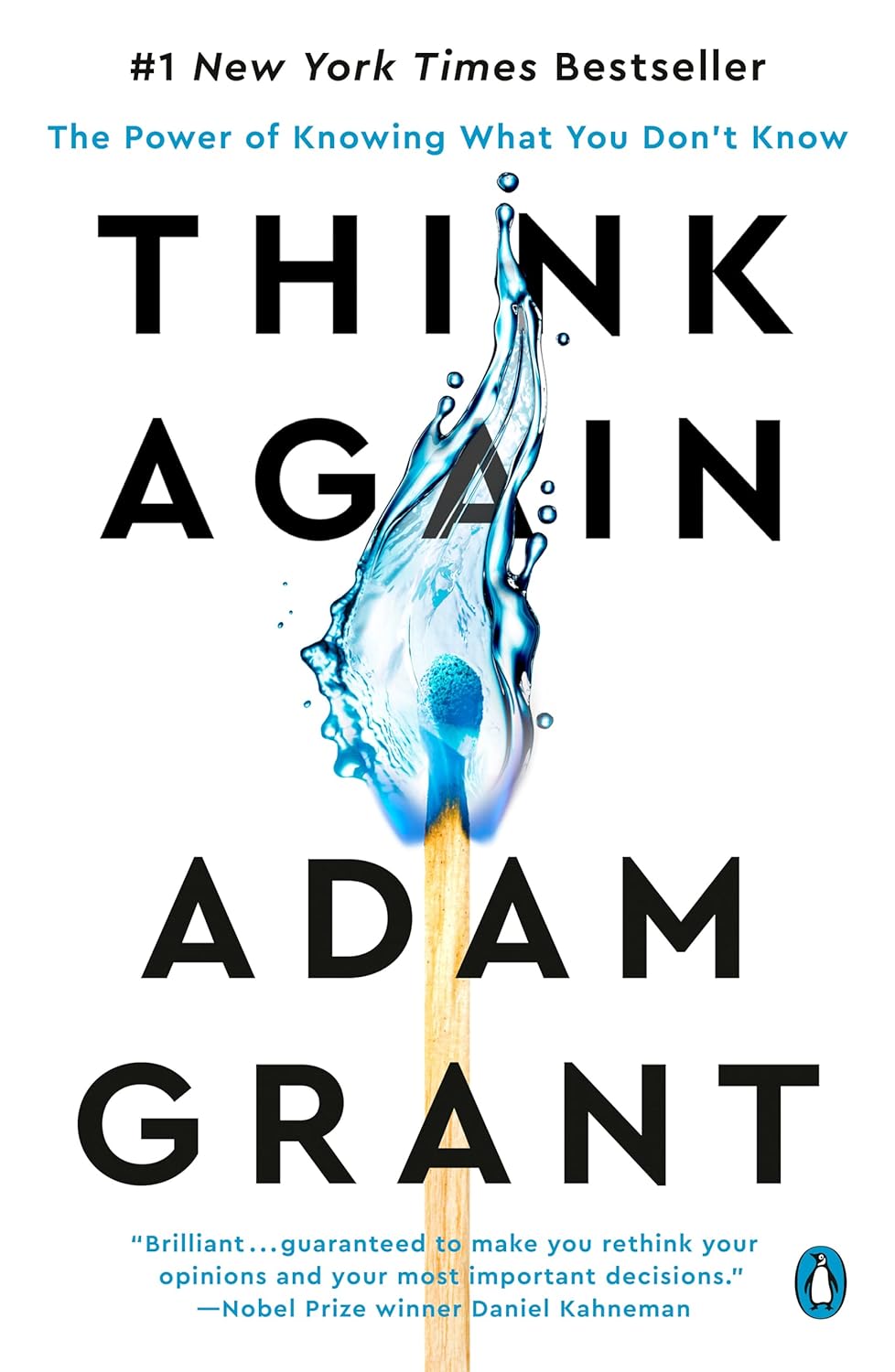
Think Again: The Power of Knowing What You Don’t Know
Original price was: $20.00.$11.00Current price is: $11.00.
Related Products






#1 New York Times Bestseller
“THIS. This is the right book for right now. Yes, learning requires focus. But, unlearning and relearning requires much more—it requires choosing courage over comfort. In Think Again, Adam Grant weaves together research and storytelling to help us build the intellectual and emotional muscle we need to stay curious enough about the world to actually change it. I’ve never felt so hopeful about what I don’t know.”
—Brené Brown, Ph.D., #1 New York Times bestselling author of Dare to Lead
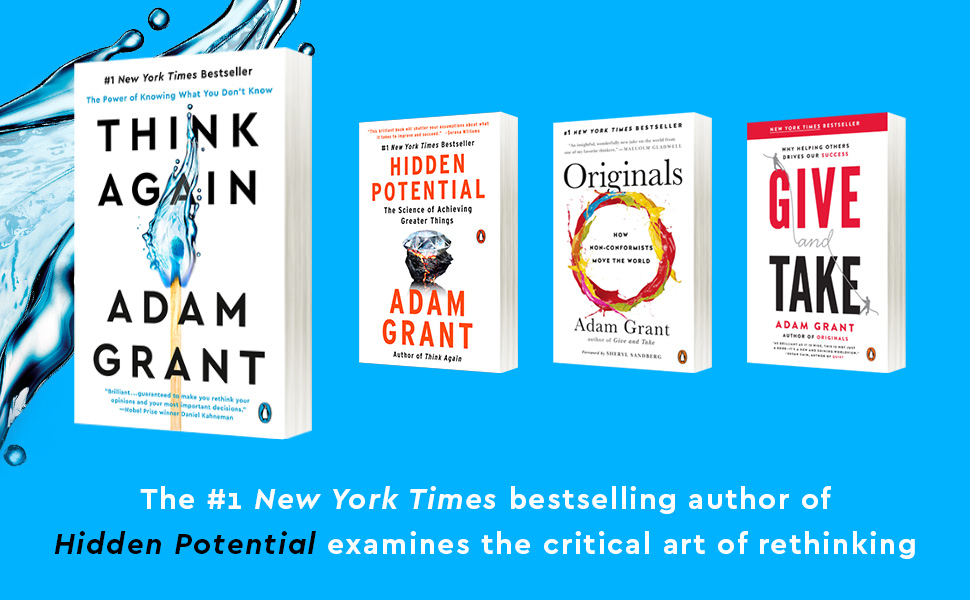
The #1 New York Times bestselling author of Hidden Potential, Originals, and Give and Take examines the critical art of rethinking: learning to question your opinions and open other people’s minds, which can position you for excellence at work and wisdom in life
Intelligence is usually seen as the ability to think and learn, but in a rapidly changing world, there’s another set of cognitive skills that might matter more: the ability to rethink and unlearn. In our daily lives, too many of us favor the comfort of conviction over the discomfort of doubt. We listen to opinions that make us feel good, instead of ideas that make us think hard. We see disagreement as a threat to our egos, rather than an opportunity to learn. We surround ourselves with people who agree with our conclusions, when we should be gravitating toward those who challenge our thought process. The result is that our beliefs get brittle long before our bones. We think too much like preachers defending our sacred beliefs, prosecutors proving the other side wrong, and politicians campaigning for approval–and too little like scientists searching for truth. Intelligence is no cure, and it can even be a curse: being good at thinking can make us worse at rethinking. The brighter we are, the blinder to our own limitations we can become.
Organizational psychologist Adam Grant is an expert on opening other people’s minds–and our own. As Wharton’s top-rated professor and the bestselling author of Originals and Give and Take, he makes it one of his guiding principles to argue like he’s right but listen like he’s wrong. With bold ideas and rigorous evidence, he investigates how we can embrace the joy of being wrong, bring nuance to charged conversations, and build schools, workplaces, and communities of lifelong learners. You’ll learn how an international debate champion wins arguments, a Black musician persuades white supremacists to abandon hate, a vaccine whisperer convinces concerned parents to immunize their children, and Adam has coaxed Yankees fans to root for the Red Sox. Think Again reveals that we don’t have to believe everything we think or internalize everything we feel. It’s an invitation to let go of views that are no longer serving us well and prize mental flexibility over foolish consistency. If knowledge is power, knowing what we don’t know is wisdom.
From the Publisher

Publisher : Penguin Books
Publication date : December 26, 2023
Language : English
Print length : 320 pages
ISBN-10 : 1984878123
ISBN-13 : 978-1984878120
Item Weight : 2.31 pounds
Dimensions : 5.48 x 0.67 x 8.36 inches
Best Sellers Rank: #3,093 in Books (See Top 100 in Books) #3 in Cognitive Psychology (Books) #7 in Motivational Management & Leadership #40 in Personal Transformation Self-Help
Customer Reviews: 4.6 4.6 out of 5 stars (17,360) var dpAcrHasRegisteredArcLinkClickAction; P.when(‘A’, ‘ready’).execute(function(A) { if (dpAcrHasRegisteredArcLinkClickAction !== true) { dpAcrHasRegisteredArcLinkClickAction = true; A.declarative( ‘acrLink-click-metrics’, ‘click’, { “allowLinkDefault”: true }, function (event) { if (window.ue) { ue.count(“acrLinkClickCount”, (ue.count(“acrLinkClickCount”) || 0) + 1); } } ); } }); P.when(‘A’, ‘cf’).execute(function(A) { A.declarative(‘acrStarsLink-click-metrics’, ‘click’, { “allowLinkDefault” : true }, function(event){ if(window.ue) { ue.count(“acrStarsLinkWithPopoverClickCount”, (ue.count(“acrStarsLinkWithPopoverClickCount”) || 0) + 1); } }); });
12 reviews for Think Again: The Power of Knowing What You Don’t Know
Add a review

Original price was: $20.00.$11.00Current price is: $11.00.
Wally Bock –
Adam Grant’s best book yet for business leaders
There are two powerful reasons to read this book. One: You’ll learn a lot. Two: This book will be mentioned in articles and discussions. It will make the short list of books every manager should read. I bought Think Again: The Power of Knowing What You Don’t Know by Adam Grant because I’ve learned a lot from his books, blogs, and articles. I expected the same level of lucid writing and penetrating insight that I got from Originals and Give and Take. For me, this was the best book yet. Think Again is the best book Grant has written for business leaders. That VUCA world we keep hearing about requires flexibility and unlearning. Most of the books I’ve seen on the kind of learning you need for today’s world focus on corporate cultures, on creating “learning institutions.” Think Again is different. Think Again is about the learning culture between your ears. Here’s how Grant states the purpose of the book. “This book is an invitation to let go of knowledge and opinions that are no longer serving you well, and to anchor your sense of self in flexibility rather than consistency. If you can master the art of rethinking, I believe you’ll be better positioned for success at work and happiness in life. Thinking again can help you generate new solutions to old problems and revisit old solutions to new problems. It’s a path to learning more from the people around you and living with fewer regrets. A hallmark of wisdom is knowing when it’s time to abandon some of your most treasured tools—and some of the most cherished parts of your identity.”The first section of the book is about opening your mind. It’s about what “thinking again” really means. The second part of the book looks at ways to encourage others to think again or to think along with you. The third section is about creating communities of lifelong learners. A key to getting the most from this book is the different mindsets that Philip Tetlock discovered. Here’s Grant’s brief description from Think Again.“Two decades ago my colleague Phil Tetlock discovered something peculiar. As we think and talk, we often slip into the mindsets of three different professions: preachers, prosecutors, and politicians. In each of these modes, we take on a particular identity and use a distinct set of tools. We go into preacher mode when our sacred beliefs are in jeopardy: we deliver sermons to protect and promote our ideals. We enter prosecutor mode when we recognize flaws in other people’s reasoning: we marshal arguments to prove them wrong and win our case. We shift into politician mode when we’re seeking to win over an audience: we campaign and lobby for the approval of our constituents. The risk is that we become so wrapped up in preaching that we’re right, prosecuting others who are wrong, and politicking for support that we don’t bother to rethink our own views.”Grant uses Tetlock’s terms for the different mindsets. I found digging around on the web and in the scholarly literature for more on the mindsets helped me squeeze even more value from this book. This is not a book where you can skip around and get much value. The description of thinking in the first section sets up later lessons and insights. The second section builds on the first and applies the lessons to debate and persuasion. The third section builds on the first two. It extends the basic mindset idea to groups. Suggestion. As a warmup for Think Again, take a minute to read a Farnam Street blog post: “Jeff Bezos on Why People that Are Often Right Change Their Minds Often.”In A NutshellThink Again is an excellent book that will give you techniques you can use to think more effectively at work and everywhere else. You’ll get more from the book if you do a little bit of homework. Learn about Tetlock’s mindsets and the general idea of changing your mind as a way of thinking.
Kristin J. Arnold –
Think Again If You Think You Don’t Need to Read This Book!
I’ve always been fascinated with understanding how people make decisions individually and collectively (including me! I’m my own little lab petri dish of thoughts!). So I was intrigued with Adam Grant’s latest book: Think Again: The Power of Knowing What You Don’t Know as less-than-stellar decisions occur because of this “blind spot” – especially in this volatile and uncertain world.Although Grant is an academic (teaches at Wharton), the book is easy to read – but a little harder to digest. Written in a conversational tone, the ideas are presented in a clear manner with examples, research, experiments, and stories. The harder part is to do the work and look in the mirror to see if and when we are on “Mount Stupid”. (Although he doesn’t really challenge you until hardback page 250 with a summary of “Actions for Impact”. )So what are some of the ideas that resonated with me?- The Dunning-Kruger Effect. It’s when we lack competence that we’re most likely to be brimming with overconfidence. Unless you’re a complete novice, you’ll overrate your abilities.- Mount Stupid is the point where you have just enough information to feel self-assured about making pronouncements and passing judgment (I have been there many times…).- Do What Forecasters Do. When forecasters form an opinion, they ask what would have to happen to prove it false? They then keep track of their views so they can see when they were right, wrong, and how their thinking has evolved.- The Value of a Challenge Network. “Across a range of networks, when employees received tough feedback from colleagues, their default response was to avoid those coworkers or drop them from their networks altogether – and their performance suffered over the following year.” Counter this tendency by creating a safe space to get feedback.- Debate vs Dispute. “Simply framing a dispute as a debate rather than as a disagreement signals that you’re receptive to considering dissenting opinions and changing your mind, which in turn motivates the other person to share more information with you.- Be a Fact-Checker – “(1) Interrogate information instead of simply consuming it. (2) Reject rank and popularity as a proxy for reliability and (3) Understand that the sender of information is often not its source.- How to Question the Expert – To question them in a way that is not embarrassing to them or makes them look like a fool, ask these questions with a sense of curiosity: “What leads you to that assumption? Why do you think t is correct? What might happen if it’s wrong? What are the uncertainties in your analysis? I understand the advantages of your recommendation. What are the disadvantages?And that’s just the tip of the iceberg! So much great information, I am going to go back through the book with Actions for Impact in hand!
Skye –
Good
Good book. Has a lot of examples. Long chapters
B. Bird –
THE book for our moment.
Just having this book is opening my mind. I embracing the whole idea of questioning my beliefs. This is definitely a book for the challenges of 2025. Great encouragement for all business owners. I wish I had this book when I owned my pet grooming business. Thank you, Adam Grant.
Melissa A –
Fun and easy read
I really enjoyed this book- I listened to it on Audible and purchased the e-book as well. It is nice taking in this frame of thought and it can be applied to work and life outside of work. I chose this book for a leadership class paper and it was definitely worth every penny.
Sat –
Great stories, techniques, fun diagrams!
Love the diagrams, so well done, cute, clean, precise. Great science, great book to design a life, career, happiness forever!📕
Naddielight –
Be curious, not judgemental – Ted Lasso
A book that makes you question what you think you know — in the best possible way. Adam Grant shows how important it is to stay curious and rethink our assumptions. It made me more open-minded at work and at home.
Magdalena Ruyú –
Loved the book, another hit by Adam. Makes you humble and eager to learn more.
Margarete –
It is amazing book , concept and it is really well written-The art of question what we already know is intriguing and also exiting
Joshua –
Love how this books makes us aware of our own self-serving bias. If you are planning to find out how to lead better, interact better or just learn better, then this is the book for you
Greg –
I liked it a lot, I liked the style of author’s writing and he also provided many examples and stories that actually help readers to understand and remember the content of the book for quite some time. It changed the way that you think about conflicts and helps you to have better constructive conversation with friends that have different opinions, You will be more welcoming to change your own mind and be aware of the biases that you might have.
Sudhakar kadiyala –
If we ask any person in the world to look back into the past & question if they have any regrets of having not done,or doing a thing wrongly,or missed opportunities of better growth in their life and so on, then it’s no surprise, if we hear almost 100% of the people having regretting the way they did or felt that,if only they have put some more thought and done differently.They wished that they should have paused for a moment or for some time,to think differently or have done in a better way.”Think Again” by Adam Grant is a book about taking time to “Rethink”..He says that or rather puts his point of view in front of us in a scientific manner telling us why “Rethinking ” is necessary.The writer very vividly categorized our reactions or thinking in four differnt ways i.e preaching, prosecuting, politicking and viewing scientifically.With his rich experience as an organizational psychalogist at Wharton,extensive research,quoting examples of the notable people who failed miserably by not rethinking at the right time and the ones who succeeded extensively by constantly rethinking,has put forth his sincere views in the book with an intent to bring the readers closer to ‘reasoning and more reasoning,’ and not to miss the chances of “Rethinking” on a day to day basis.To be honest, for the first time,I felt that as to why I should write a review at all(as usually I do after reading a book)? Perhaps it may be because I wanted to satisfy my ego, or I wish to say something about the book like a few of the other readers do after reading a book, to feel good.Well I am not sure,but here, I am writing this review feeling happy,though to write a review on a book of this kind is far different than writing on a fictional one. I like to say that here is a book that should be read by every reader who holds interest in reading, not to promote Adam Grant but for the feel good factor for themselves and about their surroundings.Reading this book,we realize that we spend days,months,years and perhaps even decades in orthodox thinking,blind beliefs and unproductive living based on which our actions,discriminations,accusations,overthinking, jugements etc depend, without a thought or concern for the actual facts or truth,bringing misery to ourselves as well as to the people around us.We also understand that no product, experience, event etc can be considered as an ideal or ultimate and that there is always a room for improvement and the best way is always to act and think scientifically.The mention of famous personalities and how they were able to remain at the top for long, while others couldn’t do so, was well illustrated with the examples like that of ‘ Mike Lazaridis and Black Berry(mobile phone)’,the forcasting & predictions of ‘Jeane Pierre vs Kjirste Morrell,the humbling British physicist Andrew Lyne(admiiting his wrong in front of a large audience),the success story of Wright brothers, Brad Bird and his failures before he won Oscar awards,the debates between Harish Natarajan vs Debra, Daryl Davis the black piano player vs a white supermacist,the innovative educator Ron Berger (*Even I wished that I should have been a student of him) and many more such real life stories of rise and fall makes the book intresting and the reading authentic.After reading the book I could find a few of the complexities with in me too which I was holding for long and realize that I too am happy for being wrong as it means that, I have come a little closer to being right.This is a book with most page markers that I have ever read.