
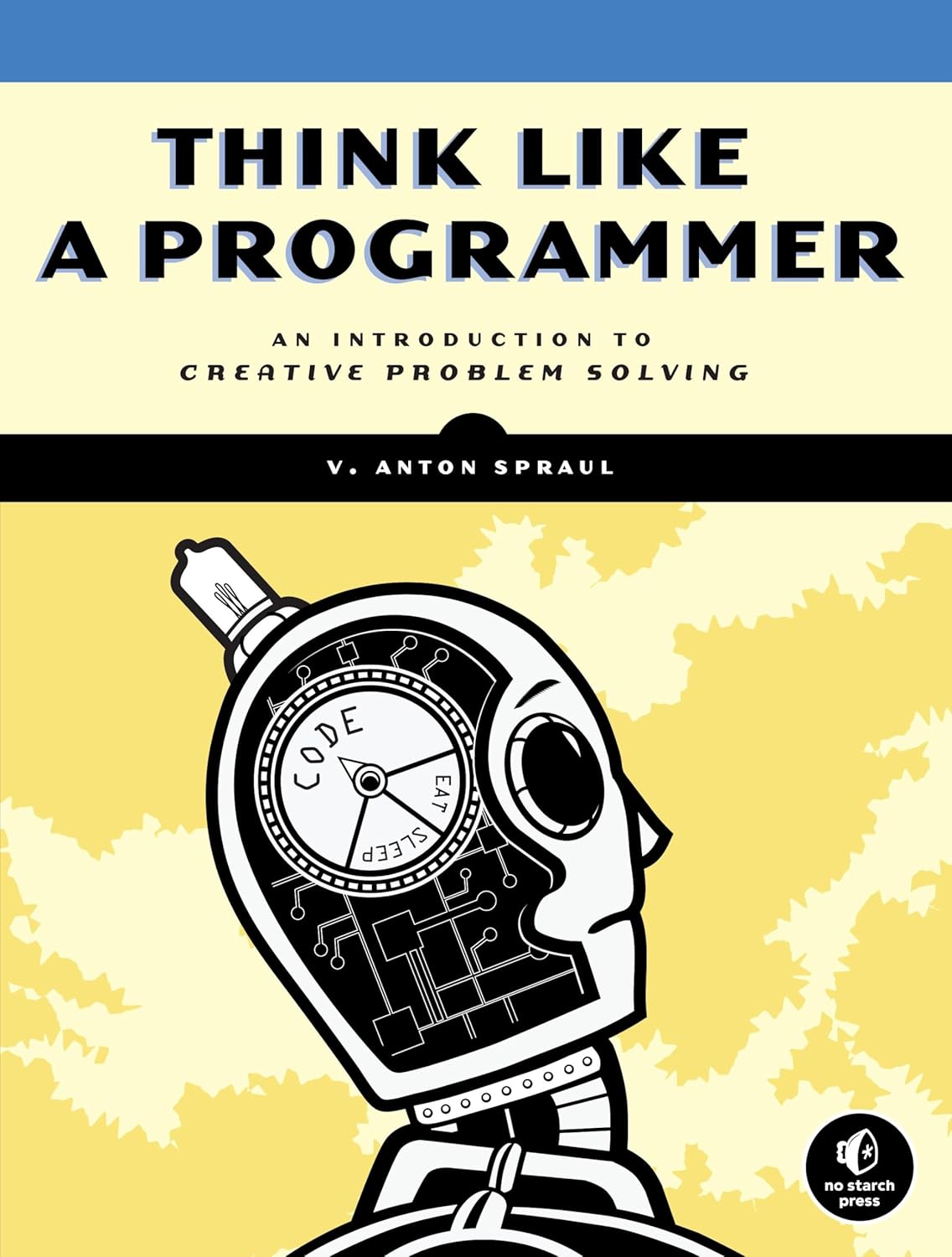
Think Like a Programmer: An Introduction to Creative Problem Solving
Original price was: $44.99.$26.96Current price is: $26.96.
Related Products


The real challenge of programming isn’t learning a language’s syntax—it’s learning to creatively solve problems so you can build something great. In this one-of-a-kind text, author V. Anton Spraul breaks down the ways that programmers solve problems and teaches you what other introductory books often ignore: how to Think Like a Programmer. Each chapter tackles a single programming concept, like classes, pointers, and recursion, and open-ended exercises throughout challenge you to apply your knowledge.
You’ll also learn how to:
–Split problems into discrete components to make them easier to solve
–Make the most of code reuse with functions, classes, and libraries
–Pick the perfect data structure for a particular job
–Master more advanced programming tools like recursion and dynamic memory
–Organize your thoughts and develop strategies to tackle particular types of problems
Although the book’s examples are written in C++, the creative problem-solving concepts they illustrate go beyond any particular language; in fact, they often reach outside the realm of computer science. As the most skillful programmers know, writing great code is a creative art—and the first step in creating your masterpiece is learning to Think Like a Programmer.
Publisher : No Starch Press
Publication date : August 12, 2012
Edition : Illustrated
Language : English
Print length : 256 pages
ISBN-10 : 1593274246
ISBN-13 : 978-1593274245
Item Weight : 1.09 pounds
Dimensions : 7 x 0.61 x 9.25 inches
Best Sellers Rank: #84,475 in Books (See Top 100 in Books) #3 in C++ Programming Language #5 in Computer Programming Structured Design #34 in Software Development (Books)
Customer Reviews: 4.7 4.7 out of 5 stars (497) var dpAcrHasRegisteredArcLinkClickAction; P.when(‘A’, ‘ready’).execute(function(A) { if (dpAcrHasRegisteredArcLinkClickAction !== true) { dpAcrHasRegisteredArcLinkClickAction = true; A.declarative( ‘acrLink-click-metrics’, ‘click’, { “allowLinkDefault”: true }, function (event) { if (window.ue) { ue.count(“acrLinkClickCount”, (ue.count(“acrLinkClickCount”) || 0) + 1); } } ); } }); P.when(‘A’, ‘cf’).execute(function(A) { A.declarative(‘acrStarsLink-click-metrics’, ‘click’, { “allowLinkDefault” : true }, function(event){ if(window.ue) { ue.count(“acrStarsLinkWithPopoverClickCount”, (ue.count(“acrStarsLinkWithPopoverClickCount”) || 0) + 1); } }); });
13 reviews for Think Like a Programmer: An Introduction to Creative Problem Solving
Add a review

Original price was: $44.99.$26.96Current price is: $26.96.
Professor dot biz –
Must Read for Today’s Changing Job Interviews
Some companies still put you in front of a whiteboard and ask you to code. BUT, given the amount of coding that’s going to Russia, China and India, the hot upcoming jobs are in coding MANAGEMENT, Data Science, Embedded Systems, Sploit management and other high level design categories. Many even smaller companies are now creating a “CDSO” (Chief Data Science Officer) position which in some cases pays in the high 6 figures.This book is outstanding for the nitty gritty not just of how but WHY we select certain Design Patterns, structures, algorithms, and, in short, solution sets. It is a fun read and if you know any OOP language you’ll have no problem with the C++ examples, they are not that advanced, but do make great and unusual points about options in, for example, modifying for efficiency or to avoid “reinventing the wheel” (or as the saying goes, reinventing the flat tire!).I interview hundreds of prospective coding managers, and I prefer to keep the questions at the 30,000 foot level of this text– solution strategies, not just coding conventions or syntax. A lot of good people, especially overseas, can code, but very few can adeptly wind through imperative vs. functional, or modular modification vs. untouched APIs that aren’t an exact fit to the problem definition.Everything from sliding puzzles and Sudoku are used by this engaging author to highlight examples not just of solutions but the differences between solution strategy options underlying those choices. The pedagogy is outstanding, as I’m finding with many No Starch titles, and you really remember this author’s examples. He doesn’t just understand analogy generalization deeply, he uses it adeptly throughout the book. I’ve found VERY FEW books that even attempt to do this, let alone do it well.A classic like Code Complete (CC) will give many more of the details that are illustrated in this book, but a triple threat of OOP Demystified, this book, and CC will make your interview, or consulting gigs, go much smoother. If you’re considering writing a software book, this is a must read just for the pace, pedagogy and format. NOT a text from the standpoint of “solutions in the back,” but great for changing your frame of reference about IT in general and problem solving specifics. Highly recommended.EMAILER NOTE: If you agree with some other reviewers that C++ is a “bias” you might enjoy Michael L. Scott’s: Programming Language Pragmatics, Third Edition– it is 900 pages and covers problem solving (in general and with specifics) in far more detail, and includes C++, Java, Ada, C# and Fortran in imperative and F#, OpenMP, and Scheme in functional as well as Erlang in concurrent/parallel. Some reviewers took umbrage that the author considers C++ a “real” language, but to be honest, people who code for nuclear plants and jet engines DO use C and C++, and many of them think of scripting languages as kid stuff. This isn’t my opinion, just wanted you to understand a lot of the thinking out there. That said, LISP folks look down on C++ folks too in some cases, and circuit designers dealing with ML and Assembler think we’re ALL kids!Library Picks reviews only for the benefit of Amazon shoppers and has nothing to do with Amazon, the authors, manufacturers or publishers of the items we review. We always buy the items we review for the sake of objectivity, and although we search for gems, are not shy about trashing an item if it’s a waste of time or money for Amazon shoppers. If the reviewer identifies herself, her job or her field, it is only as a point of reference to help you gauge the background and any biases.
Armando Leon –
Amazing and Thought Provoking for Perfectionists
I’ve been coding for 6 years. I always struggle at solving problems, or even getting projects started. I always strive for perfection, but this book highlights that really you don’t need to be perfect or an expert. You can come up with a solution and move forward, then learn new techniques and apply it to your previous solutions or projects. Programming is a work in progress. And you get better as you continuously challenge yourself and apply what you learn.
jmrecodes –
Extremely helpful converting one from a beginner to a master like thinking
jerake –
Book is fantastic for a beginner like me!
Absolutely love this book, it has really enhanced my problem-solving abilities, even after doing technical problem-solving for 15+ years. If you want to learn how to think about problems (not just get or give answers) this book will help you no matter what…and it also teaches you about programming. :)I took off a star because the moment I opened the book (paperback) the binding completely fell off. I fixed it, of course. 🙂
Melissa –
Great Into book
I can’t rate this personally but I am rating based on the person whom I bought it as a gift for. He says this was a really good read and a great Intro book to programming.
anonymous3806 –
Enjoy my first read, will definitely re read it
I found it funny because this book used C++ programming language for all its examples, which I’m not really familiar with. Now that I finished this book, I’m grateful that I didn’t just learn new language, but also much larger concepts
Cynthia S Elacqua –
I wish this had been one of my college textbooks
My college did a decent job of training computer majors to be problem solvers. This book would have made an excellent companion text to instruction on data structures and algorithms.The author recommends knowledge of or simultaneous study of C++. I feel it would be accessible to any programmer in the C language family. Programmers in other languages could also obtain some benefit, but understanding would be a harder climb.Sure wish my workplace had allowed the luxury of studying a language before building production applications with it. Some of the author’s recommendations in the last chapter are not always within the working programmer’s control. The difference between academia and the rest of the world.All in all, well written, good use of examples, and sensible exercises to put the concepts into practice.
Shakyra –
Great book. Uses C++ most programming concepts and issues …
Great book. Uses C++ and elaborates on most programming concepts and issues and puts them in words that allows you to conceptually understand. This book had arrived badly damaged, as if it was kicked across a concrete floor and then put into the box for shipping.. contacted amazon for a replacement so all is well.
G MICHAEL –
Wish this book was my first ever purchase on Programming, I would have saved myself a lot of money 10/10
Carlos Duart –
Este libro es muy bueno no para enseñarte a programar en un lenguaje especifico, si no que te su objetivo es enseñarte los mejores metodos para pensar en como resolver un problema, hacer el mapeo del problema, planificar la solucion y posteriormente trasladarlo al entorno de programacion.Su enfoque te da las bases para comprender los problemas, segmentarlo y llegar a una adecuada solucion.El precio es excelente por el contenido que ofrece.
Kleber Cesar Alves de Souza –
Excelente livro.
Persona-M –
Très déçu, sans vouloir être arrogant l’auteur ne me semble pas être une lumière il avoue n’avoir pas surésoudre le problème de la rivière par exemple.Ensuite il donne l’impression que la résolution de problèmes est une affaire de programmeur.C’est faux et archi-faux, on dirait qu’il n’a jamais entendu parler de l’algorithmiquequi elle est une vraie science .Ensuite l’organisation du livre laisse à désirer (une bonne moitié est consacrée a la programmation objet via C++ ce qui d’après mon expérience est la pire des choses à faire avec les débutants.)Il aurait mieux valu-Intro sur le hardware (comment le CPU “travaille”)-Cours et rappels sur l’algorithmique-Analyser le problème-Résolution (encore de l’algo)-Traduire par un pseudo-code-Traduire par un language simple (procédural voir fonctionnel) ou a la limite Python mais SURTOUT pas du C++ ou de l’objet.-Tester-DébuggerJe donne des cours de programmation, et c’est la meilleur méthode POINT on doit apprendre a réfléchir et résoudre un problème donné ( pas a faire les malins avec C++ Java ou je ne sais quoi).Ce qui est assez drole c’est que l’auteur nous dit “the real challenge isn’t learning a language’s syntax,it’s learning to creatively solve problems” alors qu’une bonne partie de son propos est “make code reuse with functions,classes,and libraries” ou “master advanced tools like dynamic memory”.Je vous laisse traduire…
The Truth Seekers –
Bu kitabın örnek sayfalarını nette bulup biraz incelemiştim ve gayet hoşuma gitti. Bir programmer gibi nasıl düşünülür ve problemlere nasıl yaratıcı çözümler üretebilirsiniz konusunda elinizden tutup sizi o kapıya yönlendiriyor. Bu konuda kendinizi geliştirmeniz için gerekli ve yeterli bilgiye ulaşabilirsiniz bu kitap vasıtasıyla. Balık yemeyi değil size balık nasıl tutulur onu öğretiyor. Gerisi size kalmış.