
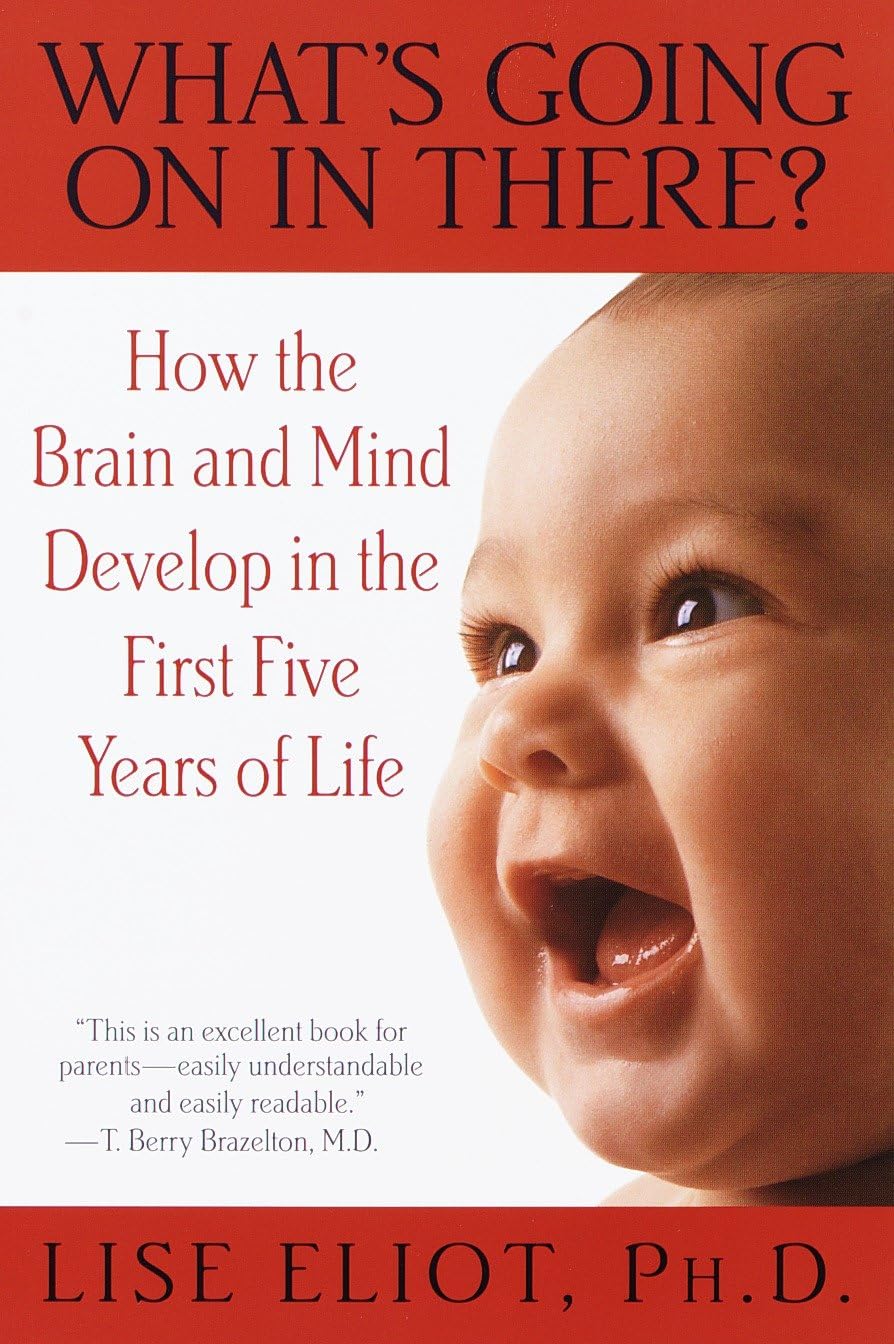
What’s Going on in There? : How the Brain and Mind Develop in the First Five Years of Life
Original price was: $22.00.$13.15Current price is: $13.15.
Related Products




As a research neuroscientist, Lise Eliot has made the study of the human brain her life’s work. But it wasn’t until she was pregnant with her first child that she became intrigued with the study of brain development. She wanted to know precisely how the baby’s brain is formed, and when and how each sense, skill, and cognitive ability is developed. And just as important, she was interested in finding out how her role as a nurturer can affect this complex process. How much of her baby’s development is genetically ordained–and how much is determined by environment? Is there anything parents can do to make their babies’ brains work better–to help them become smarter, happier people? Drawing upon the exploding research in this field as well as the stories of real children, What’s Going On in There? is a lively and thought-provoking book that charts the brain’s development from conception through the critical first five years. In examining the many factors that play crucial roles in that process, What’s Going On in There? explores the evolution of the senses, motor skills, social and emotional behaviors, and mental functions such as attention, language, memory, reasoning, and intelligence. This remarkable book also discusses:
how a baby’s brain is “assembled” from scratch
the critical prenatal factors that shapebrain development
how the birthing process itself affects the brain
which forms of stimulation are most effective at promoting cognitive development
how boys’ and girls’ brains develop differently
how nutrition, stress, and other physical and social factors can permanently affect a child’s brain
Brilliantly blending cutting-edge science with a mother’s wisdom and insight, What’s Going On in There? is an invaluable contribution to the nature versus nurture debate. Children’s development is determined both by the genes they are born with and the richness of their early environment. This timely and important book shows parents the innumerable ways in which they can actually help their children grow better brains.
From the Publisher

Publisher : Bantam
Publication date : October 3, 2000
Edition : 1st
Language : English
Print length : 544 pages
ISBN-10 : 0553378252
ISBN-13 : 978-0553378252
Item Weight : 1.45 pounds
Dimensions : 6.13 x 1.44 x 9.15 inches
Best Sellers Rank: #86,040 in Books (See Top 100 in Books) #75 in Medical Child Psychology #147 in Baby & Toddler Parenting #151 in Popular Child Psychology
Customer Reviews: 4.5 4.5 out of 5 stars (606) var dpAcrHasRegisteredArcLinkClickAction; P.when(‘A’, ‘ready’).execute(function(A) { if (dpAcrHasRegisteredArcLinkClickAction !== true) { dpAcrHasRegisteredArcLinkClickAction = true; A.declarative( ‘acrLink-click-metrics’, ‘click’, { “allowLinkDefault”: true }, function (event) { if (window.ue) { ue.count(“acrLinkClickCount”, (ue.count(“acrLinkClickCount”) || 0) + 1); } } ); } }); P.when(‘A’, ‘cf’).execute(function(A) { A.declarative(‘acrStarsLink-click-metrics’, ‘click’, { “allowLinkDefault” : true }, function(event){ if(window.ue) { ue.count(“acrStarsLinkWithPopoverClickCount”, (ue.count(“acrStarsLinkWithPopoverClickCount”) || 0) + 1); } }); });
8 reviews for What’s Going on in There? : How the Brain and Mind Develop in the First Five Years of Life
Add a review

Original price was: $22.00.$13.15Current price is: $13.15.
Rachel Heckman –
Very Fascinating (but Lacks some Practicality for those without a Science Background)
“What’s Going on in There? How the Brain and Mind Develop in the First Five Years of Life” is titled accurately in that it discusses in much detail the processes that are going on in the brain through a child’s 5th year. The book is organized in 17 chapters covering topics from how the visual system develops to how intelligence and memory is processed in the younger ages. What is great about this book is that statements are fully backed up by previous research which makes the book a reliable source for those wanting to learn how to raise a child. But it is also useful for those merely interested in the development of the brain. Overall, “What’s Going on in There?” provides a great depth of knowledge; however the details sometimes detract from those simply wanting advice on how to rear a child.Critique/How to Read the BookBecause of the dense material covered in Eliot’s book , it is difficult to turn to a page you want to learn about at random. Also, the lay out of the book being that it is organized into chapters on topics rather than in chapters by chronological age makes it challenging to turn to the sections for a 3 year old if let’s say you just bought the book when your child was 3-4 years old. To overcome these, I suggest that if you are reading this book as a resourceful guide on what to expect and how to raise your infant, it is best to read this ahead of time and highlight the parts you think are important. In this way, you can easily refer back to the sections you thought were helpful. Additionally, it is important to note that the chapters are mostly organized in chronological order from the fetus stage, early infant, then on to its toddler and pre-school years. Therefore, you can skim through the end of a chapter in an area of interest if you already have a child who is in his/her toddler years.First Few ChaptersThe first few chapters focus on the basics of the brain in an evolutionary and anatomical sense. It discusses the egg’s fertilization, passage through the fallopian tube, and implantation in the uterus, as well as briefly discusses the cellular growth in the cerebral cortex, “increasingly spiky or complex” EEGs, and of course the argument of nature versus nurture.Prenatal InfluencesAn entire 55 pages are devoted to explaining the “Prenatal Influences on the Brain.” A section of this discusses how the nicotine and carbon monoxide found in cigarettes adversely affects the fetus. They “decrease the amount of oxygen available to the fetus, and less oxygen means slower growth of all bodily organs.” The effects of maternal stress are fully explained by first providing in depth information on the how the fight-or-flight response works. There is even a table at the end of the chapter summarizing the prenatal factors (toxins, radiation, other chemicals, etc.) that are harmful, non-conclusive, and recommendations for how to avoid the harmful factors.Importance of Being HeldOne of the most well explained and interesting parts of the book are the chapters, “The Importance of Touch” and “Why Babies Love to Be Bounced.” Eliot describes how the vestibular system develops from a fetus to an infant using plenty of pictures and diagrams first, which then helps her describe specific studies on how cuddling and holding a baby lead to a behavior that is less irritable as children. There are many benefits to vestibular stimulation at a young age including “newborns cry less when they are being rocked, carried, jiggled, or suddenly changed in position, all actions that activate the vestibular system;” overall behavioral state in “decreasing the baby’s level of arousal;” and pre-term babies being “less irritable, move less jerkily, and sleep more.”SensesEven if you are only interested in how the visual, gustatory, vestibular, and auditory systems work in humans, you will receive an abundant amount of information regarding these systems because the chapters first discuss the basics of how each develops, works together, and the components involved in each. Eliot does an excellent job in describing the beauty of each part while providing useful information on topics such as how hearing improves (in terms of frequency sensitivity, sound localization, threshold and the ability to discriminate sounds in a noisy background), obligatory looking (where babies fixate on an object for minutes at a time), binocularity and depth perception, and the function of prenatal taste ability.Debunking MythsWhat makes this book even more interesting is that it covers many of the myths or statements you hear people making regularly. Eliot explains how being exposed to a variety of tastes at a young age influences later preferences making the adults more likely to try and also like non-novel foods. She shows that acquired taste has a large role in this process rather than genes. “What’s Going on in There?” also explains how infant walkers don’t really help infants walk mainly because of its limiting effect on an infant’s ability to explore the world on its own, stimulating various parts of his/her brain. She states, “They can explore and satisfy their curiosity without developing their balance or locomotor skills, so these abilities come more slowly.”Smarter Child?The last few chapters provide the most information in terms of practical use that parents can utilize to encourage a better lifestyle, memory, and social emotional growth. Even though Eliot describes countless ways of improving these based on previous research conducted, she states an important view to keep in mind. “It is the model we set, rather than the specific teaching we attempt, that is going to have the biggest impact on a child’s cognitive abilities and success in life.”ConclusionIn conclusion “What’s Going in There?” by Lise Eliot, provides wonderful explanations as to how the brain develops from a fetus through age 5. It provides a myriad of useful information and debunks I would greatly recommend this book to one simply wanting to learn more about the details of how the brain is formed and how much plasticity there is at an early age. I would also recommend this great book to mothers-to-be or one who already have an infant to use as a resource to refer to. It is detailed enough to not only know what is going on in the brain, but also understand the processes taking place! What you do with these facts from diagrams or previous studies is up to you though since Eliot focuses more on the actual material rather than how to implement this knowledge into practical use- which may be a challenge if you do not have a very good science background but can be great for those who already know some in this area to form your own ideas.
P. Schilling –
A MUST-HAVE for any parent-to-be!
Honestly, I never write reviews. But, like you, I read lots of reviews about the products I’m considering for purchase and I never know if a favorable review on a given item will hold true because so much is very subjective. And after buying some products I believe the people writing the reviews must have been related to the owner/author/creator or that they just like seeing their words on screen because my experience can end up so far from what was described. Quite simply, this is not one of those reviews.So, right of the bat, let me say what is wrong with this book: the binding. Yes, it is poor. worse then poor. It sucks. But that’s no ding on the author. Beyond that, this book is AMAZING!I am an expecting first-time father at age 39. I am driven and focused to give my child every advantage I can through a nurturing relationship. With so many self-proclaimed experts out there it’s hard for the new parent to decide on one camp. When talking to other parents or reading other parenting books I would constantly ask myself, “How do I know this particular piece of advice is sound or will provide useful knowledge that applies to my situation?”I no longer ask myself that question. The information contained within this poor bound book is practical, current, well-structured, un-biased, thought-provoking, and based on studies, tests, and experiments from professionals around the world considered experts in their fields.If you’re like me and are not easily led by crack-pot, self-proclaimed gurus or fact-less observations that present no correlations from real-world studies, then you need to read this book. It changed what I believed about parenting. It has inspired me and my wife to develop a prenatal relationship. It’s given us the understanding of the stages of development and key- or sensitive periods to apply new stimulation and teaching techniques. It’s never too early to start.
Best Hubris –
Good – If You Want to Know the Biology…
For some reason, I thought this book would be more about what my baby is thinking. Instead it is very much about biology. Every chapter starts with a discussion of when a certain part of your baby’s brain began developing including regions, names, and discussions about when and how fast the nuerons in that area mylenate. This leads to discussions about what your baby’s brain can and cannot do and when that changes. You can extrapolate from this information to get an idea of “Whats going on in there?”, but it isn’t really what the book is about. For example, the book discusses that your baby can smell right at birth (maybe before) and that the scent of the mother and milk and so on play a roll in bonding. Then, it talks about the tests that were done to show that this is true. It never says whether or not your baby would enjoy more smells, or maybe which smells, or even if it matters whether or not there are any smells. For me, I wanted that kind of information, not so much biology. For example, if her room seems a bit stuffy to me, will is seem that way to her? Should I delay her nap time by 5 minutes to maybe open the windows and air it out, or could she care less? This book does not answer those kinds of questions.However, as a baby brain biology book, I have no doubt that this is probably the tops on that score. It is interesting to know how your baby’s senses develop and what her brain is and isn’t capable of at a certain age. So if you want a book about that, this book is great, it is easily readable, and very accessable (the brain has complicated names for its parts, but there is nothing the author can do about that). If you are looking for a book that lets you in on what might be going on in that little head of hers…well, I haven’t found that book yet.
Srikanth –
I enjoyed reading this book. A must read for every parent who wants to provide the best care for their child (and who doesn’t?). This book has a lot of scientific information as well for those interested in those topics, but it doesn’t mean that this book is a scientific read. It has a perfect blend of both scientific and “general” topics, probably a little more on the non-scientific side, which makes it even more interesting (at least for me) and doesn’t make it feel like you are reading a technical book. You will understand a great deal on how brain works, not just in children, but also in adults.I especially enjoyed reading the last few chapters of this book (Chapter 12 to 17) which provide a lot of practical information on how raise a “smarter” child.
Maya –
I am expecting my first child and this book was very useful preparation for me. It explains in accessible scientific details how a child develops from conception to early childhood and what is the parents and environment role in this.Knowing this information helped me and my partner decide what to do with all the advice we are getting as first-time parents and feel more confident. It is also a very enjoyable read.
M. Van –
I am now expecting my second child and rereading this book. It has helped me so much with my first one! It does really help you understand well what is going on in there (as the book says) from a scientific point of view (aren’t you tired of the thousands of books that are just some parents’ opinions without any actual science behind their words?). And that deep understanding and knowledge can really help you maximize your child’s intelligence and sociability.By far this is the best book on this topic and a must-buy for any expectant family.
readingmonkey –
This is highly recommended if you want a scientific explanation of brain development. It’s a good read for nurses!
Arun –
The book goes into significant detail about the development through time for every skill. It gives a good summary of the existing body of knowledge about each skill, and suggests the course a parent should take based on the evidence we have. It is admirable that the book is so readable in spite of the detail it goes into.